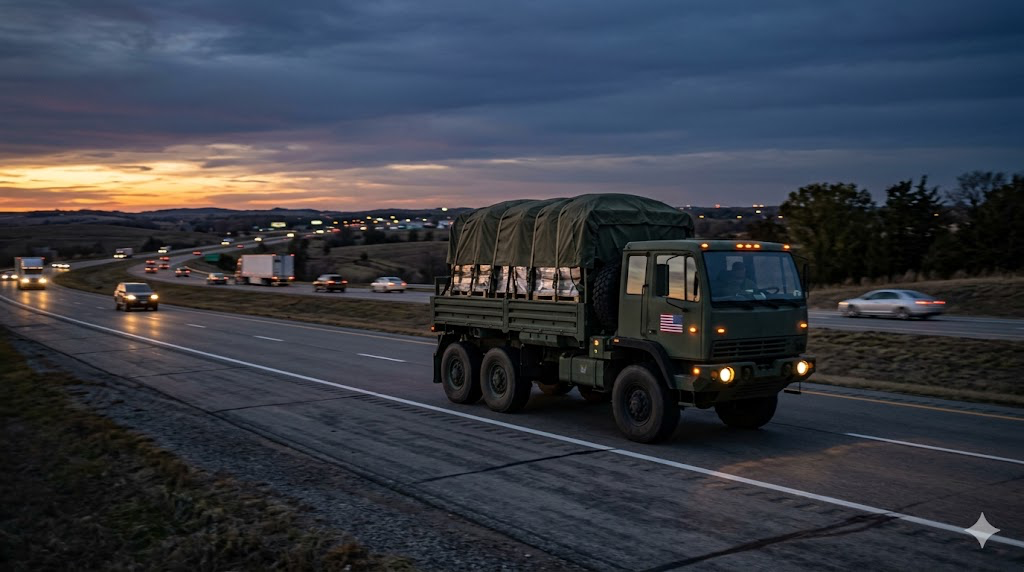
If you want to haul freight for the U.S. military, there is one document standing between you and a DoD contract — and most carriers find out about it for the first time when they are already trying to register. The Department of Defense performance bond is not optional, not substitutable, and not something you can work around. Here is everything you need to know to get it right the first time.
What Is a Department of Defense Performance Bond?
A Department of Defense performance bond — also called an SDDC bond, an ARTRANS bond, or a DoD performance bond — is a commercial surety bond required of all Transportation Service Providers who want to transport military freight for the U.S. Department of Defense. It functions as a financial guarantee that the TSP will fulfill its contractual obligations to deliver DoD cargo as agreed.
One important distinction that most guides overlook: despite being called a “performance bond,” this is classified as a commercial surety bond, not a construction contract performance bond. The structure, pricing, and filing process are different from the contract performance bonds used on construction projects. Understanding this difference matters when you are selecting a surety provider — not all providers who write construction performance bonds are equipped to handle DoD freight carrier bonds.
The Command Behind the Bond: MTMC, SDDC, and Now ARTRANS
The bond has gone through three names as the military command overseeing it has evolved. It was originally called an MTMC bond, after the Military Traffic Management Command. In 2004, MTMC was renamed the Military Surface Deployment and Distribution Command — giving us the name “SDDC bond” that the industry still uses today. On September 24, 2025, Army Secretary Dan Driscoll officially redesignated SDDC as the U.S. Army Transportation Command, now known as ARTRANS.
The bond itself continues under the same requirements and structure. Most of the industry still refers to it as an SDDC bond or DoD performance bond, and those terms remain widely understood. But carriers and surety providers working with the most current government communications will encounter the ARTRANS name going forward. None of the top-ranking guides on this topic have updated their content to reflect this change — which means most of what you will read online is working from an outdated command name.
Who Needs This Bond
Any Transportation Service Provider wishing to transport DoD freight must obtain this bond. The ARTRANS program covers a broad range of TSP types, including freight carriers, freight brokers, logistic companies, and freight forwarders. Not all carrier types are required to participate. Local drayage operators, commercial zone carriers, barge operators, rail carriers, sealift carriers, and pipeline carriers are all exempt from the bond requirement.
What the Bond Covers — and What It Does Not
The DoD performance bond covers financial losses caused by a TSP’s failure to deliver cargo it has been contracted to move. Specifically, it covers default, abandoned shipments, and carrier bankruptcy. It does not cover operational performance problems. The following situations are explicitly excluded from bond coverage:
| Covered | Not Covered |
|---|---|
| Default on delivery obligations | Late pickup or delivery |
| Abandoned shipments | Excessive transit times |
| Carrier bankruptcy | Refusals or no-shows |
| Failure to perform contracted haul | Improper or inadequate equipment |
| Claims for lost or damaged cargo | |
| Payment to subcontractors |
This distinction is critical for carriers who assume the bond functions like cargo insurance. It does not. If a shipment is damaged in transit, your cargo insurance handles that — not this bond. If you simply fail to show up and deliver the freight you were contracted to move, the bond is what protects the DoD.
Two Types of DoD Performance Bonds
Most guides treat this as a single bond category, but there are actually two distinct types depending on your role in military logistics.
Transportation Performance Bonds apply to contractors involved in physically moving military freight — trucks, freight carriers, and similar surface transport providers. These are the most common and are what the ARTRANS bond requirement primarily targets.
Service Performance Bonds apply to contractors providing logistics support services such as maintenance, warehousing, or other critical operational support roles. These bonds provide financial assurance that the contractor will uphold the quality and reliability of their services to military operations.
If you are unsure which type applies to your specific DoD contract, review the bond requirement language in your solicitation documents.
Bond Amounts: What You Are Required to Post
Bond amounts are determined by your company size, TSP type, and the number of states in which you will be operating. Movements must begin and end in one of your selected states.
For large companies, the tiers are straightforward:
| States Served | Required Bond Amount |
|---|---|
| 1 state | $25,000 |
| 2 to 3 states | $50,000 |
| 4 or more states | $100,000 |
For carriers registered with the Small Business Administration (SBA), the thresholds are more generous:
| States Served | Required Bond Amount |
|---|---|
| Up to 3 states | $25,000 |
| Up to 10 states | $50,000 |
| 11 or more states | $100,000 |
Some carrier categories have fixed bond amounts regardless of the state count. Surface freight forwarders, logistic companies, freight brokers, and air freight forwarders are all required to post a $100,000 bond due to the volume of traffic they handle. Bulk fuel carriers are required to post only $25,000.
There is also a special calculation available for experienced carriers. If your company has conducted business in its own name with the DoD for three or more consecutive years, you may have the option to submit a bond equal to 2.5% of your total DoD revenue for the prior 12 months — subject to a floor of $25,000 and a ceiling of $100,000. This can be a cost-saving option for high-revenue established operators.
One important rule that many carriers miss: you must obtain a separate bond for each Standard Carrier Alpha Code (SCAC) you hold. If your operation uses multiple SCAC codes, each one requires its own bond filing.
Before You Can Apply: The Registration Prerequisites
This is the part that surprises most first-time applicants. You cannot simply apply for the bond and start hauling military freight. There is a registration sequence that must be completed in order, and the bond application comes near the end of that process.
Step 1 — Obtain a Standard Carrier Alpha Code (SCAC). A SCAC is a unique two-to-four letter identifier for your transport carrier, issued by the National Motor Freight Traffic Association (NMFTA). You can apply online or by mail.
Step 2 — Establish an Electronic Payments Account. Contact U.S. Bank Freight Payments to establish an account that enables you to accept electronic payments for your DoD freight services.
Step 3 — Become Syncada Certified. Syncada (formerly PowerTrack) is a free online platform that enables shippers and carriers to coordinate and manage transportation issues. Registration is required before you can complete your SDDC/ARTRANS registration.
Step 4 — Complete SDDC/ARTRANS Registration Online. This registration requires that you have already completed Steps 1 through 3. Your SCAC and Syncada certification are prerequisites.
Step 5 — Apply for your DoD Performance Bond. Once your carrier registration is in place, you apply for and obtain your bond, which the surety files electronically with ARTRANS.

How to Get Your Department of Defense Performance Bond
Once your SCAC and carrier registration are complete, the bond process itself is straightforward. Submit your bond application along with a personal credit authorization — for most bond amounts, this is the primary underwriting input. Swiftbonds works with carriers at all bond levels and credit profiles, including applicants with less-than-perfect credit histories, and handles the electronic filing with ARTRANS directly so you are not waiting on paperwork. You receive a quote, pay the annual premium, sign the surety agreement, and the bond is filed electronically. Once ARTRANS confirms acceptance, you receive filing confirmation along with instructions for obtaining your Electronic Transportation Acquisition (ETA) password — your credential for accessing DoD transportation programs and freight opportunities.
Swiftbonds LLC
2024 Surety Bond Provider of the Year
4901 W. 136th Street
Leawood KS 66224
(913) 214-8344
https://swiftbonds.com/
What It Costs
Premium rates on DoD performance bonds are based primarily on the personal credit of the business owner. All owners holding 10% or more ownership in the company have their credit evaluated as part of underwriting — this is not widely disclosed in most guides but it is standard practice for this bond type.
| Credit Profile | Annual Premium Rate |
|---|---|
| Excellent credit (700+) | 1% to 3% of bond amount |
| Average or imperfect credit | 3% to 5% of bond amount |
| Poor credit or prior issues | 5% to 10% of bond amount |
For a $50,000 bond at 3%, the annual premium is $1,500. At 10%, the same bond costs $5,000 annually. Poor credit is not a barrier to getting bonded — but it meaningfully affects what you pay each year. Improving your credit profile between renewals is one of the most effective cost-management strategies available to small carriers over time.
Submitting strong personal and business financial statements or documenting liquid assets can also help lower your rate, even when credit scores are imperfect. Sureties view documented financial strength as evidence of your ability to reimburse any claims, which reduces their risk.
One thing worth noting: trust funds, customs bonds, DOT bonds, and letters of credit are not accepted in lieu of this bond. The DoD program is explicit on this point. There is no workaround or substitute instrument — if you want to haul military freight, you need the bond.
Filing and Renewal
The bond term is one year and is annually renewable. Your surety company files the bond electronically with ARTRANS — the original bond document is not required by ARTRANS. Once your bond is accepted, you receive filing confirmation from the surety along with instructions for obtaining your ETA (Electronic Transportation Acquisition) password. This password is your access credential for DoD transportation programs and is not issued until the bond acceptance is confirmed.
At renewal, the surety emails confirmation of the renewal directly to ARTRANS. Maintaining an unbroken bond record matters: a lapse in coverage can disrupt your active carrier registration and your ability to receive DoD freight assignments. Set renewal reminders well ahead of your annual expiration date.
FAQs
What is the difference between a DoD performance bond and a construction performance bond? Despite sharing the name “performance bond,” these are different instruments. A construction performance bond is a contract surety bond that guarantees a contractor will complete a construction project. A DoD performance bond is a commercial surety bond that guarantees a freight carrier will fulfill its obligation to transport military cargo. Different underwriting standards, different forms, different filing processes. Carriers should work with a surety provider experienced specifically in transportation bonds.
What happens if I fail to deliver military freight I was contracted to move? If you default on a contracted delivery, abandon a shipment, or go into bankruptcy while under contract, the DoD can file a claim against your bond. If the claim is valid, the surety pays the DoD for its losses up to the bond amount. The surety then seeks full reimbursement from you — plus any interest and investigation costs. The bond provides protection to the DoD, not to the carrier.
Can I use a trust fund or letter of credit instead of a bond? No. The ARTRANS program explicitly does not accept trust funds, customs bonds, DOT bonds, or letters of credit as substitutes for the performance bond. The bond is the only accepted financial instrument.
Do I need a separate bond for each SCAC I hold? Yes. Each Standard Carrier Alpha Code requires its own separate DoD performance bond. If your operation uses two SCAC codes, you need two bonds. Your bond filings are tracked and confirmed at the SCAC level.
What is an ETA password and why do I need it? An Electronic Transportation Acquisition (ETA) password is the access credential you receive after your bond is accepted by ARTRANS. It gives you access to DoD transportation programs, freight assignment systems, and contract management tools. You cannot access these programs without a confirmed bond on file and an active ETA password.
What is ARTRANS and why do most guides still say SDDC? On September 24, 2025, the Military Surface Deployment and Distribution Command (SDDC) was officially renamed the U.S. Army Transportation Command — known as ARTRANS. The bond program and requirements remain the same. Most guides have not updated their content to reflect this change, so you will see both names in current circulation. For practical purposes, surety providers and carriers still widely use “SDDC bond” as shorthand.
Can carriers with bad credit still get bonded? Yes. Poor credit is not an automatic disqualification. It affects the premium rate you pay — typically in the 5%–10% range of the bond amount annually. Providing business and personal financial statements or documenting liquid assets can help offset poor credit scores by demonstrating your ability to cover potential claims. Bad credit programs are available through most specialized transportation surety providers.
What is a SCAC and how do I get one? A Standard Carrier Alpha Code is a unique two-to-four letter identifier for your transport carrier. It is issued by the National Motor Freight Traffic Association (NMFTA). You apply online or by mail, and the SCAC is required before you can complete your ARTRANS carrier registration or apply for your DoD performance bond. Without a SCAC, the bond cannot be filed.
Conclusion
The Department of Defense performance bond is the financial foundation of your ability to transport military freight in the United States. It is a commercial surety bond — not a construction bond — and it is backed by a specific registration process, a tiered bond amount structure, and an annual renewal cycle that keeps your DoD carrier credentials active. With SDDC now officially operating as ARTRANS following the September 2025 redesignation, carriers who stay ahead of the naming transition will be better positioned when updating registrations and communicating with program administrators. Getting the bond right, understanding what it covers, and maintaining it without lapses is what keeps you in the DoD freight market for the long term.
5 Interesting Things About the Department of Defense Performance Bond Not Found in Any of the Top 10 Sites
- The September 24, 2025 redesignation of SDDC to ARTRANS was driven in part by a recognition that the command had operationally outgrown its previous name — a concern that had been raised internally as far back as the early 2010s. The name change was approved by Army Secretary Dan Driscoll and reflects the command’s evolution from a surface-deployment-focused organization into a broader Army-level transportation command supporting global logistics for U.S. military forces in an era of strategic competition. The bond program carries forward unchanged, but the command authority issuing it is now formally ARTRANS, the Army component of U.S. Transportation Command (USTRANSCOM).
- The ETA (Electronic Transportation Acquisition) password that carriers receive after bond acceptance is not simply an administrative credential — it is the gateway to the entire DoD freight opportunity ecosystem. Without an active ETA password tied to a confirmed bond, a carrier cannot bid on DoD freight assignments, access load boards for military cargo, or participate in rate tenders issued by ARTRANS. A bond lapse does not just affect compliance status; it functionally locks the carrier out of the market until reinstatement is confirmed and the ETA access is restored.
- The 2.5%-of-revenue bond calculation option available to carriers with 3+ years of continuous DoD business can actually work against high-volume operators. A carrier doing $3 million in DoD revenue annually would have a calculated bond amount of $75,000 under the revenue formula — potentially higher than the $25,000 or $50,000 flat-tier amount they would otherwise qualify for based on their state footprint. Carriers with strong DoD revenue should calculate both options before deciding which filing to submit.
- The ARTRANS Freight Carrier Registration Program (FCRP) has historically operated in “open” and “closed” seasons — periods during which new carrier registrations are accepted versus periods when the program is closed to new entrants. This means that even a carrier who is fully bonded and SCAC-registered may not be able to activate their DoD carrier status if they apply during a closed registration window. Carriers planning to enter the military freight market should verify whether FCRP registration is currently open before starting the bond and registration process, to avoid completing all prerequisites and then waiting months for an open season.
- The Syncada certification step in the pre-bond registration process is a direct link to U.S. Bank’s freight payment infrastructure — the platform through which the DoD settles freight invoices electronically. By requiring carriers to establish a Syncada account before they can even complete their ARTRANS registration, the DoD is effectively pre-wiring the payment relationship before the first load is ever moved. This means that when a carrier delivers military freight and submits an invoice, payment flows through the same U.S. Bank system they set up during registration — creating a direct, auditable payment trail that the DoD uses for both financial oversight and contractor performance tracking.