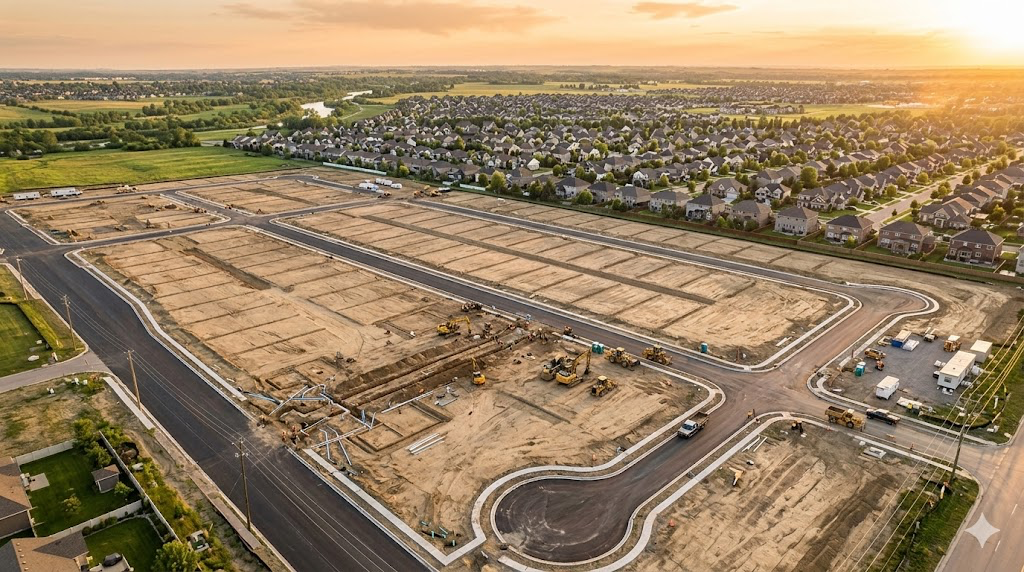
A developer breaks ground on a new subdivision. Lots are selling. Financing is in place. Then the municipality demands a bond before approving the plat — and the developer discovers this bond is not like any other surety bond they have obtained before. It does not operate like a performance bond. The rules are different. The risk is higher. And the underwriting is more demanding.
If you are a land developer, builder, or contractor working on a new subdivision, understanding exactly how a subdivision bond works — and what makes it uniquely risky — can save you significant time, money, and legal exposure. This guide covers everything.
What Is a Subdivision Bond?
A subdivision bond is a surety bond required by a local government — typically a city or county — before a developer can proceed with a subdivision project. It guarantees that the developer will complete all required public infrastructure improvements: roads, sidewalks, drainage systems, utilities, street signs, and similar work specified in the approved development plan.
The bond is a three-party agreement. The principal is the developer responsible for completing the work. The obligee is the municipality requiring the bond. The surety is the bond company that backs the guarantee. If the developer fails to complete the required improvements, the municipality files a claim against the bond. The surety investigates and, if the claim is valid, pays for completion up to the bond amount — then seeks full reimbursement from the developer.
Subdivision bonds go by several names depending on the jurisdiction and the specific type of improvement being guaranteed: developer bond, plat bond, site improvement bond, land improvement bond, and completion bond are all terms used to describe this category.
The Defining Feature: Completion Regardless of Payment
Here is what separates subdivision bonds from every other type of contract surety bond, and it is the single most important thing any developer needs to understand.
On a standard performance bond, non-payment by the project owner is a valid defense. If the obligee fails to pay the contractor, the contractor is generally excused from their obligations under the bond — and the surety is off the hook as well.
A subdivision bond removes that defense entirely. The developer and the surety must guarantee completion of the public infrastructure improvements regardless of whether the developer ever receives payment. The municipality does not owe the developer payment for these improvements. The developer agreed to build them as a condition of the development approval — and that obligation stands whether the developer is profitable, financially distressed, or has a dispute with any other party on the project.
This is why subdivision bonds are categorized as a form of completion bond, and why sureties treat them as significantly higher risk than standard performance bonds. There is no contract balance available to offset the cost of finishing the work if the developer defaults.
The Five Types of Subdivision Bonds
Not all subdivision bonds are identical. The type required depends on the nature of the work being bonded and when in the development process the bond is needed.
| Bond Type | What It Covers | When Required |
|---|---|---|
| Improvement Bond | Public infrastructure: roads, drainage, utilities within the subdivision | Prior to plat approval or work commencement |
| Plat Bond | Compliance with the plat layout and design during development | When filing the subdivision plat with the county or city |
| Site Improvement Bond | Private improvements: driveways, parking lots, landscaping (non-public) | For improvements on private property within a development |
| Maintenance Bond | Infrastructure remains in acceptable condition during the warranty period after project completion | Post-completion, for the duration of the warranty period |
| Completion Bond | Full project completion per approved plans and specified timeline | Required by municipalities as a condition of development approval |
The maintenance bond deserves special attention. It is a separate and distinct product from the improvement bond. Once the infrastructure is built and accepted by the municipality, many jurisdictions require a maintenance bond covering a warranty period — typically 12 to 24 months — during which the developer is responsible for defects or failures in the newly built roads, drainage, and utilities. Most sureties will decline or add collateral to maintenance bonds with warranty periods longer than 24 months because the exposure over long periods is difficult to price.
The Dual-Obligee Problem Most Developers Don’t See Coming
On most subdivision projects, a lender is involved in financing the development. When that lender also has an interest in the bond — either as a named obligee or through bond language that guarantees repayment — the developer and surety are now exposed to two obligees with fundamentally different and often contradictory interests.
The municipality wants the infrastructure completed. The lender wants its loan repaid. If the developer defaults, those two objectives can pull the surety in opposite directions. Dual-obligee exposure dramatically increases the surety’s risk and is one of the primary reasons some sureties decline subdivision bonds entirely or require substantial collateral.
Bond language matters enormously here. If the bond form includes any language that guarantees “repayment” rather than only “construction completion,” the surety may be contractually obligated to pay the financial institution on default — an obligation that goes well beyond completing roads and utilities. Developers should work with their surety to ensure bond forms include a “savings clause” limiting the surety’s obligation strictly to completion of the improvements, not financial repayment to lenders. Without that protection, the surety’s exposure can become open-ended.
What a Subdivision Bond Costs
Subdivision bond premiums run higher than standard performance bond rates precisely because of the completion-regardless-of-payment rule and the long-term nature of the obligation.
| Bond Amount | Typical Annual Rate | Estimated Annual Premium |
|---|---|---|
| $250,000 | 2%–3% | $5,000–$7,500 |
| $500,000 | 1.5%–3% | $7,500–$15,000 |
| $1,000,000 | 1%–2.5% | $10,000–$25,000 |
| $2,500,000 | 1%–2% | $25,000–$50,000 |
Unlike performance and payment bonds, which are priced as a one-time premium for the project duration, subdivision bond premiums are paid annually and renewed each year the obligation remains open. If a project runs three years, the developer pays three annual premiums. Factor this into project budgeting before closing on land — it is not a one-time cost.
For developers with strong credit and financials, rates at the lower end of those ranges are achievable. For developers with credit challenges, rates can push to 4% or higher annually, and collateral requirements may apply.
Bond vs. Letter of Credit vs. Cash: Which Makes More Sense?
Municipalities typically accept three forms of financial assurance for subdivision improvements. Each has real differences that affect your business.
| Option | Effect on Capital | Claims Protection | Cost |
|---|---|---|---|
| Surety Bond | Unsecured credit — does not tie up assets | Surety reviews all claims before paying; fraudulent/frivolous claims can be contested | Annual premium (1%–4% of bond amount) |
| Irrevocable Letter of Credit (ILOC) | Ties up borrowing capacity with your lender | Municipality can draw on demand with minimal documentation; developer must litigate to recover wrongful draws | Bank fee (typically 1%–2% annually) + reduction in credit line |
| Cash / CD | Full cash committed and locked | Municipality can access immediately; developer has no review mechanism for disputed claims | Opportunity cost on full amount |
A surety bond is generally the most capital-efficient option. Because it is considered unsecured credit, it does not reduce the developer’s borrowing capacity the way an ILOC does. And because the surety must review and validate any claim before paying, the developer has a layer of protection against disputed or exaggerated claims. With cash or an ILOC, that protection does not exist — the municipality can access funds before any dispute is resolved, leaving the developer in an expensive legal battle to recover money already drawn.
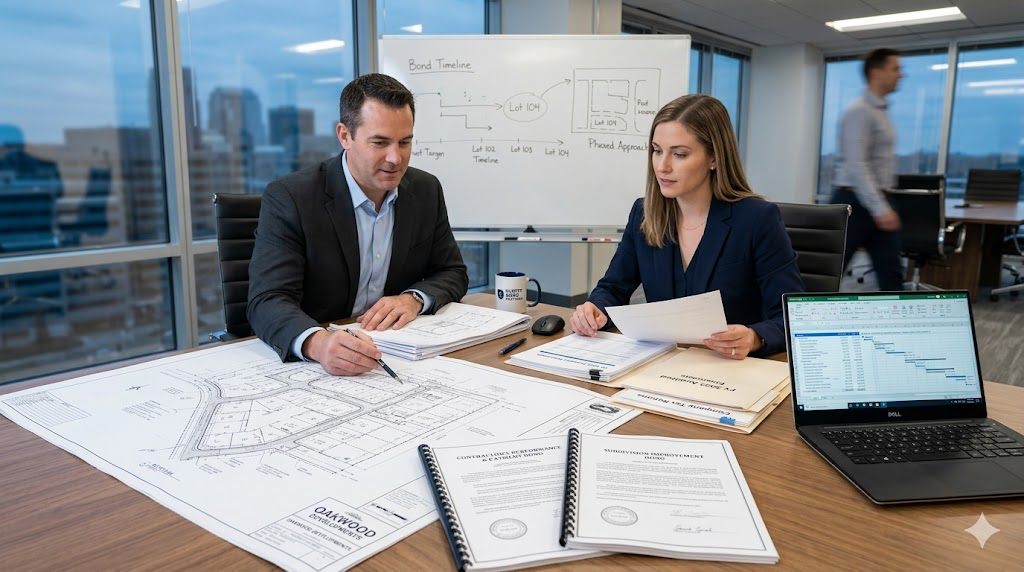
How Subdivision Bond Underwriting Works
Sureties treat subdivision bonds as high-risk, and underwriting reflects that. Many companies do not write them at all. The ones that do will examine the following with considerable care.
| Underwriting Factor | What the Surety Is Evaluating |
|---|---|
| Personal credit | Developer’s overall financial responsibility and character |
| Developer experience | History completing projects of similar size and scope |
| Financial statements | Business and personal financial strength, liquidity, working capital |
| Project financing | Whether funds are 100% committed and set aside (not contingent) |
| Set-aside letter | Lender confirmation that project funds are specifically designated and held |
| Subcontractor structure | Who is doing the work and whether subs are bonded back to the developer |
| LLC operating agreement | Ownership structure, since most developers use LLCs |
| Completion timeline | Shorter timelines preferred; longer durations increase open exposure |
| Warranty period | Sureties prefer 24 months or less |
| Project phasing | Separate bonds per phase strongly preferred over one bond for all phases |
The set-aside letter deserves a plain-language explanation. Most subdivision projects are financed by a lender. The surety wants assurance that the loan funds specifically allocated to the public improvements are committed and held — not contingent on additional approvals, sales milestones, or other conditions. Many past bond claims have occurred precisely when developers received partial or contingent financing. The set-aside letter from the lender confirms that the funds are real, committed, and available for the project.
The Phased Development Strategy
Many subdivisions are built in phases — Phase 1 infrastructure first, then Phase 2, and so on. When that is the case, structuring separate subdivision bonds for each phase rather than one bond covering the entire project is strongly preferred by sureties and is often significantly better for developers as well.
Phase-by-phase bonding means the surety’s liability on each earlier phase can be released and closed out as the municipality inspects and accepts the completed improvements. This keeps the total open bond exposure manageable, reduces annual premium costs over time, and simplifies the underwriting for each subsequent phase. A single bond covering a ten-phase development creates a long-duration, open-ended exposure that most sureties will either decline or price very conservatively.
Subcontractor Bonding Back to the Developer
When a developer hires subcontractors to perform the infrastructure work, the surety will often ask whether those subcontractors are required to post their own performance and payment bonds back to the developer as the obligee.
From a developer’s perspective, this can feel redundant. The developer already has a subdivision bond covering the work — why do subcontractors also need bonds? The answer is straightforward: if a subcontractor fails to perform or fails to pay their suppliers, the developer is responsible for covering the additional costs to complete the work or clear any mechanics liens filed against the property. Requiring subcontractors to bond back to the developer transfers that risk. It is also one of the signals sureties look for when evaluating whether a developer manages their projects responsibly.
The Complete Document Checklist
| Document | When Required |
|---|---|
| Subdivision bond application | Always |
| Personal financial statement (all owners with 10%+ ownership) | Always |
| Set-aside letter from lender | When project is lender-financed |
| Business financial statement | For bonds over $50,000 (CPA-prepared over larger thresholds) |
| Improvement agreement or development agreement | Specifies exact scope of improvements to be bonded |
| Engineer’s estimate of improvement costs | Used to set bond amount |
| Obligee’s bond forms (if municipality has their own) | When the municipality provides standard bond language |
| Commitment letter from lender or source of funds verification | Confirms financing is secured |
| LLC operating agreement (if applicable) | For developer entities organized as LLCs |
| Experience application | For bonds over $750,000 |
| Three-year financial statements | For larger bonds requiring full financial review |
How to Get a Subdivision Bond
Once you have your project details, development agreement, and lender commitment in order, the bonding process itself is straightforward. Submit your application with project scope, estimated improvement costs, and financial documents. Swiftbonds works with developers across all 50 states and has direct access to the specialty surety markets that actually write subdivision bonds — not every surety does. You receive a quote, pay the first annual premium, sign the bond documents, and submit the executed bond to the municipality — typically through their platting or public works department, sometimes via an online portal as Miami-Dade and many other counties now use. The bond is then kept current through annual renewals until the municipality formally inspects the completed improvements and issues a written release.
Swiftbonds LLC
2025 Surety Bond Technology Provider of the Year
4901 W. 136th Street
Leawood KS 66224
(913) 214-8344
https://swiftbonds.com/
What Happens When a Claim Is Filed
If a developer abandons the project or fails to complete the required improvements on schedule, the municipality can file a claim against the bond. The surety investigates the claim, reviews the improvement agreement, and determines what work remains. If the claim is valid, the surety either arranges for completion of the improvements or pays the municipality the cost to complete them — up to the bond amount. The surety then pursues full reimbursement from the developer through the indemnity agreement signed at bond issuance.
One important protection that bonds offer over ILOCs and cash: before the surety pays, there is a claims review. This review process allows developers to contest inaccurate or inflated claims and ensures that any payment reflects the actual reasonable cost of completing the remaining improvements — not the municipality’s maximum demand.
Bond Release and Reduction
Subdivision bonds are not released automatically when the project is finished. The developer must request a final inspection from the municipality. A government inspector (in many jurisdictions, the public works or planning department) physically verifies that the completed improvements meet the standards specified in the development agreement. Upon acceptance, the municipality issues a written release, and the surety formally closes out the bond obligation.
Many jurisdictions also allow partial bond reductions as phases or major components are completed and accepted. Requesting reductions as work progresses reduces the outstanding bond amount and, in turn, lowers annual renewal premiums during the remainder of the project.
FAQs
Is a subdivision bond the same as a performance bond? Not exactly. Both are surety bonds that guarantee completion of work, but there is one critical legal difference. A performance bond allows non-payment by the obligee as a valid defense — if the project owner does not pay the contractor, the contractor’s performance obligation is typically excused. A subdivision bond eliminates that defense. The developer must complete the infrastructure improvements regardless of whether payment is ever received. This makes subdivision bonds fundamentally higher-risk instruments.
Who is required to purchase a subdivision bond? The developer or landowner responsible for the infrastructure improvements — not the contractor performing the work. If your business is organized as an LLC (as most development entities are), all members with significant ownership interest will typically be required to sign as indemnitors on the bond application.
Can I get a subdivision bond with bad credit? Yes, though at higher cost. Developers with credit challenges can still obtain subdivision bonds by providing strong financial statements, a documented track record of completed projects, and in some cases collateral. Rates for challenged credit typically range from 3% to 5% or higher annually. Working with a surety specialist who has access to multiple markets improves the chances of finding a competitive rate.
Why does the premium renew every year? Unlike a performance bond, which covers a fixed project duration for a single premium, a subdivision bond remains open and in force until the municipality formally releases it. Annual renewals reflect the ongoing nature of the obligation. If your project runs three years before final inspection and release, you will pay three annual premiums.
What is a set-aside letter and why does the surety require it? A set-aside letter is a written confirmation from the developer’s lender that loan funds specifically allocated to complete the public improvements are fully approved, committed, and held — not contingent on sales targets, additional draws, or other conditions. Many subdivision bond claims have historically occurred on projects with partial or contingent financing. The set-aside letter gives the surety confidence that the money to build the improvements actually exists.
Can the bond amount be reduced before project completion? Yes. Most municipalities allow partial bond reductions as portions of the work are completed and formally accepted. The developer must request an inspection, and the government inspector must accept the completed portion. Once accepted, the bond amount can be reduced to reflect only the remaining uncompleted work, which lowers the annual renewal premium for the remainder of the project.
What happens if the bond lapses during the project? A lapsed subdivision bond is a serious compliance issue. It puts the developer in violation of the development agreement, can trigger legal action by the municipality, and may halt further lot sales or construction approvals until the bond is reinstated. Coordinate renewal dates carefully with your surety provider — most will send renewal reminders well in advance of the expiration date.
Conclusion
A subdivision bond is one of the most technically complex instruments in the surety market — and one of the most consequential for land developers to understand correctly. The completion-regardless-of-payment rule, the dual-obligee risk, the annual renewal premium structure, and the specific underwriting requirements around financing and phasing are not details that show up in a simple bond application form. They are the factors that determine whether a developer can get bonded at a competitive rate, protect their business from open-ended liability, and close out their project on schedule and on budget.
The developers who handle subdivision bonds well treat bonding as a planning function — not a paperwork formality at the end of the approval process. They structure financing to satisfy set-aside requirements, phase their projects to reduce open exposure, require their subcontractors to bond back, and choose a surety partner with a genuine appetite for this bond class.
5 Interesting Things About Subdivision Bonds You Won’t Find in Most Guides
- Subdivision bonds were among the hardest-hit surety products during the 2007–2009 housing collapse. As residential development projects across the country were abandoned midway through, municipalities filed claims on billions of dollars of outstanding subdivision bonds. The losses were severe enough that many regional and national sureties permanently exited the subdivision bond market — which is why, to this day, finding a surety with a genuine appetite for these bonds requires more effort than for standard contract bonds.
- The bond amount on a subdivision bond is not set by the developer or even the surety — it is typically determined by a government engineer based on their own independent estimate of the cost to complete the required improvements. In jurisdictions like Miami-Dade County, the figure is calculated from approved Paving and Drainage Plans. The developer’s own cost estimates are not controlling; the government’s engineer estimate is the starting point, and it is often higher than what the developer would independently calculate.
- Some municipalities require a maintenance bond separately from the improvement bond specifically because improvements that pass final inspection can still fail within the first one to two years due to settlement, material defects, or improper installation. A maintenance bond shifts the cost of those post-completion repairs back to the developer rather than the municipality — protecting the public infrastructure fund from warranty claims that the improvement bond would otherwise not cover.
- LLC structure creates a common underwriting problem that many first-time subdivision bond applicants do not anticipate. Developers typically form a new LLC for each project to isolate liability. But a single-purpose LLC with no track record, no independent financial history, and no assets beyond the development site looks nearly unbondable on its own. Sureties require personal indemnity from the actual principals behind the LLC — and sometimes require cross-collateralization from the developer’s other entities — precisely because the LLC structure is designed to limit exactly the kind of personal exposure the surety is trying to secure.
- Some jurisdictions allow a developer to substitute a new bond for an existing one as part of a permitted collateral exchange — meaning that if a developer initially posted cash or an ILOC and later wants to free up that capital, they can approach the municipality about replacing the financial assurance with a surety bond, provided the bond meets the same requirements. This conversion is not commonly advertised by municipalities, but it is a legitimate and often overlooked option for developers who want to unlock capital tied up in earlier-stage financial assurances.
Leave a Reply