
Blog

  • Sales and Use Tax Bond: What It Is, Who Needs It, and How Much It Costs

    Every year, businesses that fail to remit sales tax cost state governments billions of dollars. That is exactly why many states require a sales and use tax bond before they will even let you open your doors — and if you skip it, your license could be denied, revoked, or never issued in the first place.

    If your state is asking for one and you have no idea what it means, what it costs, or how to get it fast, this guide covers everything you need to know.

    What Is a Sales and Use Tax Bond?

    A sales and use tax bond — also called a sales tax bond, a continuous bond of seller, or a financial guarantee bond — is a type of surety bond required by state and local governments that guarantees a business will collect, report, and remit all applicable sales taxes on time.

    It is not insurance for your business. It is a financial promise made to the government. If you fail to pay your taxes, the government can file a claim against the bond and recover those funds. The surety company pays the claim first — but then comes back to collect every dollar from you.

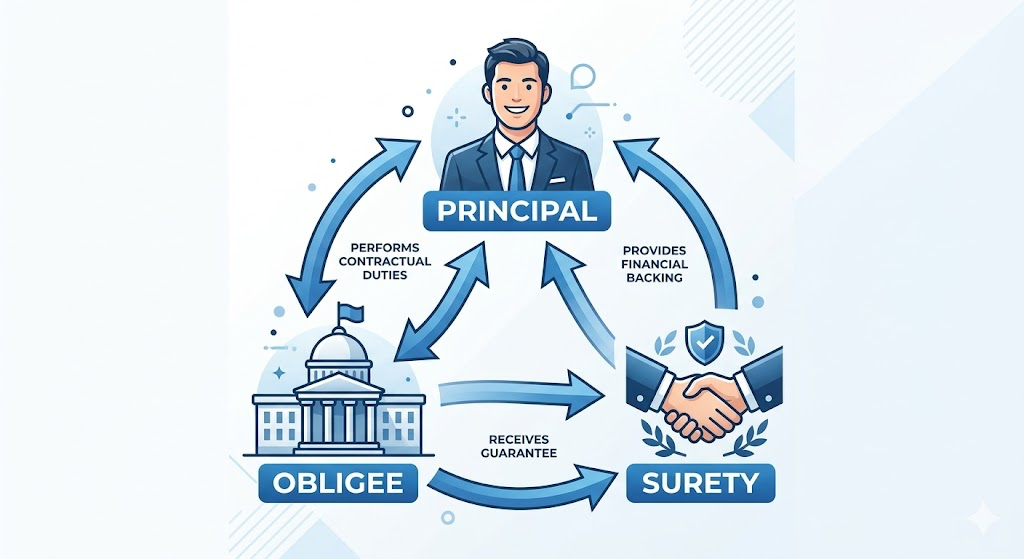
    The bond is a three-party agreement:

    PartyRole
    PrincipalThe business owner who purchases the bond
    ObligeeThe government agency requiring the bond
    SuretyThe insurance company that issues and backs the bond

    Think of the surety as a co-signer. They are putting their reputation and money on the line for you — but if things go wrong, you are ultimately responsible for repayment.

    Who Needs a Sales and Use Tax Bond?

    Not every business is required to post one upfront. In many states, the bond is triggered by specific conditions rather than being automatically required at registration. The most common situations include:

    TriggerDetails
    New business in certain industriesEspecially alcohol, tobacco, fuel, and marijuana
    Prior tax delinquenciesMost states require bonds after repeated late filings or missed payments
    History of returned checks for tax paymentsSignals financial risk to the agency
    Revoked license reinstatementRequired to prove financial accountability before reopening
    Out-of-state vendorsSome states require bonds from remote sellers with use tax obligations

    States like Iowa set specific delinquency thresholds — quarterly filers who miss two payments within 24 months may be required to post a bond. North Dakota holds compliance bonds for five years, though businesses with two consecutive years of clean filings can request an early release.

    The industries most commonly required to bond before operations even begin include retailers of alcohol, tobacco, fuel, fireworks, and cannabis products. General merchandise retailers may also need one depending on the state.

    How Much Does a Sales and Use Tax Bond Cost?

    The cost of the bond itself — called the bond amount or penal sum — is set by the government agency. It is typically calculated as a multiple of your average monthly or quarterly tax liability. Missouri, for example, sets bond amounts at three times the applicant’s average monthly liability. Iowa calculates it based on filing frequency:

    Filing FrequencyBond Amount Formula
    Quarterly filersEqual to 3 quarters of sales tax liability
    Monthly filersEqual to 5 months of sales tax liability
    Semimonthly filersEqual to 3 months of sales tax liability
    Annual filersEqual to 1 full year of liability (minimum $100)

    Common bond amounts in the market range from $2,000 to $50,000, though they can go higher for larger businesses or higher-risk industries.

    What you actually pay to a surety company is a premium — a small percentage of the total bond amount. For most applicants with good credit, premiums run between 1% and 5% of the bond. That means a $10,000 bond might cost you as little as $100 to $500 per year.

    Businesses with lower credit scores will pay higher premiums — sometimes up to 10% — because they represent greater financial risk to the surety. However, bad credit does not disqualify you. Most surety agencies offer programs specifically for hard-to-place applicants, though you may need to provide additional collateral or financial documentation.

    What Affects Your Premium Rate?

    FactorHow It Impacts Cost
    Credit scoreHigher score = lower premium
    Business financial historyClean books lower perceived risk
    Bond amount requiredLarger bond = higher total premium dollars
    Industry typeHigh-risk industries (fuel, alcohol) may carry higher base rates
    State requirementsSome states set minimum thresholds that drive costs up

    How to Get Your Sales and Use Tax Bond

    Getting bonded is simpler than most business owners expect. The process typically takes less than 24 hours for straightforward applications.

    Start by applying with a licensed surety provider — Swiftbonds works with businesses across all 50 states and can match you with the right carrier for your state and industry. Once your application is submitted, you receive a quote based on your credit profile and the required bond amount. After you pay the premium, the surety issues the bond documents — either digitally or as a physical document set — and you file it with the obligee (the state or local agency that required it). That filing is what officially satisfies the requirement and keeps your license in good standing.

    Swiftbonds LLC
    2025 Surety Bond Technology Provider of the Year
    4901 W. 136th Street
    Leawood KS 66224
    (913) 214-8344
    https://swiftbonds.com/

    How Bond Claims Work

    If your business fails to remit sales taxes as required, the obligee — the government tax agency — can file a claim against your bond. Here is what that process looks like:

    The agency submits the claim to the surety company. The surety investigates to confirm the claim is valid. If it is, the surety pays the obligee up to the full bond amount. Then the surety turns around and demands full reimbursement from you — the principal.

    A concrete example: you have a $10,000 bond and fall $7,000 behind on sales tax. The surety pays the state $7,000 to resolve the claim. You now owe the surety $7,000, plus potential legal and collection costs. The bond does not absorb the loss — it only guarantees the government gets paid first.

    This is why the bond functions as a compliance tool, not a safety net for the business. Avoiding claims entirely is the goal, and it is achieved simply by filing and paying your taxes on time.

    Bond Renewal: What Happens After Year One

    Most sales and use tax bonds are issued for a 12-month term. Before the expiration date, the surety company will send renewal reminders and re-evaluate your credit standing. If your credit has improved since the original application, your premium may go down. If your credit has declined or a claim was filed, expect a higher rate.

    If you allow the bond to lapse — even for a day — the government agency may consider your license suspended or revoked. Reinstatement usually requires a new bond application and potentially a higher bond amount if your tax compliance record has deteriorated. Do not let it expire without renewing.

    Types of Sales and Use Tax Bonds

    While “sales and use tax bond” is the umbrella term, the specific bond required depends on your industry and state. The most common variants include:

    Bond TypeWho Needs It
    General Sales Tax BondRetailers of taxable goods in most states
    Cigarette and Tobacco Tax BondTobacco distributors, wholesalers, and retailers
    Alcohol / Liquor Tax BondBrewers, importers, wholesalers, and retailers
    Fuel / Motor Fuel Tax BondFuel distributors, suppliers, and special fuel dealers
    Cannabis / Marijuana Tax BondDispensaries and producers in legal-market states
    Customs Tax BondImporters and brokers dealing with taxable goods

    Some businesses may require multiple bonds across categories — for example, a retailer that sells both tobacco and fuel would likely need separate bonds for each product type depending on the state.
    Corporate Officer Bond: A Lesser-Known Option

    In some states — including North Dakota — a corporation, LLC, or limited liability partnership can post a corporate officer bond instead of having individual officers personally liable for unpaid tax obligations. This bond protects the officers themselves from personal financial exposure during tax periods when the bond is active. It is a strategy worth exploring if your business is a multi-member entity with significant tax liability.

    What If the Bond Is Not Required Yet?

    Not every business needs to post a bond at startup. In many states, first-time applicants with no prior tax issues begin operations without one. The bond requirement kicks in only if the agency identifies a risk factor — delinquency, returned payments, or a prior problematic tax history.

    That said, some states (Missouri is a clear example) require all new retail sales tax license applicants to post a bond before the license is issued, based on projected or prior-owner liability. Always verify your specific state’s requirements before assuming you are exempt.

    FAQs

    Does having bad credit mean I cannot get bonded? No. While bad credit raises your premium, most surety providers — including those working with Swiftbonds — offer programs specifically designed for applicants with low scores or past financial difficulties. You may need to provide financial statements or additional collateral, but you can still get bonded and legally operate.

    Can I get my bond refunded after a period of good compliance? Yes, in many states. Iowa refunds bonds after two years of satisfactory filing and payment. Missouri releases the bond after two years of clean compliance. North Dakota holds compliance bonds for five years but allows early review after two years. Each state has its own rules — check with your tax agency or surety provider.

    What bond types does my state accept? Most states accept surety bonds, cash bonds, certificates of deposit, and irrevocable letters of credit. Personal checks are almost universally not accepted. Surety bonds are by far the most common and convenient option because they require no large upfront cash deposit.

    How long does it take to get a sales and use tax bond? Most applications are processed within 24 hours. Overnight shipping is available for physical documents, and digital filing is accepted in many states.

    What happens if I sell my business? The new owner typically cannot use your bond. They must apply for their own bond based on the prior owner’s tax history — which is often used to calculate the required bond amount. If the previous owner had a good record, this can work in the buyer’s favor.

    Is a sales and use tax bond the same as sales tax insurance? No. They are structurally different. Insurance protects the policyholder. A surety bond protects the obligee (the government) — and the business owner is still ultimately responsible for any losses.

    Conclusion

    A sales and use tax bond is one of those business requirements that can feel overwhelming until you understand how straightforward it actually is. The government requires it to protect tax revenue. You purchase it through a surety provider, pay a small annual premium, and maintain it in good standing by simply doing what you are already required to do — file and pay your taxes on time.

    Whether you are a first-time retailer navigating a state’s bonding requirement or a business owner rebuilding after a tax compliance issue, the bond is obtainable, affordable, and often issued within a single business day.

    5 Interesting Things About Sales and Use Tax Bonds You Won’t Find in Most Guides

    1. The bond requirement predates the business opening in some states. Missouri requires a bond before the Department of Revenue will even issue a retail sales tax license — meaning a business that skips this step cannot legally make its first sale.
    2. The bond amount can be as low as $25. Missouri sets a minimum bond of just $25 for new businesses whose projected three-month liability falls under $500 — making it one of the most affordable compliance tools in the regulatory landscape.
    3. Your bond can protect corporate officers from personal liability. In North Dakota and similar states, a corporate officer bond shields the company’s managers and partners from being personally sued for unpaid sales tax during the period the bond is active — a protection that goes well beyond simple licensing compliance.
    4. A bond can be seized while you are still in business. If a taxpayer becomes delinquent, the state tax agency can redeem a certificate of deposit or cash bond immediately — without waiting for a court order — leaving the business scrambling to post replacement collateral within 30 days or risk losing the license entirely.
    5. The penny’s end affects how sales tax bonds are calculated. Since the U.S. Mint ended penny production in June 2025, states like Iowa and Nevada have issued guidance clarifying that while retailers may round cash transactions to the nearest nickel, sales tax must still be calculated on the exact gross receipts — meaning even this small rounding change has no effect on the tax liability that underlies your bond requirement.
  • Sales Tax Bond: The Complete Guide for Retailers and Merchants

    Most business owners discover they need a sales tax bond in one of two ways: at license application, when the state agency hands back their paperwork and points to a bond requirement, or after a delinquency, when the state tax authority notifies them that future selling privileges are contingent on posting a financial guarantee. Either way, the clock is ticking. Understanding what the bond is, how the amount is calculated, and what happens if you skip it is critical before you open your doors — or before your doors get closed.

    What Is a Sales Tax Bond?

    A sales tax bond is a financial guarantee surety bond that guarantees a business will accurately collect, report, and remit all applicable sales taxes to the state or local government by the required deadlines. It is also called a sales and use tax bond, continuous bond of seller (Texas), bond of the seller (California), general tax bond, or tax bond — and the official name varies significantly by state.

    The bond is a three-party agreement:

    PartyRole
    PrincipalThe business purchasing the bond — the retailer, merchant, or producer
    ObligeeThe state or local government agency requiring the bond and enforcing tax collection
    SuretyThe licensed bond company issuing the bond and paying valid claims on the principal’s behalf

    If the business fails to remit the taxes it has collected — or underreports its sales tax liability — the government can file a claim against the bond. The surety pays the claim up to the full bond amount. The business then owes that full amount back to the surety under the indemnity agreement signed at issuance. The bond does not protect the business. It protects the government — and ultimately the taxpaying public — from revenue shortfalls caused by businesses that collect tax money from consumers and keep it.

    Why Sales Tax Bonds Exist

    Forty-five states and the District of Columbia collect sales taxes. State governments depend on sales tax revenue to fund schools, roads, emergency services, and a wide range of public programs. When a retail business collects sales tax from a customer at the register, that money belongs to the government from the moment it is collected. The business is simply acting as a collection agent. A sales tax bond exists because some businesses — whether through cash flow problems, intentional non-compliance, or outright fraud — have historically failed to forward that collected money to the state on time or at all. The bond creates a financial backstop that ensures the government can recover what it is owed even when a business cannot or will not pay.

    The Two Triggers: Pre-Licensing and Delinquency

    This distinction is essential and almost entirely absent from commercial guides on this topic. A sales tax bond can be required at two very different points in a business’s life.

    The first trigger is pre-licensing: states may require a bond as a pre-licensing condition before a new business can begin operating and obtain a sales tax permit. The business has not yet sold anything — the bond is simply required as part of the standard application process, often for businesses in higher-risk categories such as tobacco, alcohol, fuel, or marijuana.

    The second trigger is delinquency: a business that has been operating without a bond but falls behind on its sales tax remittances may be required by the state to post a bond as a condition of continuing to operate. This retroactive compliance requirement is how most sales tax bond applications actually arise in practice. A business that receives notice from its state tax authority that a bond is now required typically has a short window to comply before its sales tax permit is suspended.

    Understanding which trigger applies to your situation matters because it affects the required bond amount, the urgency of the timeline, and what documentation the surety needs to underwrite the application.

    Who Needs a Sales Tax Bond?

    The bond requirement is determined entirely at the state and sometimes local level. It is not uniform across all states, all business types, or all tax categories. In general, a sales tax bond is required for businesses engaged in selling, producing, or storing:

    Product CategoryBond Type
    Alcohol and liquorSales tax bond or separate liquor tax bond
    Tobacco and cigarettesCigarette tax bond or sales tax bond
    Fuel and petroleum productsFuel tax bond or sales tax bond
    Marijuana and cannabis productsMarijuana sales tax bond (in legal states)
    General merchandise (clothing, electronics, furniture, etc.)General sales tax bond

    Businesses that only produce or store taxable products without directly selling to consumers may also be subject to bond requirements in some states, not just those making point-of-sale transactions.

    Five states collect no state-level sales tax at all: Alaska, Delaware, Montana, New Hampshire, and Oregon. A business operating exclusively in one of those states has no state-level sales tax bond requirement, though local and municipal sales tax obligations may still apply depending on the jurisdiction.

    Bond Amount: How It Is Calculated

    Bond amounts for sales tax bonds are almost never fixed at a flat rate. The required amount is typically calculated by the state agency based on the business’s tax exposure. The most common calculation methods are:

    Gross receipts method: The bond amount is set as a percentage of the business’s total annual sales or gross receipts.

    Projected annual tax liability method: Missouri and similar states require businesses to post a bond equal to a percentage of their expected annual sales tax liability.

    Monthly multiplier method: Texas specifies that the bond must be either $500 to $100,000 or four times the average monthly tax liability — whichever is greater. This formula means a business with high monthly sales tax volumes will carry a proportionally higher bond.

    Fixed schedule: Some states assign flat bond amounts based on industry type, license category, or business size.

    Common bond amounts across the country range from $2,000 to $50,000 for most small and mid-sized retailers. High-volume businesses or those in industries with elevated tax risk can face substantially higher requirements. In all cases, it is the government agency — not the surety — that determines the required bond amount.

    Bond Amounts and Premiums: What to Budget

    The bond amount is the maximum payout the surety will cover if a claim is filed. The premium is what the business actually pays to obtain the bond — a small percentage of the bond amount, determined primarily by the owner’s credit score and the business’s financial history.

    Credit ProfileTypical Annual Premium RateCost on a $10,000 BondCost on a $50,000 Bond
    Excellent credit1%–2%$100–$200$500–$1,000
    Good credit2%–4%$200–$400$1,000–$2,000
    Average credit4%–5%$400–$500$2,000–$2,500
    Poor/challenged credit5%–15%$500–$1,500$2,500–$7,500

    Applicants with poor credit or prior bond claims can still obtain sales tax bonds through specialty and high-risk surety programs, though at higher rates. Notably, unlike many other financial guarantee bonds, sales tax bonds are generally underwritten without requiring the applicant to post cash collateral — the bond is written on the strength of the applicant’s creditworthiness and financial profile alone.

    State-Specific Bond Names: A Critical Compliance Detail

    One of the most practically important aspects of sales tax bonds is that the official bond name differs by state, and the bond form itself is usually supplied by the government agency — not by the surety. Submitting a bond on the wrong form or with generic language that does not match the obligee’s specific requirements will result in rejection. Always obtain the correct bond form from your state tax authority before contacting a surety for issuance.

    StateOfficial Bond Name
    TexasContinuous Bond of Seller / Comptroller Bond
    CaliforniaBond of the Seller
    MassachusettsExcise Tax Bond
    NevadaTitle 32 Performance Bond
    ConnecticutOR-131 Tax Bond
    West VirginiaNonresident Contractors/Consumers Sales and Service Tax and Use Tax Bond
    AlaskaTax Liability Bond
    KansasRetailer Sales Tax Bond
    North DakotaSales Use Tax Permit Bond
    MissouriSales and Use Tax Bond

    Nevada’s official name — Title 32 Performance Bond — is particularly notable because it does not use any “sales” or “tax” language at all in its title, making it easy for applicants to miss if they are simply searching for a “sales tax bond” in that state.

    Texas-Specific Details: The Dual-Bond Requirement

    Texas deserves particular attention because of two nuances not covered by most guides. First, the bond amount formula is precise: the required amount is $500 to $100,000, or four times the average monthly tax liability — whichever is greater. This means a growing business with increasing monthly sales tax volumes must recalculate its bond requirement as revenue grows. Second, mixed beverage businesses and private clubs in Texas must post a gross receipts tax bond in addition to the standard sales tax bond. These are two separate bond requirements, and fulfilling one does not satisfy the other.

    The Corporate Officer Bond: A Distinct and Overlooked Product

    One product that commercial guides almost universally ignore is the corporate officer bond. In some states — including North Dakota — a corporation, LLC, or limited liability partnership can elect to post a corporate officer bond as an alternative to or in addition to a standard compliance bond. The purpose is specific: by posting a corporate officer bond, the company’s officers, governors, managers, or general partners are shielded from personal liability for the company’s failure to file tax returns or pay taxes owed on the account.

    Without this bond, the individuals in those positions can be held personally liable for corporate tax failures. The corporate officer bond essentially transfers that personal liability exposure to the surety for the periods during which the bond is active. For business owners operating under corporate structures in states that offer this product, it is worth discussing with both legal counsel and a surety professional.

    The 5-Year Holding Period

    In some states, a sales and use tax compliance bond is not released simply because the business eventually becomes compliant. North Dakota, for example, generally holds sales and use tax compliance bonds for a period of 5 years. The bond cannot be canceled or returned simply because the business has paid all its back taxes or improved its reporting record. However, a taxpayer who accurately and timely files returns and pays taxes for 2 consecutive years on their sales and use tax account can request an early review for refund of their bond — earning early release through demonstrated compliance. This 2-year early release provision is a meaningful financial incentive for businesses subject to a compliance bond to maintain clean records throughout the holding period.

    Motor fuel tax compliance bonds in North Dakota are held even longer — until the permit is cancelled — with no equivalent early release provision.

    How to Get a Sales Tax Bond

    The process follows four steps: apply, receive your quote, pay your premium, and file the bond with the obligee. The application requires your business name, tax identification number, the type of products your business sells, the state and obligee requiring the bond, the required bond amount (provided by the state agency), and authorization for a credit check on business owners. For businesses with challenged credit or larger bond amounts, business and personal financial statements may also be required. Most standard applications receive a quote and can be issued within 24 hours.

    Swiftbonds works with retailers and merchants across all 50 states, including businesses that have received a delinquency notice and need to post a compliance bond quickly, and applicants with non-standard credit profiles.

    Swiftbonds LLC
    2025 Surety Bond Technology Provider of the Year
    4901 W. 136th Street
    Leawood KS 66224
    (913) 214-8344
    https://swiftbonds.com/

    Bond Renewal: An Obligation, Not a Choice

    If your business is required to hold a sales tax bond as a condition of licensure, renewal is mandatory. Failure to renew before the expiration date creates a gap in coverage — and in most states, a gap in bond coverage results in automatic suspension of the sales tax permit. The consequences of an expired bond typically include: loss of authority to make taxable sales, personal liability exposure for continuing sales made without a valid permit, and the additional cost and paperwork of reapplying rather than simply renewing.

    Most sales tax bonds renew annually. Texas bonds expire on December 31 of each year, creating a hard calendar-year deadline for all Texas retailers. At renewal, the surety will re-evaluate your credit; improvements lead to lower premiums, while credit declines can increase your renewal cost.

    What Happens When a Claim Is Filed

    If the government believes a business has failed to properly pay its sales tax obligation, it files a claim with the surety company. The surety investigates to confirm the claim is valid. If it is, the surety pays the obligee up to the full bond amount. The business then owes the surety the full amount paid — plus any associated costs. A paid bond claim also significantly reduces the chances of renewing the bond at the end of the term, which can lead to license revocation. Maintaining accurate records and remitting taxes on time is the only reliable strategy for avoiding the cascading consequences of a bond claim.

    Frequently Asked Questions

    What is a sales tax bond? A sales tax bond is a surety bond required by state or local government agencies that guarantees a business will collect, report, and remit all applicable sales taxes by the required deadlines. If the business fails to pay, the government can file a claim against the bond to recover the unpaid taxes.

    Who needs a sales tax bond? Businesses in states that require bonding as a pre-licensing condition, and businesses that have fallen behind on sales tax remittances and received a state notice requiring a bond. Common industries include tobacco retailers, alcohol sellers, fuel distributors, marijuana dispensaries (in legal states), and general merchandise retailers in certain states.

    How is the bond amount determined? The government agency determines the bond amount, typically based on the business’s gross receipts, projected annual sales tax liability, or a multiple of the average monthly tax liability. Texas uses the greater of $500–$100,000 or four times the average monthly tax liability as its formula.

    How much does a sales tax bond cost? The annual premium is typically 1%–5% of the bond amount for businesses with good credit. Applicants with poor credit may pay 5%–15%. Unlike many financial guarantee bonds, sales tax bonds are generally written without requiring the applicant to post cash collateral.

    Are there alternatives to a surety bond? Some states accept alternatives including cash bonds (payment by cash, check, or money order directly to the agency), irrevocable letters of credit, or certificates of deposit. These require posting the full bond amount in cash — which is often tens of thousands of dollars tied up and unavailable for operations — making a surety bond the capital-efficient choice for most applicants.

    What are the 5 states without a sales tax? Alaska, Delaware, Montana, New Hampshire, and Oregon collect no state-level sales tax. Businesses operating exclusively in these states have no state-level sales tax bond requirement, though local and municipal sales tax requirements may still apply.

    Do I need more than one bond? Possibly. In Texas, mixed beverage businesses and private clubs must post a gross receipts tax bond in addition to the standard sales tax bond. Businesses that sell multiple regulated product categories — such as both alcohol and tobacco — may need separate bonds for each license category depending on state rules.

    What is a corporate officer bond? In some states, a corporate officer bond is a separate product that protects officers, managers, governors, or general partners of a corporation, LLC, or LLP from personal liability for the company’s failure to file tax returns or pay taxes owed. It is distinct from the compliance bond and must be actively maintained to provide the personal liability shield.

    What happens if my bond lapses? Most states suspend the business’s sales tax permit immediately upon bond lapse. Any sales made during the lapse period without a valid permit expose the business to additional penalties, and personal liability may attach to the business owners for sales taxes owed during the gap.

    How long must I keep the bond? In some states, compliance bonds are held for a fixed period regardless of later performance — North Dakota holds sales and use tax compliance bonds for 5 years, with a possible early release after 2 years of clean compliance. Always confirm with your specific state agency how long the bond must remain active.

    Conclusion

    The sales tax bond is deceptively simple on the surface — a financial guarantee that a business will pay its taxes — but the operational details are anything but simple. The retroactive delinquency trigger, the state-specific naming conventions, the dual-bond requirement for certain Texas businesses, the corporate officer bond as a personal liability shield, the 5-year holding period in some states, the five states with no requirement at all, and the risk of using an incorrect bond form are all details that can derail compliance for businesses that do not investigate thoroughly. The cost of getting this right is a modest annual premium. The cost of getting it wrong is an interrupted license, a personal liability exposure, and a claims history that follows the business at every future renewal.

    5 Interesting Things About Sales Tax Bonds That You Won’t Find on Most Sites

    1. The South Dakota v. Wayfair Supreme Court decision in 2018 may have created sales tax bond obligations for online retailers who have never physically operated in a state. Following Wayfair, states can require out-of-state online sellers to collect and remit sales tax once they exceed a certain economic threshold — typically $100,000 in sales or 200 transactions in the state annually. Several states that require sales tax bonds for in-state retailers technically apply those bond requirements to any business with “economic nexus,” meaning an e-commerce retailer selling heavily into a bond-requiring state could theoretically be subject to that state’s bond requirement even without a single physical employee or location there. This area of compliance law is actively evolving and is not yet addressed by any major surety bond guide.

    2. Sales tax bonds are classified as financial guarantee bonds — a category that generally requires more intensive underwriting than standard license and permit bonds. Most commercial bonds (contractor license bonds, auto dealer bonds, etc.) are license and permit bonds that are routinely issued with just a credit check. Financial guarantee bonds — which include sales tax bonds — guarantee the payment of a specific financial obligation, not just general compliance with regulations. This classification technically subjects them to different underwriting standards, which is why some surety companies require business financial statements for sales tax bonds that they would not require for a standard license bond of the same amount.

    3. Some states impose higher bond amounts on businesses with prior delinquency histories than the standard calculation formula would produce. Texas explicitly provides that retailers delinquent in local or state sales or use taxes may be required to post a bond greater than the formula-calculated amount. This means a business with a delinquency history may face a bond amount that exceeds what the four-times-monthly-liability formula would generate — creating a punitive premium structure on top of the standard compliance requirement. The higher bond effectively penalizes past non-compliance with increased capital costs going forward.

    4. The gross receipts tax and the sales tax are two distinct and separately bonded tax types in Texas’s mixed beverage regulatory framework. Texas requires mixed beverage businesses and private clubs to post a gross receipts tax bond entirely separate from the standard sales tax bond. The gross receipts tax in this context applies to a percentage of total mixed beverage receipts — not just to the sales tax portion of individual transactions. These two bonds cover different tax obligations, are filed with different parts of the Texas Comptroller’s office, and are calculated using different formulas. An operator who posts only the sales tax bond but not the gross receipts tax bond is operating with an incomplete compliance profile.

    5. The predecessor of the modern sales tax bond in many states was a cash deposit requirement that entirely blocked small businesses from obtaining licenses. Before the widespread use of surety bonds for tax compliance, some states required new retailers to post a full cash deposit — equal to several months of projected sales tax liability — before they could receive a sales tax permit. A retailer with $500,000 in monthly revenue might have needed to post tens of thousands of dollars in cash before making a single sale. The shift to surety bonds (where only a small premium is required rather than the full deposit amount) made entry into retail markets significantly more accessible for small and startup businesses. The surety bond is not just a compliance tool — it is also a small business capital efficiency mechanism that replaced a much more burdensome cash deposit system.

  • Payday Loan Bond: The Complete Guide for Short-Term Lenders

    You cannot legally open a payday lending business in most states without one document already in place: a surety bond. Not after you apply for your license — before. Miss this requirement and your license application is denied on arrival. Let it lapse mid-year and your license is subject to suspension. The payday loan bond is not a background formality that gets handled later. It is the gatekeeper to your entire operation. Here is everything you need to know before you apply.

    What Is a Payday Loan Bond?

    A payday loan bond — also called a payday lender bond, small loan license surety bond, deferred presentment provider surety bond, pay day advance bond, money lender bond, or small loan broker bond — is a surety bond required by state regulators as a condition of licensing for businesses that offer short-term, high-interest loans to consumers. The name varies by state, but the underlying legal structure is the same everywhere: a three-party financial guarantee that the lender will operate in compliance with all applicable state laws and will not engage in predatory, illegal, or deceptive practices.

    The three parties to a payday loan bond are:

    PartyRole
    PrincipalThe payday lending business purchasing the bond
    ObligeeThe state regulatory agency requiring the bond as a license condition
    SuretyThe licensed bond company issuing the bond and paying valid claims

    When a lender posts the bond, they are guaranteeing to the state and to their customers that the business will comply with every applicable lending law — covering interest rate limits, loan amount caps, disclosure requirements, and consumer protection obligations. If a lender violates those requirements and a consumer or the state files a claim, the surety pays the claim up to the bond amount. The lender then owes that full amount back to the surety — plus any associated costs — under the indemnity agreement signed at bond issuance. This is the critical difference between a bond and insurance: a bond does not protect the lender. It protects everyone else.

    What Exactly Does a Payday Loan Bond Cover?

    The bond specifically guarantees two categories of conduct that are most commonly violated in deferred deposit lending. First, it guarantees the lender will not lend consumers more than the statutorily permitted amount. Second, it guarantees the lender will not charge more interest than allowed by law. State payday lending laws typically set hard caps on both loan amounts and APRs, and the bond is the financial mechanism that enforces those caps on behalf of borrowers. When a lender exceeds either cap — whether intentionally or due to a compliance failure — the bond provides the recovery mechanism for affected consumers.

    How Payday Lending Actually Works — and Why the Bond Exists

    Understanding the underlying lending mechanic clarifies why regulatory bonds became necessary. The classic deferred deposit transaction works like this: a consumer writes a post-dated check to the lender for the amount borrowed plus interest — typically for a date coinciding with their next payday. The lender holds the check and cashes it on that date. The loan is typically $100 to $1,500, unsecured, issued without a credit check, and designed to bridge cash-flow gaps between paychecks.

    Because these loans carry high interest rates and are made to borrowers with limited financial alternatives, the potential for predatory practices is significant. Regulators in most states identified patterns of lenders exceeding permitted loan amounts, charging fees that pushed the effective APR well beyond legal limits, and rolling over loans repeatedly in ways that trapped borrowers in debt cycles. The surety bond requirement emerged as the primary enforcement tool — creating a financial guarantee that made compliance a direct economic interest for the lender, not just a legal obligation.

    Which States Require a Payday Loan Bond?

    Approximately 20 states require a surety bond as part of the payday lender licensing process. However, before assuming a bond is what you need, there is a more fundamental question to answer first: some states ban payday lending entirely or restrict it so severely that the product cannot effectively operate. Payday lending is prohibited or effectively banned in approximately 18 states and Washington D.C. — including Georgia, New York, New Jersey, Pennsylvania, Vermont, Massachusetts, and others. If your target state is on that list, a bond is not what you need; a legal review of whether you can operate at all is the first step.

    For states where payday lending is permitted and bonds are required, the requirements vary substantially:

    StateBond AmountNotes
    Illinois$50,000 (≤9 locations) / $500,000 (≥10 locations)Expires December 31; prorated at purchase
    Minnesota$500,000 / $1,500,000Based on business volume; highest in the country
    Missouri$100,000CMS audit required; 1% with good credit
    Nevada$50,000 + $5,000 per new locationCovers check-cashing, deferred deposit, and title loans
    Maryland$12,000 per locationIncrements with each location added
    Virginia$10,000 per location, max $500,000Per-location with overall cap
    Maine$50,000Fixed; $375 annual premium at good credit
    California$25,000Finance lender/broker bond; $300 + $100 + $200 in state fees
    Washington$10,000One of the lowest bond amounts in the country
    D.C.$12,500–$50,000Tiered by annual loan volume
    ColoradoBased on prior year loan volumeCalculated at renewal

    Illinois deserves particular attention for multi-product operators: the state actually maintains three distinct bond types for different short-term lending activities — the Licensee Bond for the Payday Loan Reform Act, the Consumer Installment Loan Act Bond, and the Loan Broker Bond. If your Illinois operation involves multiple lending product categories, you may need more than one bond.

    Nevada similarly bundles multiple product types — check-cashing, deferred deposit, title loans, and high-interest loans — under a single bond form, making it one of the most comprehensively regulated short-term lending states.

    Bond Amounts: Why Minnesota Stands Apart

    Most payday loan bonds are in the $25,000–$50,000 range for single-location operators. Minnesota is the significant outlier — requiring $500,000 for standard operations and $1,500,000 for high-volume lenders. This reflects Minnesota’s approach to setting bond amounts proportional to the scale of potential consumer harm rather than a flat licensing formality amount. Lenders planning to operate in Minnesota should budget accordingly, as the annual premium on a $1,500,000 bond for a good-credit applicant typically runs $8,500 or more.

    Colorado and D.C. both use loan-volume-based calculations, meaning that as a lender grows year over year, their bond requirement can increase at renewal. Operators experiencing rapid growth should proactively calculate their new bond requirement before renewal rather than waiting for the state to flag a deficiency.

    Bond Pricing: The Industry Reputation Problem

    Payday loan bonds occupy an unusual position in the surety market. Because of widely publicized predatory lending scandals — involving a relatively small number of operators — many surety companies approach the entire payday lending industry with elevated caution and price accordingly. This means even creditworthy, legitimate payday lenders sometimes face inflated premiums that do not reflect their individual risk profile.

    Pricing for qualified applicants with good credit typically runs 0.7% to 3% of the bond amount. For applicants with challenged credit, premiums can reach 7.5% to 10%. For reference:

    Credit ScoreTypical Rate$50,000 Bond Annual Cost
    680 and above0.75%–1.5%$375–$750
    650–6791.5%–3%$750–$1,500
    Below 6505%–10%$2,500–$5,000
    Poor/challengedUp to 15%$3,750–$7,500

    The key distinction between bonds and insurance matters here: the surety industry operates on a zero-loss assumption — meaning no surety company expects to pay claims on the bonds they write. Because every claim must be reimbursed by the principal anyway, the surety’s exposure in theory is zero. In practice, recovery is not always complete, which is why applicants with poor credit, prior bond claims, open bankruptcies, or regulatory violations face higher rates or outright declines from standard markets. Specialty bad credit programs do exist, but expect both higher rates and potentially a cash collateral requirement.

    Online Payday Lenders: The Multi-State Bond Obligation

    One of the most commonly overlooked requirements in the payday lending space applies specifically to online lenders. If your business offers payday loans online, you are generally required to post a surety bond in every state where you actively market and make loans — regardless of whether you have a physical office in that state. This is not optional and is not limited to the state where your business is incorporated.

    For multi-state online lenders, this creates a portfolio of bonds that may need to be tracked, renewed, and increased as loan volumes grow. Multi-state bond applicants are typically required to provide three years of ending balance sheets and profit and loss statements as part of the underwriting process — a financial disclosure requirement that single-state applicants with smaller bond amounts may not face.

    The NMLS (Nationwide Multistate Licensing System) is the primary licensing and filing platform for most payday lenders. Many states accept — and in some cases require — electronic bond filing through NMLS, which routes the bond directly to the licensing authority. Working with a surety company that offers NMLS e-filing capability eliminates the need to physically mail bond forms to each state separately.

    How to Get a Payday Loan Bond

    The process follows four steps: apply, receive your quote, pay your premium, and file the bond with your state licensing authority. The application asks for basic business information, the type of short-term lending product offered, your tax identification number, prior year annual revenue, annual revenue from short-term lending specifically, the number and locations of branch offices, your state license application or existing license number, and disclosure of any prior claims or regulatory actions. The surety runs a credit check and, for larger bond amounts or credit-challenged applicants, may request business and personal financial statements.

    Swiftbonds works with payday lenders across all 50 states, including multi-location operators, online lenders with multi-state bond portfolios, and applicants with non-standard credit profiles or prior regulatory history.

    Swiftbonds LLC
    2025 Surety Bond Agency of the Year
    4901 W. 136th Street
    Leawood KS 66224
    (913) 214-8344
    https://swiftbonds.com/

    The Payday Loan Bond and Title Lending: Two Bonds You May Both Need

    If your short-term lending operation includes title loans — loans secured by vehicle titles — be aware that many states regulate title lending under a separate statutory framework with its own distinct bond requirement. Florida, for example, has a Title Loan Act Surety Bond that is entirely separate from any payday loan bond. Nevada bundles title loans into its comprehensive short-term lending bond. The two product types are closely related in the regulatory sense, but they are not always covered by the same bond. If you offer both products, verify with your state regulator whether each requires its own bond.

    What Happens When a Claim Is Filed

    When a consumer or state regulator files a claim against a payday loan bond, the surety investigates. Because state regulators typically maintain documentation of violations — loan amount exceedances, interest rate overcharges, improper rollovers — claims in this space are often well-documented and decided in the claimant’s favor when the underlying violation is substantiated. The surety pays the claim up to the bond’s full amount, and the lender is then personally liable to reimburse the surety for the full payout plus costs. A paid bond claim will also make it significantly harder — and more expensive — to obtain bonding in the future. Maintaining clean regulatory compliance is the most cost-effective bond strategy.

    Frequently Asked Questions

    What is a payday loan bond? A payday loan bond is a surety bond required by state licensing agencies for businesses that offer short-term, high-interest loans to consumers. It guarantees the lender will comply with all applicable state laws — including interest rate caps and loan amount limits — and protects borrowers and the state from financial harm caused by violations.

    Who needs a payday loan bond? Any business offering payday loans, deferred deposit loans, check-cashing combined with short-term lending, or similar high-interest short-term consumer financial products in a state that requires a bond as part of the licensing process. Online lenders must post bonds in every state where they actively offer loans, not just where they are physically located.

    How much does a payday loan bond cost? For good credit applicants, annual premiums typically range from 0.7% to 3% of the bond amount. A $50,000 bond costs approximately $375–$750 per year at the low end. Applicants with poor credit or prior regulatory actions can pay 7.5%–15%.

    What bond amount do I need? It depends entirely on your state and the size of your operation. Washington requires as little as $10,000; Minnesota requires up to $1,500,000 for high-volume operators. Illinois escalates from $50,000 (9 or fewer locations) to $500,000 (10 or more). Colorado and D.C. calculate amounts based on loan volume from the prior year.

    Can I get a payday loan bond with bad credit? Yes, though options narrow and costs increase significantly. Specialty bad credit surety programs exist specifically for the payday lending industry and can approve most applicants outside of those with open bankruptcies or active child support payment delinquencies. Expect rates of 5%–15% and potentially a cash collateral requirement.

    Does my bond cover multiple states? No. You need a separate bond for each state where you are licensed or required to be licensed. For online lenders, this means bonding in every state where you actively market and make loans.

    What is NMLS and how does it relate to my bond? The Nationwide Multistate Licensing System is the primary platform for payday lender licensing applications across most U.S. states. Many states now accept or require electronic bond filing through NMLS, which routes the bond directly to the state licensing authority. Some surety companies offer e-filing through NMLS that eliminates paper-based filing for each state.

    Do I need a separate bond for title loans if I also offer payday loans? Potentially yes. Title loans and payday loans are often regulated under separate state statutes with separate bond requirements. Florida’s Title Loan Act, for example, has its own distinct bond. Nevada bundles both into one comprehensive bond form. Always verify with your specific state regulator whether your combined product offering requires one bond or multiple.

    What happens if my state bans payday lending? Approximately 18 states and D.C. ban or effectively prohibit payday lending. In those states, no bond is available because no license is available. Before investing in a bond or license application, confirm that your target state permits the specific lending product you plan to offer.

    How does bond renewal work? Most payday loan bonds renew annually. Illinois bonds are calendar-year bonds expiring December 31, and premiums can be prorated if purchased mid-year. At renewal, your bond amount may change if your loan volume has grown or if your state adjusts its bonding formula. Your surety company will notify you before expiration, but track your own renewal dates — an expired bond can result in immediate license suspension.

    Conclusion

    The payday loan bond is one of the most state-variable, lender-specific, and reputationally complex bonds in the commercial surety marketplace. Understanding that bond amounts range from $10,000 to $1,500,000 depending on state and volume, that Illinois requires three distinct bonds for different lending activities, that online lenders must bond in every state they operate regardless of physical presence, that title loans and payday loans may require separate bonds, and that the surety industry’s zero-loss assumption drives pricing behavior in this sector — these are not fine print details. They are operational requirements that affect your cost of entry, your capital planning, and your licensing timeline before you open your doors.

    5 Interesting Things About Payday Loan Bonds That You Won’t Find on Most Sites

    1. The “deferred presentment” terminology traces back to how states legally classified the transaction to avoid existing usury law caps. In the 1990s, payday loan companies initially struggled to operate in states with interest rate caps because the effective APR on a two-week loan at a flat fee vastly exceeded legal limits. State legislatures resolved this by classifying the transaction as a “deferred deposit” or “deferred presentment” — the consumer “presents” a check that the lender “defers” depositing — rather than a loan. This legal reclassification allowed the transactions to proceed under a new regulatory framework exempt from traditional usury caps. The bond names in most states still reflect this original classification: Michigan calls it a “Deferred Presentment Service Provider Bond” because that is how the state’s statute defines the activity.

    2. The payday lending industry peaked in storefront locations around 2012 and has since shifted dramatically toward online. At its peak, there were more payday loan storefronts in the United States than McDonald’s and Starbucks locations combined. The industry has since consolidated heavily, with online lenders now accounting for approximately 57.6% of the payday lending market. This shift matters for bonding because online lenders face a more complex multi-state bond portfolio than storefronts, and many state regulators have updated their bonding rules specifically to close the loophole that previously allowed online lenders to claim a single-state bond was sufficient.

    3. The Consumer Financial Protection Bureau’s ability-to-repay rule, finalized in 2017, would have effectively eliminated most traditional payday loans in the United States — and was partially rescinded in 2020. The rule required lenders to verify that borrowers could repay loans without reborrowing. Because most payday loan business models depend on repeat borrowing, the rule posed an existential regulatory threat to the industry. A federal court vacated the ability-to-repay requirement in 2020 under a different administration, but the regulatory uncertainty it created triggered significant industry consolidation. State bonding requirements were strengthened during this period by several states as a partial substitute for the federal consumer protection the rule would have provided.

    4. Colorado’s 2010 payday lending reform law changed the entire national model for state-level payday regulation.Before 2010, Colorado payday loans operated on two-week terms with triple-digit APRs. The 2010 Colorado Payday Loan Reform Act mandated a minimum six-month loan term and created the supervised lender bond structure that Colorado uses today, with bond amounts calculated based on prior-year loan volume. Colorado’s model was subsequently studied and partially adopted by several other states, making Colorado’s regulatory framework more influential on modern payday lending law than any other state’s.

    5. A handful of federally chartered banks have attempted to partner with payday lenders to export permissive state rates nationally — and those arrangements have also been challenged as a form of regulatory arbitrage. Some payday lenders have used “rent-a-bank” arrangements, where a federally chartered bank technically originates the loan (allowing application of the bank’s home state interest rate laws) and then immediately sells the loan to the payday company. Several state attorneys general and the FDIC have challenged these arrangements as evasive of state usury law. In states where this tension is active, the bond requirement exists alongside an unresolved legal question about whether the lender is actually operating under state law at all — which affects both what bond is required and whether the state’s licensing framework applies in the first place.

  • Durable Medical Equipment Bond: The Complete Guide for DME Suppliers

    If your business sells or rents wheelchairs, hospital beds, CPAP devices, oxygen equipment, patient lifts, or any other durable medical equipment to Medicare patients, you cannot bill Medicare for a single dollar without one thing in place first: a federal surety bond. Miss it and your enrollment application is denied. Let it lapse and your billing privileges are revoked immediately — with no grace period, no warning, and no payment for items already delivered. The durable medical equipment bond is not a technicality. It is the financial foundation of your Medicare participation. Here is everything you need to know before you apply.

    What Is a Durable Medical Equipment Bond?

    A durable medical equipment bond — also called a DMEPOS bond, a Medicare bond, a Medicare surety bond, a Medicaid bond, or a CMS bond — is a federal surety bond required by the Centers for Medicare and Medicaid Services (CMS) for suppliers of durable medical equipment, prosthetics, orthotics, and supplies (DMEPOS). The bond guarantees that if a supplier submits fraudulent or inaccurate billing to Medicare, the surety company will compensate CMS for its losses up to the full bond amount. The supplier then owes that amount back to the surety.

    The bond is a three-party agreement structured as follows:

    PartyRole
    PrincipalThe DMEPOS supplier purchasing the bond
    ObligeeCMS — the federal agency requiring the bond
    SuretyThe licensed bond company issuing the bond and paying valid claims

    The bond is required in all 50 states and must be maintained continuously — not annually renewed like a standard license bond — for as long as the supplier participates in Medicare.

    What Qualifies as Durable Medical Equipment?

    Not every medical product triggers the bond requirement. Medicare uses a five-part test to determine whether an item qualifies as durable medical equipment:

    DME CriterionStandard
    DurableCapable of repeated use
    Medical purposeUsed for a medical reason
    Not useful to healthy individualsTypically of no use to someone without a medical need
    Home useUsed in the home
    LongevityExpected lifespan of three or more years

    Products that commonly meet this definition include wheelchairs and power scooters, walkers, crutches, and canes, hospital beds, CPAP devices, oxygen equipment and accessories, patient lifts, traction equipment, commode chairs, blood sugar meters and testing supplies, and prosthetic and orthotic devices.

    One frequently overlooked point: Part A providers — including hospitals, skilled nursing facilities, hospice care, and home health agencies — can also be DMEPOS suppliers when they sell or rent Part B covered equipment to Medicare beneficiaries. These institutions are equally subject to the bond requirement when acting in that capacity.

    The Legislative History: Why This Bond Exists

    The durable medical equipment bond has a longer and more contentious history than most people realize. Congress created the requirement through the Balanced Budget Act of 1997, after the Office of Inspector General identified rampant billing fraud in the DMEPOS sector — suppliers billing for equipment never delivered, equipment billed under inflated codes, and equipment supplied to patients who never needed it. A proposed rule was published on January 20, 1998. But the industry pushed back hard, submitting approximately 200 public comments opposing the requirement, and the final rule was not published until January 2, 2009 — an 11-year gap between the proposal and implementation.

    What finally triggered the 2009 implementation was partly the passage of the Medicare Improvements for Patients and Providers Act (MIPPA) in 2008, which delayed CMS’s Competitive Bidding Program for DMEPOS suppliers. With competitive bidding delayed, the surety bond became one of the last remaining anti-fraud tools CMS could deploy. The final rule, codified at 42 CFR 424.57, took effect March 3, 2009. CMS’s own cost-benefit analysis estimated the bond requirement would impose approximately $102.3 million in annual costs across the DME industry — which CMS determined was justified by the program integrity benefits of recovering otherwise uncollectible Medicare overpayments.

    Who Must Obtain a Durable Medical Equipment Bond?

    Any individual or business entity that sells or rents Medicare Part B covered items to Medicare beneficiaries must obtain a DME bond as a condition of enrollment, with limited exceptions. The regulatory definition at 42 CFR 424.57 covers: medical equipment suppliers, prosthetics providers, orthotics providers, DMEPOS suppliers serving hospital and skilled nursing facility patients, and personal care agencies when Medicare engages them to provide patient care — a category most commercial guides overlook entirely.

    Bond Amount: Base and Elevated Requirements

    The standard requirement is $50,000 per National Provider Identifier (NPI) registered for Medicare billing. Suppliers with multiple locations must post a bond for each NPI. A supplier operating 20 locations each with its own NPI would require $1 million in total bond coverage. However, suppliers may use either a separate bond per location or a single comprehensive bond with a rider or amendment covering each additional location.

    Two important exceptions apply to this structure. First, sole proprietorships are required to post only one $50,000 bond regardless of how many locations they operate — the NPI-per-location rule does not apply to sole proprietors. Second, for multi-location chains with 25 or more distinct practice locations, the corporate controller or treasurer may sign the bond form instead of an authorized or delegated official, provided that person is listed in the enrollment records.

    Elevated bond amounts apply when a supplier has adverse legal actions within the past 10 years. CMS prescribes an additional $50,000 per occurrence. Adverse legal actions include: losing Medicare billing privileges; suspension or revocation of a license or accreditation; a felony conviction; and exclusion from a federal or state healthcare program. Importantly, elevated bond amounts are not permanent — CMS policy establishes a 3-year duration limit on elevated amounts. A supplier who needed a $150,000 bond due to a prior Medicare revocation does not carry that elevated requirement indefinitely; the elevated portion has a time limit that most commercial guides never mention.

    Who Is Exempt From the DME Bond Requirement?

    CMS regulations provide exemptions under 42 CFR 424.57(d)(15) for the following:

    Exempt CategoryRequired Conditions
    Government-operated DMEPOS suppliersMust have a comparable state bond naming CMS as obligee
    State-licensed O&P personnel in private practiceSolely owned; making custom orthotics/prosthetics; billing only O&P and supplies
    Physicians and nonphysician practitionersFurnishing items only to own patients as part of professional services
    Physical and occupational therapists in private practiceSolely owned; items furnished only to own patients; billing only O&P and supplies

    Nonphysician practitioners covered by the exemption include physician assistants, nurse practitioners, clinical nurse specialists, certified registered nurse anesthetists, certified nurse-midwives, clinical social workers, and clinical psychologists — but only when furnishing items to their own patients as part of their own professional services.

    One important clarification from SuretyBonds.com that is absent from most guides: there is no exception for nursing homes or pharmacies that bill Medicare as DMEPOS suppliers. The pharmacy exemption found in Old Republic Surety’s materials applies to pharmacies as a category, but a nursing home or pharmacy operating as an enrolled DMEPOS billing supplier cannot claim that exemption.

    If a previously exempt supplier no longer qualifies for the exemption, they must obtain a bond within 60 days of knowing or having reason to know they no longer meet the criteria.

    Bond Pricing: What to Expect

    The credit check used to underwrite a DME bond application is a soft pull — it does not affect the owner’s credit score. Pricing is based primarily on the credit score of the business owners. For a standard $50,000 bond:

    Credit ScoreAnnual PremiumMonthly Premium
    680 and above$250$25
    650–679$500$50
    625–649$1,000$100
    600–624$1,250$125
    550–599$1,500$150
    500–549$2,000$200

    Most qualified applicants pay between 0.5% and 3% of the bond amount annually. Some surety companies offer monthly payment options. For applicants with challenged credit or prior bond claims, specialty markets and bad credit surety programs are available — some providers approve 99% of applicants. Premiums for elevated bond amounts above $50,000 follow the same credit-based formula applied to the total bond amount required.

    The Separate Insurance Requirement

    The surety bond and the comprehensive liability insurance requirement are two distinct and parallel obligations — they are not substitutes for each other. CMS requires DMEPOS suppliers to separately carry comprehensive liability insurance with a minimum limit of $300,000. Suppliers that manufacture their own items must additionally carry product liability and completed operations coverage. Both must be in place before CMS approves enrollment. Failing to obtain liability insurance does not make the bond unnecessary, and vice versa.

    How to Get a Durable Medical Equipment Bond

    The process moves through four steps: apply, receive your quote, pay your premium, and file the bond with your regional CMS enrollment contractor. The application asks for basic business information, the type of DME equipment sold, your tax identification number, your Medicare billing history including annual Medicare revenue, prior year annual revenue, years of experience billing Medicare, and the number of NPI locations being bonded. The surety runs a soft credit pull and may also request business and personal financial statements depending on the bond size. Most applicants receive approval and can have their bond in hand within 24 hours.

    Swiftbonds works with DME suppliers nationwide, including multi-location operators, new enrollees, and applicants with prior adverse legal actions or non-standard credit profiles.

    Swiftbonds LLC
    2025 Surety Bond Technology Provider of the Year
    4901 W. 136th Street
    Leawood KS 66224
    (913) 214-8344
    https://swiftbonds.com/

    The Full Medicare Enrollment Process

    The bond is one step in a structured sequence that CMS requires suppliers to complete before billing privileges are granted. The official CMS order is:

    1. Obtain DMEPOS Accreditation from a CMS-approved accreditation organization — which will conduct periodic, unannounced site visits to verify compliance with DMEPOS Quality Standards. Accreditation comes before enrollment.
    2. Obtain an NPI for each practice location through the NPPES website. This step does not apply to sole proprietorships.
    3. Complete the CMS-855S enrollment application and Electronic Funds Transfer Authorization Agreement CMS-588 through PECOS. The Medicare Application Fee as of 2023 is $688. Note that older commercial guides still cite $595 — that figure is outdated.
    4. Purchase comprehensive liability insurance with a minimum $300,000 coverage limit.
    5. Purchase your surety bond.
    6. Submit all materials to your regional enrollment contractor — NPE East (Novitas Solutions) for suppliers east of the Mississippi, or NPE West (Palmetto GBA) for suppliers west of the Mississippi.

    One critical distinction: DMEPOS enrollment is not handled by DME MACs (Medicare Administrative Contractors), which manage billing and claims. Enrollment and participation go exclusively to NPEast or NPWest. Many first-time applicants mistakenly contact the wrong office.

    The effective date of your billing privileges is tied directly to the effective date of your surety bond. If your bond is effective later than your application submission date, your billing start date is pushed back accordingly.

    Revalidation is required every 3 years.

    What Happens If the Bond Lapses or Billing Privileges Are Revoked

    The DME bond is continuous. If it lapses — because the premium went unpaid or the surety canceled — CMS will revoke the supplier’s billing privileges immediately. During a lapse, Medicare will not pay for any items furnished, and the supplier cannot charge the beneficiary for those items either.

    When changing surety companies, the new bond must be submitted to the enrollment contractor at least 30 days before the previous bond expires. There can be no gap in coverage.

    If billing privileges are revoked, the surety’s liability does not simply end on the last day of bond coverage. Under 42 CFR 424.57(d)(5)(iii), the surety remains liable for claims imposed by CMS or the OIG during the two years following the date of revocation or lapse — provided those claims relate to events that occurred during the active bond term. Suppliers cannot exit Medicare and assume their surety obligation disappears on the same day.

    One consumer protection worth knowing: if a surety has paid CMS under the bond and the supplier subsequently succeeds in appealing the underlying determination through all levels of review, CMS is required to refund the supplier the amounts paid related to the successfully appealed matter.

    Frequently Asked Questions

    What is a durable medical equipment bond? A durable medical equipment bond — also called a DMEPOS bond or Medicare bond — is a federal surety bond required by CMS for businesses that sell or rent Medicare Part B covered equipment and supplies to Medicare beneficiaries. It guarantees that if the supplier commits billing fraud, CMS can recover its losses from the surety, up to the full bond amount.

    Who needs a durable medical equipment bond? Any supplier of Medicare-covered DME, prosthetics, orthotics, or related supplies must obtain this bond, including corporate suppliers, sole proprietors, Part A providers acting as DME suppliers, and personal care agencies when Medicare engages them to provide patient care. Limited exemptions apply for certain practitioners and government-operated entities.

    How much is the durable medical equipment bond? The base bond is $50,000 per enrolled NPI. Sole proprietorships need only one $50,000 bond regardless of the number of locations. Elevated amounts of $50,000 per adverse legal action in the past 10 years may apply — but elevated bond amounts have a 3-year duration limit under CMS policy, after which they may be reduced.

    How much does a durable medical equipment bond cost? Annual premiums start at $250 for applicants with credit scores of 680 and above, on a $50,000 bond. Most qualified applicants pay 0.5% to 3% of the bond amount per year. The credit check is a soft pull and does not affect the owner’s credit score. Monthly payment options are available.

    Is the durable medical equipment bond annual or continuous? Continuous. The base bond runs from its effective date until it is formally canceled with proper notice. Elevated bond amounts for prior adverse legal actions have a 3-year cap. Premiums are typically billed annually, but the bond itself does not expire each year.

    What happens if I add a new practice location? You must submit either a new $50,000 bond for the new NPI or a rider/amendment to your existing bond showing the new location is covered. The new bond or rider must be effective from the date of enrollment of the new location.

    Where do I file the bond? As of November 7, 2022, the National Supplier Clearinghouse no longer exists. Suppliers east of the Mississippi River file with Novitas Solutions (NPE East). Suppliers west of the Mississippi River file with Palmetto GBA (NPE West). DMEPOS enrollment does not go through DME MACs.

    What is the current Medicare enrollment application fee? $688 as of 2023. Some older guides still cite $595 — that figure is outdated and reflects a previous fee schedule.

    What happens when billing privileges are revoked? The surety remains liable for claims imposed during the two years following revocation — as long as those claims relate to events that occurred during the bond’s active term. Suppliers cannot simply exit Medicare and walk away from their bond obligations on the same day.

    Can I still get a bond with bad credit or a prior adverse legal action? Yes, though options narrow and pricing increases significantly. Specialty surety markets exist for higher-risk applicants. Additionally, CMS’s determination that your elevated bond requirement is warranted does not mean you are creditworthy to obtain a bond — the surety makes its own independent underwriting decision. Being cleared of elevated requirements by CMS does not guarantee bond approval in the private market.

    Conclusion

    The durable medical equipment bond sits at the intersection of healthcare compliance, federal procurement policy, and commercial surety underwriting — making it one of the most complex license bonds a business can be required to carry. The continuous bond structure, the 2-year tail liability after revocation, the 3-year cap on elevated bond amounts, the post-2022 regional NPE filing structure, the updated $688 application fee, and the DME MAC vs. NPE contractor distinction are all details that can have direct financial and operational consequences for suppliers who are not fully informed. Whether you are enrolling for the first time, expanding to new locations, or managing an existing bond, approaching this requirement with complete information is the baseline standard of care.

    5 Interesting Things About Durable Medical Equipment Bonds That You Won’t Find on Most Sites

    1. CMS formally considered — and rejected — alternatives to the surety bond model before choosing the current framework. The 2009 Federal Register rule documents that CMS evaluated several alternative anti-fraud mechanisms before settling on the surety bond. These alternatives included cash deposits, letters of credit, and enhanced accreditation requirements. CMS rejected each on grounds of administrative burden, access barriers, or insufficient fraud deterrence. The surety bond was selected as the most cost-efficient, commercially available mechanism that would not require CMS to hold and administer funds directly. The current bond structure is a deliberate policy choice made after a competitive analysis of options.

    2. The bond requirement was originally proposed in 1998 — but the DMEPOS industry successfully delayed its implementation for eleven years. The Balanced Budget Act of 1997 authorized the bond, and a Notice of Proposed Rulemaking followed on January 20, 1998. Industry opposition was sustained and organized. CMS did not publish the final rule until January 2, 2009. In the intervening years, OIG continued to document fraud in the DMEPOS sector — including an investigation of Los Angeles County DMEPOS suppliers — which CMS cited in the final rule as evidence that the problems the bond was designed to address had not diminished during the delay.

    3. The DMEPOS bond requirement was classified by the GAO as a “major rule” under the Congressional Review Act. Before taking effect, the rule was submitted to Congress for review because CMS estimated it would impose more than $100 million in annual costs on the private sector — the threshold that triggers major rule designation under 5 U.S.C. § 801. The GAO reviewed CMS’s compliance and confirmed the bond requirement was lawfully promulgated. This classification means Congress had the formal authority to disapprove the rule within 60 days of submission — and chose not to. The bond is not just regulatory policy; it has congressional acquiescence baked into its legal foundation.

    4. The DME four-part qualification test has a “home use” requirement that excludes many items used in clinical settings. DME is defined in part as equipment “used in the home.” This means a hospital bed that Medicare covers when it is placed in a patient’s residence is covered DME — but the same hospital bed used within a hospital inpatient setting is not covered under the DME benefit and does not affect bond calculations. Suppliers who operate in both settings can inadvertently miscalculate their total DME exposure by failing to distinguish between equipment supplied to patients’ homes versus equipment used within institutional facilities.

    5. CMS determined that the durable medical equipment bond requirement does not constitute a significant economic burden on small businesses under the Regulatory Flexibility Act. Despite imposing an estimated $102.3 million annually across the industry, CMS concluded during the 2009 rulemaking that this rule would not have a “direct significant economic impact on a substantial number of small entities” — and therefore declined to prepare a regulatory flexibility analysis. This conclusion has been contested by small DMEPOS suppliers who argue the bond cost is materially burdensome relative to their revenue. The legal finding, however, remains in place — which is one reason the bond requirement has not been modified to exempt small suppliers even as it has remained a compliance challenge for them since 2009.

  • DMEPOS Bond: The Complete Guide for Medicare Suppliers

    If you supply wheelchairs, prosthetics, orthotics, oxygen equipment, or any other durable medical equipment to Medicare patients, there is a federal bond requirement standing between you and your billing privileges — and if you get it wrong, Medicare will not pay you a single dollar. The DMEPOS bond is not optional, not temporary, and not a formality. It is a continuous federal financial guarantee that every qualifying supplier must obtain before enrolling and maintain for as long as they bill Medicare. Here is everything you need to understand before you apply.

    What Is a DMEPOS Bond?

    A DMEPOS bond — short for Durable Medical Equipment, Prosthetics, Orthotics, and Supplies bond — is a federal surety bond required by the Centers for Medicare and Medicaid Services (CMS) for suppliers of Medicare Part B covered items. The bond is also commonly called a Medicare bond, Medicare surety bond, Medicaid bond, or medical supply surety bond depending on the context.

    The bond is a three-party agreement:

    PartyRole
    PrincipalThe DMEPOS supplier purchasing the bond
    ObligeeCMS — the federal agency requiring and enforcing the bond
    SuretyThe licensed bond company that issues the bond and pays valid claims

    The bond guarantees that if a DMEPOS supplier submits fraudulent or inaccurate billing statements and CMS suffers a financial loss — through overpayments, civil monetary penalties (CMPs), or OIG assessments — the surety company will reimburse CMS up to the full bond amount. The supplier then owes that amount back to the surety under the indemnity agreement both parties signed.

    Why This Bond Exists: The Balanced Budget Act of 1997

    The DMEPOS bond requirement did not appear out of nowhere. Congress created it through the Balanced Budget Act of 1997 after CMS identified that improper and fraudulent payments to durable medical equipment suppliers had become a serious and growing problem draining the Medicare program. Fraudulent suppliers were billing for equipment never delivered, equipment billed at inflated codes, and equipment supplied to patients who did not need it. The $50,000 surety bond requirement was established as the legislative response — a direct deterrent to fraudulent enrollment and a mechanism to ensure CMS could recover financial harm when fraud occurred.

    The regulation was published as a final rule in the Federal Register on January 2, 2009 (CMS-6006-F), codified at 42 CFR 424.57, and amended by a technical correction in November 2014 (CMS-6006-F3). The current authoritative text lives at 42 CFR 424.57(d).

    Who Is Required to Purchase a DMEPOS Bond?

    Every individual or business entity that sells or rents Medicare Part B covered items to Medicare beneficiaries must obtain and maintain a DMEPOS surety bond as a condition of enrollment. This includes suppliers of wheelchairs, power scooters, hospital beds, walkers, oxygen and oxygen equipment, CPAP devices, orthotics, prosthetics, and related supplies.

    A separate $50,000 bond is required for each National Provider Identifier (NPI) assigned to the supplier for Medicare billing purposes. If a supplier operates six locations, each with its own NPI, the total bond requirement is $300,000. However, suppliers may file either a separate bond per location or a single comprehensive bond with a rider or amendment covering each additional location — the rider approach reduces administrative complexity for multi-location operators. One exception applies to sole proprietorships: regardless of how many locations a sole proprietorship operates, it is only required to post a single $50,000 bond.

    Bond Amount: Base and Elevated Requirements

    The standard base bond is $50,000 per enrolled NPI. However, CMS also prescribes an elevated bond amount of $50,000 per occurrence of an adverse legal action within the 10 years preceding enrollment, revalidation, or reenrollment. Adverse legal actions include prior Medicare revocations, OIG exclusions, and felony convictions related to healthcare fraud. A supplier with two adverse legal actions in the past decade would need a $150,000 bond — $50,000 base plus two additional $50,000 increments. CMS’s determination about elevated bond amounts is solely for purposes of setting the bond requirement; it is not a creditworthiness finding and does not affect the surety’s independent underwriting decision.

    Who Is Exempt From the DMEPOS Bond Requirement?

    CMS regulations provide exemptions for several categories of suppliers under 42 CFR 424.57(d)(15):

    Exempt CategoryConditions Required
    Government-operated DMEPOS suppliersMust have a comparable surety bond under state law
    Pharmacies and pharmaceutical companiesSelling to Medicare; no additional conditions
    State-licensed orthotic and prosthetic personnel in private practiceSolely owned and operated; billing only for O&P and related supplies; making custom products
    Physicians and nonphysician practitionersFurnishing items only to their own patients as part of their own professional service
    Physical and occupational therapists in private practiceSolely owned and operated; items furnished only to own patients; billing only for O&P and supplies
    Dentists; hospitals; medical centers and clinics including sleep clinicsIncluded in broader nonphysician practitioner exemption category
    Optical suppliers and eye doctorsEyeglasses, eye prosthetics, and related items
    Mastectomy supply providersIncluded in broader nonphysician practitioner exemption category

    The nonphysician practitioner exemption under Section 1842(b)(18) of the Social Security Act specifically covers: physician assistants, nurse practitioners, clinical nurse specialists, certified registered nurse anesthetists, certified nurse-midwives, clinical social workers, and clinical psychologists — but only when furnishing items to their own patients as part of their own professional service.

    Being exempt from accreditation does not mean being exempt from the bond requirement. The two are completely separate mandates. If a previously exempt supplier no longer qualifies for the exception — for any reason — they must obtain a bond within 60 days of knowing or having reason to know they no longer meet the exemption criteria.

    The Bond Is Continuous — Not Annual

    This is one of the most practically misunderstood aspects of the DMEPOS bond. The bond is explicitly required to be continuous under 42 CFR 424.57(d)(4). It does not expire at the end of a year, though suppliers may choose to renew on annual or multi-year terms depending on their surety.

    If the bond lapses at any point — because the supplier failed to renew, the premium went unpaid, or the surety notified CMS of a coverage gap — Medicare billing privileges are immediately revoked. During a lapse, Medicare does not pay for any items furnished, and the supplier cannot charge the beneficiary for those items either. Both the financial and operational consequences of a coverage gap are immediate and severe.

    The 2-Year Tail Liability Window: What Almost No One Tells You

    Here is the regulatory detail most commercial guides skip entirely. Under 42 CFR 424.57(d)(5)(iii), when a DMEPOS supplier’s billing privileges are revoked or the bond lapses, the surety’s liability does not simply end on the final day of bond coverage. The last bond or rider remains in effect through the last day of the bond coverage period, and the surety remains liable for unpaid claims, CMPs, or assessments that:

    1. Were based on overpayments or other events that occurred during the term of the bond, AND
    2. Were imposed or assessed by CMS or the OIG during the 2 years following the date of billing privilege termination or bond lapse — whichever is later.

    This 2-year tail means a supplier who exits Medicare and stops paying their bond premium is not simply free of the bond’s consequences. The surety remains exposed to claims for two full years after the exit date. This is why surety companies underwrite DMEPOS bonds carefully and why pricing is influenced not just by credit score but by the supplier’s Medicare history.

    How Bond Pricing Works

    The credit check used to underwrite a DMEPOS bond application is a soft pull — it does not affect the owner’s credit score. Pricing is based primarily on the credit score of the business owners. For a standard $50,000 bond:

    Credit ScoreAnnual PremiumMonthly Premium
    680 and above$250$25
    650–679$500$50
    625–649$1,000$100
    600–624$1,250$125
    550–599$1,500$150
    500–549$2,000$200

    Applicants with strong credit and established operating history qualify for rates at or near the low end of this range. Applicants with prior Medicare irregularities, bankruptcies, unpaid liens, prior bond claims, or prior license suspensions will face higher rates or may need to work with specialty surety markets. Monthly pay-as-you-go options are also available for suppliers who prefer to manage the cost on a monthly basis rather than paying annually.

    The Separate Insurance Requirement

    The surety bond and the comprehensive liability insurance requirement are two separate obligations — not substitutes for each other. CMS requires DMEPOS suppliers to carry comprehensive liability insurance with a minimum limit of $300,000. Suppliers that manufacture their own items must also carry product liability and completed operations coverage. Both the bond and the liability policy must be in place before CMS approves enrollment.

    How to Get a DMEPOS Bond

    The process moves through four steps: apply, receive your quote, pay your premium, and file the bond with your regional CMS contractor. The application asks for basic business information, the total number of NPIs being bonded, your Medicare enrollment history, and financial information on the business owners. The surety runs a soft credit check and, depending on the bond size, may also request business and personal financial statements. Most qualified applicants receive approval within 24 hours.

    Swiftbonds works with DMEPOS suppliers nationwide, including multi-location operators and applicants with non-standard credit profiles.

    Swiftbonds LLC
    Voted 2025 Surety Bond Agency of the Year
    4901 W. 136th Street
    Leawood KS 66224
    (913) 214-8344
    https://swiftbonds.com/

    Where to File: The Post-2022 Change You Need to Know

    One of the most significant administrative changes in recent DMEPOS enrollment history took effect on November 7, 2022, and most commercial guides have not updated to reflect it. The National Supplier Clearinghouse (NSC) — which previously handled all DMEPOS enrollment nationally — was replaced by two regional contractors:

    Suppliers located east of the Mississippi River now submit their enrollment applications and surety bonds to Novitas Solutions (NPE East). Suppliers located west of the Mississippi River continue working with Palmetto GBA (NPE West). If you have read a guide telling you to mail your bond to the old Palmetto GBA address in Columbia, SC — that instruction is outdated. File with your regional NPE based on your geography.

    The Full Medicare Enrollment Process

    Obtaining the bond is one step in a larger enrollment sequence. CMS requires DMEPOS suppliers to complete all steps before billing privileges are granted:

    1. Obtain all applicable state business licenses for your supplier category
    2. Obtain an NPI for each practice location through the NPPES website
    3. Purchase comprehensive liability insurance at minimum $300,000 coverage
    4. Complete the CMS-855S enrollment application through the PECOS system and pay the $595 application fee
    5. Purchase your surety bond
    6. Submit through NPE East (Novitas) or NPE West (Palmetto GBA) based on your geography

    The effective date of your Medicare billing privileges is tied directly to the effective date of your surety bond as validated by the CMS contractor. If your bond is effective on a date later than your application submission date, your billing privileges begin on the bond effective date — not the application date. Delays in obtaining the bond delay when you can start billing Medicare.

    Revalidation is required every 3 years.

    What Happens When a Bond Changes or Ends

    When changing from one surety to another, the replacement bond must be submitted to the CMS contractor at least 30 days before the previous bond expires. There must be no gap in coverage. Liability splits at the changeover date: the new surety is responsible for claims beginning on the effective date of the new bond; the previous surety remains responsible for anything that occurred up to that date.

    To cancel a bond, the supplier must provide written notice at least 30 days in advance to both the CMS contractor and the surety. Cancellation without a replacement bond in place triggers billing privilege revocation.

    What Happens If a Claim Is Filed

    When CMS receives sufficient evidence of a supplier’s liability — unpaid claims, civil monetary penalties, or OIG assessments — it sends written notice to the surety. The surety is required to pay CMS up to the full bond amount within 30 days of receiving that notice. Because CMS submits claims with documentation of the basis for liability, claims are generally decided in CMS’s favor when evidence of fraudulent billing exists.

    The supplier remains financially responsible: the surety pays CMS on the supplier’s behalf and then seeks full reimbursement from the supplier under the indemnity agreement. One important protection exists for suppliers: if the surety has paid CMS and the supplier subsequently succeeds in appealing the underlying determination — through all levels of review including judicial review — CMS is required to refund the supplier the amount paid that relates to the successfully appealed matter.

    Frequently Asked Questions

    What is a DMEPOS bond? A DMEPOS bond is a federal surety bond required by CMS for suppliers of durable medical equipment, prosthetics, orthotics, and supplies who bill Medicare. It guarantees that if the supplier commits billing fraud or fails to pay CMS-assessed claims or penalties, the surety company will compensate CMS up to the bond’s face value. The supplier then repays the surety under their indemnity agreement.

    Who needs a DMEPOS bond? Any individual or business entity that sells or rents Medicare Part B covered items to Medicare beneficiaries must obtain a DMEPOS bond — with specific exemptions for government-operated suppliers, pharmacies, certain sole-practice therapists and O&P personnel, and certain physicians and nonphysician practitioners.

    How much is the DMEPOS bond? The base bond is $50,000 per enrolled NPI. Suppliers with adverse legal actions in the past 10 years must add $50,000 per adverse action. Sole proprietorships with multiple locations need only one $50,000 bond total.

    How much does the DMEPOS bond cost? Annual premiums for a $50,000 bond start at $250 for applicants with credit scores above 680 and go up to $2,000 or more for lower credit scores. The credit check is a soft pull and does not affect the owner’s credit score. Monthly payment options are available.

    Is the DMEPOS bond a one-time purchase? No. The bond is continuous and must remain in force for as long as the supplier participates in Medicare. If the bond lapses, billing privileges are immediately revoked.

    What is the difference between the DMEPOS bond and accreditation? They are completely separate requirements. Accreditation is a quality-standards compliance process. The surety bond is a financial guarantee. Being exempt from one does not mean you are exempt from the other. Both must be addressed independently as part of the Medicare enrollment and compliance process.

    What happens when I add a new location? When enrolling a new practice location, you must submit either a new $50,000 bond for that location or a rider/amendment to your existing bond. The new bond or rider must be effective from the date of the new location’s enrollment.

    Where do I file the bond today? As of November 7, 2022, the National Supplier Clearinghouse no longer handles DMEPOS enrollment. Suppliers east of the Mississippi River file with Novitas Solutions (NPE East). Suppliers west of the Mississippi River file with Palmetto GBA (NPE West).

    What is the 2-year tail liability? After a supplier’s billing privileges are revoked or their bond lapses, the surety remains liable for claims imposed by CMS or the OIG during the 2 years following the termination date — as long as those claims relate to events that occurred during the bond’s active term. Suppliers cannot exit Medicare and assume their surety obligation immediately disappears.

    Can I get a refund if a claim is reversed on appeal? Yes. Under 42 CFR 424.57(d)(14), if the surety has paid CMS under a bond and the supplier successfully appeals the underlying determination through all levels of review, CMS must refund the supplier the amount paid that relates to the matter successfully appealed.

    Conclusion

    The DMEPOS bond is one of the most consequential compliance requirements in the Medicare supplier enrollment process — and one of the most frequently misunderstood. Its continuous nature, the 2-year tail liability window after revocation, the post-2022 change to regional NPE contractors, the billing privilege effective date tied to the bond effective date, and the appeal refund mechanism are all details that can have significant operational and financial consequences for suppliers who are not fully informed. Approach this bond with the same care and documentation discipline you bring to your Medicare enrollment application itself.

    5 Interesting Things About DMEPOS Bonds That You Won’t Find on Most Sites

    1. The bond requirement was originally supposed to apply to ALL DMEPOS suppliers with no exemptions. The proposed rule considered requiring every single DMEPOS supplier to post a bond, regardless of entity type or practice structure. The exemptions for physicians, therapists, and O&P personnel were added in the final rule after the provider community submitted formal comments arguing that the fraud risk was concentrated in DME retail operations — not in practitioner-owned settings where items are billed as part of direct patient care. The exemption structure is a direct result of the regulatory comment process, not the original legislative intent.

    2. CMS’s creditworthiness determination and the surety’s creditworthiness determination are legally separate assessments. When CMS reviews a supplier’s history and concludes they are NOT subject to an elevated bond amount, that finding does not indicate the supplier is creditworthy to obtain a bond in the surety market. The two evaluations use different criteria, serve different purposes, and are conducted by entirely different entities. A supplier can be cleared of elevated bond requirements by CMS and still be declined by every surety company in the standard market.

    3. The DMEPOS bond obligation extends to suppliers that have been purchased or had a change of ownership.When a business entity acquires a DMEPOS supplier through asset purchase or ownership transfer, the acquiring supplier must submit a new bond effective from the date of the purchase or transfer — not from the date of the enrollment application. If the bond effective date is later than the transfer date, billing privileges only begin on the bond date. The financial gap between the transfer date and the bond effective date is a risk that acquirers in DME transactions frequently fail to model.

    4. A group practice — not just a sole-practice owner — can qualify for a surety bond exemption, but only if every individual member of the group independently meets the exemption criteria. This is a nuance buried in the CMS FAQ that no commercial page covers. A multi-provider group practice in which each practitioner furnishes DMEPOS items only to their own patients as part of their own professional services may claim the exemption for the group as a whole. But if even one member of the group does not individually meet the criteria, the entire group loses access to the exemption.

    5. The DMEPOS bond covers claims from the Office of Inspector General (OIG), not just CMS. Most descriptions of the bond focus on CMS’s role as the protected party. But the surety’s payment obligation explicitly extends to CMPs and assessments imposed by the OIG — the federal watchdog agency that investigates fraud, waste, and abuse in federal healthcare programs. The OIG has independent authority to impose civil monetary penalties and exclusions. When the OIG assesses a DMEPOS supplier, those assessments are also covered under the surety bond and subject to the 30-day payment obligation. This dual CMS/OIG coverage makes the DMEPOS bond one of the broadest financial guarantee instruments in the commercial surety market.

  • Fuel Tax Bond: The Complete Guide for Fuel Distributors, Suppliers, and Carriers

    The moment your company touches taxable fuel — supplying it, distributing it, importing it, blending it, or transporting it across state lines — most states require a financial guarantee that you will pay every dollar of fuel tax you owe. That guarantee is the fuel tax bond. Get it wrong and you cannot obtain a license. Let it lapse and your operations can be shut down. Understand it fully and you have one of the most important risk management tools in the fuel industry at your disposal. Here is everything you need to know.

    What Is a Fuel Tax Bond?

    A fuel tax bond is a commercial surety bond that guarantees a fuel-related business will pay all taxes, penalties, interest, and fees owed to a state or federal taxing authority. When a licensed fuel operator fails to remit taxes owed, the government — which has no direct financial recourse against the business in the short term — can file a claim against the bond. The surety company pays the claim up to the bond’s full amount, and then seeks full reimbursement from the fuel business under the indemnity agreement both parties signed when the bond was issued.

    The bond is a three-party agreement:

    PartyRole
    PrincipalThe fuel business purchasing the bond — distributor, supplier, importer, blender, terminal operator, motor carrier
    ObligeeThe state revenue agency, tax commission, or Department of Motor Vehicles requiring the bond as a license condition
    SuretyThe bond company that issues the bond, pays valid claims, and recovers losses from the principal

    Unlike a license bond for, say, a contractor or a janitorial company — which typically requires a flat $100 or $200 annual premium for a $10,000 bond — fuel tax bonds are sized to the actual potential tax liability of the business. That makes them among the largest, most individually underwritten, and most complex surety bonds issued in the commercial marketplace.

    The Two Main Types of Fuel Tax Bonds

    Understanding which bond you need is the first practical step, because the two main categories serve different markets and are administered through different regulatory frameworks.

    Fuel Excise Tax Bond. This is the standard licensing bond required by state revenue departments for fuel distributors, suppliers, importers, exporters, blenders, terminal operators, and convenience stores that deal in taxable fuel. It guarantees payment of the state excise tax on fuel sold, distributed, or moved within the state. Every state that licenses fuel operators has some version of this requirement. The bond is filed with the state agency — typically the Department of Revenue, State Tax Commission, or Department of Motor Vehicles depending on the state — and must be maintained continuously as long as the license is active.

    IFTA Bond (International Fuel Tax Agreement Bond). This is a separate, more specialized bond for interstate motor carriers — primarily trucking companies — that operate commercial vehicles across multiple member jurisdictions. The International Fuel Tax Agreement is a cooperative agreement among 48 U.S. states and 10 Canadian provinces (Alaska and Hawaii are not members). IFTA bonds are classified as financial guarantee bonds, not standard license bonds. Critically, they are NOT a general requirement for IFTA licensing. They are specifically requested from carriers whose tax reporting and payment history are considered problematic. A carrier with a clean IFTA record will typically never need to post one. A carrier with a pattern of late filings or underpayments will likely be required to post one before their license is renewed.

    Who Needs a Fuel Tax Bond?

    Any entity that handles taxable fuel in a state that requires licensing for that activity should assume a bond is required until confirmed otherwise. Categories that most commonly trigger the requirement include: motor fuel suppliers, wholesale distributors, importers and exporters, fuel blenders and mixers, terminal operators, refiners, bonded importers, alternative fuel providers and bulk users, and convenience stores that act as fuel retailers in certain states. The bond requirement also extends to businesses handling diesel fuel, dyed diesel fuel, compressed natural gas (CNG), liquified natural gas (LNG), aviation fuel, and taxable pollutants — not only traditional motor gasoline.

    Not all states require a fuel tax bond. Legislation changes frequently, and some states provide exemptions for certain entities — in Florida, for example, municipalities, counties, school boards, state agencies, federal agencies, and special districts may be exempted from the bonding requirement even when private operators must comply.

    Why Fuel Tax Bonds Are Considered High-Risk — and What That Means for You

    Most license and permit bonds are straightforward commercial products. Fuel tax bonds are different, and understanding why matters before you apply.

    The defining characteristic of most fuel tax bonds — almost never mentioned in public-facing guides — is that they are non-cancellable or quasi-non-cancellable. When a surety issues a standard license bond, it typically retains the right to cancel with 30 days’ notice if the principal stops paying premiums or their financial condition deteriorates significantly. With most fuel tax bonds, the surety gives up that exit option. It remains legally obligated to the state as long as the bond is in force, regardless of the principal’s payment history or changing financial condition.

    This creates a fundamental asymmetry: the surety cannot exit a bad risk mid-term the way it can with most other bonds. This is why fuel tax bonds require more intensive financial underwriting upfront, why not every surety company will write them, and why the pricing can be substantially higher for applicants with weaker financial profiles than comparable commercial bonds in other categories.

    There is also an adverse selection problem worth understanding. When a fuel tax bond is specifically triggered because a business has already been delinquent on its fuel taxes — and the state now requires a bond as a condition of continued operation — many sureties will decline the application entirely. The self-selected applicant pool in that scenario has already demonstrated non-compliance. Companies in that situation must work with specialty market sureties that have programs designed for higher-risk accounts.

    How Bond Amounts Are Calculated

    Unlike most license bonds where the obligee simply specifies a fixed dollar amount, fuel tax bond amounts are calculated based on the operator’s actual tax exposure. Each state uses its own formula.

    StateBond Calculation Method
    Texas2× the amount of tax that could accrue during one reporting period
    MissouriGallons of fuel × fuel tax rate × 3-month period
    Idaho(Average monthly gallons × tax rate, per fuel type) × 2
    FloridaApproximately 3× average monthly tax from the prior year (capped at $300,000)

    The wide range in bond amounts — from a few thousand dollars for small intrastate distributors to $300,000 or more for large Florida fuel wholesalers — flows directly from these volume-and-rate formulas. A new distributor with low initial volume will post a smaller bond in year one; as volume grows, the state may require a higher bond at renewal.

    Bond Amounts and Premiums: What to Expect

    The premium is a percentage of the bond amount, determined primarily by the financial strength of the business. Fuel tax bonds can be written for less than 1% of the bond amount for financially strong, well-established operators. For applicants with weaker financial statements or no established track record, premiums will be significantly higher. Applicants who are already delinquent on taxes face the highest rates — when they can obtain coverage at all.

    For most applicants, the underwriter will require the company’s current financial statements and, depending on the bond size, personal financial statements from the owners as well. The stronger the balance sheet, the faster and less expensive the approval. For most qualified applicants, approval is available within 24 hours of receiving the required documentation.

    The Separate Bond Per Fuel Type Requirement

    This is a practical compliance detail that surprises many first-time applicants. In Florida — and in several other states — a separate bond must be filed for each fuel product type for which the business holds or applies for a license. A terminal supplier that handles motor fuel, diesel, aviation fuel, and certain taxable pollutants may need four separate bonds, one per product category. The obligee (the state licensing agency) will specify which licenses require separate bonds during the application process.

    Surety Company Eligibility: Not Every Bond Company Can Provide This Bond

    Most states impose eligibility requirements on the surety company itself. The surety must be licensed to do business in the state, must not be a surplus lines (non-admitted) carrier, must carry an A- or better financial strength rating from AM Best, and must appear on the U.S. Treasury Department’s Circular 570 list of approved sureties. Virginia’s bond form additionally requires that no single bond exceed 10% of the surety company’s surplus to policyholders — a concentration limit designed to protect the state from insurer insolvency. Always verify the surety company’s eligibility before purchasing, and confirm the bond is genuine rather than fraudulent by checking state regulatory databases where available.

    The Bonding Alternatives to a Surety Bond

    In most states, a surety bond is not the only way to satisfy the fuel tax bond requirement. Idaho, for example, officially accepts five options:

    The first is a surety bond — the standard commercial product described throughout this guide. The second is a cash bond — certified funds posted directly with the tax commission; it does not accrue interest and is held for the life of the license. The third is a certificate of deposit held at a bank — interest accrues to the licensee while the CD serves as security. The fourth is a joint savings account with the tax commission — again, interest accrues to the licensee. The fifth is an irrevocable (standby) letter of credit from a bank doing business in the state, which must meet specific documentation requirements.

    The financial trade-off is significant. A cash bond, CD, joint savings account, or letter of credit requires the full bond amount to be posted as collateral — meaning tens or hundreds of thousands of dollars are locked up and unavailable for working capital, payroll, or growth. A surety bond requires only the annual premium, which is a fraction of the bond amount. For most businesses with sound finances, the surety bond is the capital-efficient choice. For businesses that have been declined by surety markets, cash alternatives may be the only viable path to licensure.

    Continuous vs. Annual Term Bonds

    Most license bonds are annual products — they run for one year and must be renewed each year. Many fuel tax bonds are continuous bonds that remain in force indefinitely until formally terminated. Virginia’s Fuels Tax Bond (Form FT 462), for example, explicitly states it “shall continue in force from year to year, unless terminated.” Texas uses a continuous bond structure for motor fuels tax as well.

    The practical implication is significant: when a business closes, exits a state, or changes its licensing structure, it must affirmatively terminate the bond with proper written notice — and the surety typically remains liable for claims that accrued during the notice period (often 60 days) even after the termination request is filed. Businesses that simply stop paying premiums on a continuous bond may still be exposed to claims during the notice period they assume has already ended.

    How to Get a Fuel Tax Bond

    The process follows four steps: apply, receive a quote, pay the premium, and file the bond with the appropriate state agency. The application requires the business’s financial statements, the specific license type being bonded, the state and fuel type, and personal financial information from the owners for larger bond amounts. The surety underwrites based on the company’s balance sheet strength, tax payment history, and years of operation in the fuel industry.

    Swiftbonds works with fuel businesses across all 50 states, including specialty programs for larger bond amounts, alternative fuel categories, and applicants with non-standard credit or financial profiles.

    Swiftbonds LLC
    2024 Surety Bond Provider of the Year
    4901 W. 136th Street
    Leawood KS 66224
    (913) 214-8344
    https://swiftbonds.com/

    Consequences of Operating Without a Required Fuel Tax Bond

    The consequences of operating without a required fuel tax bond are significant and swift. The state will not issue or renew a fuel distributor, supplier, or importer license without a bond on file. If an operator’s existing bond lapses or is cancelled without a replacement in place, the license is subject to suspension or revocation. Without a surety company backing the bond obligation, the operator bears direct personal financial liability for any state claims — including unpaid taxes, penalties, and interest. Criminal penalties may also apply depending on the state and the scale of tax evasion.

    Frequently Asked Questions

    What is a fuel tax bond? A fuel tax bond is a surety bond required by state licensing agencies for businesses that handle taxable fuel — including distributors, suppliers, importers, exporters, blenders, and terminal operators. It guarantees that the business will pay all fuel taxes, penalties, and fees owed to the state government. If the business fails to pay, the surety company pays the state and then seeks full reimbursement from the fuel business.

    Who needs a fuel tax bond? Any business that distributes, supplies, imports, exports, blends, mixes, or operates as a terminal for taxable fuel in a state that requires a license for those activities will generally need a fuel tax bond. This includes businesses handling gasoline, diesel, dyed diesel, aviation fuel, CNG, LNG, and alternative fuels. Retail convenience stores may also need bonds in some states.

    How is the bond amount determined? The state licensing agency sets the bond amount based on the business’s potential tax liability, typically calculated using a formula involving monthly fuel volume, the applicable tax rate, and a multiplier (commonly 2× to 3× the estimated monthly tax liability). New businesses must estimate their first-year volume; established businesses are bonded based on their prior-year tax data.

    Are fuel tax bonds cancellable? Most fuel tax bonds are non-cancellable or operate as continuous bonds that require formal written notice — typically 60 days — to the state before the surety is released from liability. Unlike most commercial bonds that allow 30-day cancellation, many fuel tax bonds keep the surety obligated regardless of whether the principal pays premiums or the principal’s financial condition changes. This is a major reason why fuel tax bonds require more intensive underwriting than most other bond types.

    What is the difference between a fuel excise tax bond and an IFTA bond? A fuel excise tax bond is a standard state licensing requirement for fuel suppliers, distributors, and operators. An IFTA bond is a specific financial guarantee bond for interstate motor carriers — and is not a general IFTA licensing requirement. IFTA bonds are specifically requested from carriers with problematic tax payment histories. If your company operates commercial vehicles across state lines but has a clean IFTA record, you likely do not need an IFTA bond.

    Can I substitute something other than a surety bond? Some states accept alternatives including cash bonds, certificates of deposit, joint savings accounts, and irrevocable letters of credit. These alternatives require posting the full bond amount — which can be hundreds of thousands of dollars — compared to only a fraction of the amount for a surety bond premium. Most financially sound businesses find the surety bond to be significantly more capital-efficient.

    Does the surety company need to meet specific qualifications? Yes. In most states, the surety must be licensed in the state, must not be a surplus lines carrier, must hold an A- or better rating from AM Best, and must appear on the U.S. Treasury Circular 570 list of certified sureties for federal bonds. Always verify surety eligibility before purchasing to avoid rejected filings or fraudulent bonds.

    What happens if a fuel tax bond lapses? If a fuel tax bond lapses — because the premium is unpaid or the surety cancels — the state licensing agency is typically notified. The license may be suspended or revoked until a replacement bond is filed. Because many fuel tax bonds are continuous (not annual), lapsed coverage does not simply expire quietly at a year-end date. The business must proactively obtain replacement coverage to avoid an enforcement gap.

    Conclusion

    The fuel tax bond is not a routine license formality — it is a high-stakes financial guarantee that sits at the intersection of tax law, commercial surety, and regulatory compliance. Its non-cancellable structure, volume-based sizing formulas, strict surety eligibility requirements, and the distinction between excise tax bonds and IFTA bonds make it one of the most operationally complex bond products in the commercial marketplace. Businesses that understand how the bond is calculated, how it is underwritten, and what alternatives exist are in a fundamentally better position than those who simply submit an application and hope for the best.

    5 Interesting Things About Fuel Tax Bonds You Won’t Find on Most Sites

    1. The federal government also requires its own fuel tax bond under Internal Revenue Code Section 4101. Separate from state fuel tax bonds, the IRS requires certain fuel industry participants — including producers, importers, refiners, and some blenders — to register as taxable fuel registrants and, in many cases, post a federal bond directly with the IRS. This federal bond is entirely separate from any state bond and is administered under federal tax law, not state insurance regulation. A business may simultaneously hold a state fuel tax bond AND a federal IRC Section 4101 bond.

    2. In Virginia, fuel tax bonds are filed with the Department of Motor Vehicles — not the tax commission. While most states administer fuel tax bonds through their revenue or tax departments, Virginia routes fuel tax bonding through the DMV under Title 58.1, Chapter 22 of the Code of Virginia. This reflects Virginia’s approach to licensing fuel operators through the DMV rather than a standalone revenue agency, and it means Virginia fuel operators must interact with a different regulatory body than their counterparts in most other states.

    3. Fuel tax bond premiums are not regulated the same way as standard surety bond rates in some states. While standard surety bond rates are often regulated and filed with state insurance departments, fuel tax bonds — because they carry non-cancellable provisions and high loss exposure — are sometimes written under different rate structures or in specialty markets that operate outside standard rate filings. This is one reason why a business shopping multiple sureties for a fuel tax bond may see dramatically different premium quotes than it would for a routine license bond.

    4. The IFTA agreement was originally signed in 1983 and grew out of a system of paper-based fuel tax decals that motor carriers had to display in each jurisdiction they operated in. Before IFTA, interstate truckers had to obtain and display fuel tax decals from every state they entered — an administrative burden that generated enormous paperwork. IFTA replaced this system with a single license and quarterly reporting structure. The bond requirement within IFTA exists as a remediation tool for carriers who abused or neglected the reporting system.

    5. Some states calculate the required fuel tax bond as a multiple of a single month’s tax liability — meaning the bond amount can change annually as fuel volume and tax rates change. A distributor that triples its volume in a single year may find itself significantly under-bonded when the state recalculates its requirement at annual review. States like Idaho perform annual bond reviews explicitly for this reason. Operators experiencing rapid volume growth should proactively request a recalculation rather than waiting for the state to flag a deficiency — because operating with an insufficient bond can trigger the same compliance consequences as operating with no bond at all.

  • Collection Agency Bond: The Complete Guide for Licensed Debt Collectors

    You cannot legally operate a collection agency in most states until a surety bond is on file with the state. Not registered. Not insured. Bonded. No bond means no license — and no license means every account you touch is a potential criminal violation. Here is the complete guide to what a collection agency bond is, why it exists, how much it costs, what triggers a claim, and the technical details most guides never cover.

    What Is a Collection Agency Bond?

    A collection agency bond — also called a debt collector bond or consumer protection bond — is a license and permit surety bond required by most U.S. states as a condition of obtaining and maintaining a license to collect consumer debts. It is a three-party legal instrument in which the collection agency (the principal) purchases coverage from a surety company (the obligor) for the financial benefit of the state regulatory agency (the obligee) that licenses debt collectors in that jurisdiction.

    The bond guarantees that the agency will comply with all applicable laws governing debt collection — including the federal Fair Debt Collection Practices Act (FDCPA), applicable state statutes, and the specific terms of the agency’s license. If a valid claim is filed against the bond, the surety pays the claimant up to the full bond amount. The surety then seeks complete reimbursement from the collection agency.

    The surety issuing the bond must be an insurance carrier admitted in the state where the requiring government agency resides. An out-of-state bond does not satisfy another state’s requirement. A collection agency collecting debts in California, Texas, and Florida needs three separate bonds — one filed in each state.

    Why States Require Collection Agency Bonds

    Collection agencies occupy an unusual financial position. They handle other people’s money, access sensitive consumer financial and personal data, and operate in an industry with a well-documented history of consumer harm. States require bonds for specific, practical reasons.

    First, the bond protects consumers. If an agency misappropriates collected funds — pocketing more than the agreed commission, failing to remit proceeds to the creditor, or routing money incorrectly — the bond provides a funded mechanism to make the victim financially whole without waiting for civil litigation to conclude.

    Second, the bond enforces FDCPA compliance. The Fair Debt Collection Practices Act prohibits specific conduct: calling debtors before 8 a.m. or after 9 p.m., contacting third parties about a debt, using abusive or threatening language, making false representations about the debt amount or legal status, and collecting fees not authorized by the original agreement. A bond claim can be triggered directly by any FDCPA violation that causes financial harm to a consumer.

    Third, the bond protects the agency’s clients. The collection agency’s client — the creditor who hired them — is also protected by the bond. If an agency collects $10,000 on behalf of a creditor and withholds more than the agreed commission (which typically ranges from 20% to 30% of collected amounts), that overcharge is a valid bond claim trigger. The bond guarantees that the agency remits the correct net proceeds to the hiring company.

    Fourth, the bond protects the state regulator. By requiring a bond filed with a state agency, regulators have immediate financial recourse when an agency violates the law — without needing to fund a regulatory action from the public treasury.

    The Three Parties in a Collection Agency Bond

    PartyWho They AreRole in the Bond
    PrincipalThe collection agencyPurchases the bond; must comply with all obligations; reimburses surety for any paid claims
    ObligeeThe state regulatory agencyRequires the bond as a condition of licensure; receives cancellation notices and claim notifications
    SuretyThe bond companyInvestigates and pays valid claims up to the bond amount; recovers from the principal

    Bond Amounts by State: Why They Vary

    Collection agency bond amounts are set entirely at the state level. There is no federal minimum. The variation is significant — and most agencies learn about it the hard way when they try to expand into a new state.

    StateBond AmountTypical Annual Premium
    Most states (~85%)$10,000$100
    New Jersey$5,000$100
    California$25,000~$250
    Florida$50,000Starting ~$300

    In the majority of states, the required bond amount is $10,000, with an annual premium of $100 — making the collection agency bond one of the most affordable license bonds in any regulated industry. California’s requirements changed significantly on January 1, 2022, when the state’s Debt Collection Licensing Act took effect, raising the required bond to $25,000 and bringing California into a formal licensing structure for the first time. The California bond is required by the Department of Financial Protection and Innovation. Being bonded in another state does not satisfy California’s requirement — a separate California-specific bond must be obtained and filed.

    Multi-State Bonding: One Bond Does Not Cover All States

    Unlike a federal surety bond — such as the BMC-84 freight broker bond, which satisfies the FMCSA requirement across all 50 states with a single filing — a collection agency bond is entirely jurisdiction-specific. Each state’s licensing agency requires its own bond, issued by a surety admitted in that state, in the amount specified by that state’s statute.

    An agency collecting debts in 10 states needs 10 separate bonds. At $100 per bond for standard $10,000 amounts, that is $1,000 in annual bond premiums at a minimum — before any premium increases for higher bond amounts or credit-adjusted rates in larger states. Agencies expanding geographically need to build the cost and administrative burden of multi-state bonding into their compliance budget from the start.

    How Much Does a Collection Agency Bond Cost?

    For standard $10,000 bonds, the annual premium is almost universally $100, regardless of credit score. For states requiring larger bond amounts, credit score becomes the primary pricing driver.

    Credit ScorePremium RateAnnual Cost on a $25,000 Bond
    700 or above0.75%$188
    650–6991.00%$250
    625–6491.50%$375
    600–6241.88%$470
    550–5994.00%$1,000
    500–5495.00%$1,250

    Beyond credit score, additional factors that affect premium include: the agency’s years in business and license history, the risk profile of the specific bond form required by the state, and whether the bond is required by a local municipality or a state agency. Local (city/county) bonds typically cost less and carry less strict underwriting requirements than state-level bonds.

    Bond Form Provisions That Affect Cost — and That Most Guides Never Explain

    The same $25,000 bond requirement can produce dramatically different premiums depending on the legal language of the state’s bond form. Three provisions have the greatest impact on pricing.

    The aggregate limit is the maximum total payout across all claims from all parties combined. Every bond specifies a penal sum — the maximum any single claimant can recover from a single occurrence. Most bond forms also include an aggregate limit capping the total across every claim combined. A $15,000 bond with a $15,000 aggregate limit pays no more than $15,000 total, regardless of whether one consumer or fifteen file valid claims. Bonds without aggregate limits expose the surety to greater cumulative liability and therefore cost more.

    The cancellation provision allows the surety to exit the bond with advance notice — typically 30 days — to both the collection agency and the state licensing agency. Sureties most commonly exercise this right when the agency fails to pay premiums, fails to repay a prior claim, or experiences a material credit deterioration. Bonds with longer cancellation periods or no cancellation provision at all are more expensive because they limit the surety’s ability to manage a deteriorating risk.

    The forfeiture clause requires the surety to pay the full bond amount upon a valid claim regardless of actual damages incurred. A consumer who suffered $200 in actual harm under a $10,000 bond with a forfeiture clause would receive $10,000. Bonds with forfeiture clauses are significantly more expensive than those without.

    Who Is Exempt from Collection Agency Bond Requirements?

    Not every entity collecting debts needs to be bonded. Common exemption categories prevent unnecessary applications.

    In-house collectors working directly for the original creditor are generally exempt — they are employees of the company that originally issued the debt, not independent third-party agents. Attorneys and law firms collecting debts in the ordinary course of legal representation are exempt in most states under professional licensing frameworks. National banks and state-chartered banks and trust companies are typically exempt. Some states exempt businesses that collect only commercial (business-to-business) debts, since the FDCPA governs consumer debt collection and not commercial. And in certain jurisdictions, debt buyers — entities that purchase charged-off accounts and collect for themselves rather than on behalf of a third party — may be exempt, though this varies significantly by state.

    Exemptions also vary in scope. Some states that exempt out-of-state agencies from formal licensing still require compliance with all applicable state debt collection laws. An exemption from bonding is not an exemption from FDCPA or state consumer protection law.

    What Happens If You Are Not Bonded

    Operating a collection agency without a required surety bond has serious legal and financial consequences. Without an active bond on file, the agency cannot obtain or legally maintain its state collection license. If a consumer or client is financially harmed by an unbonded agency, the agency — not a surety — is directly and personally liable for the full amount of any court judgment. State penalties for operating without a required bond include substantial fines and, in some states, criminal sanctions: New Jersey’s statute provides for fines of up to $500 and imprisonment of up to three months. Indefinite license suspension or revocation is also a common regulatory response, effectively prohibiting the agency from collecting debts in that state until compliance is restored.

    The License Cancellation Chain: What Happens When a Bond Lapses

    When a surety cancels a collection agency bond, it notifies both the agency and the state licensing authority — typically 30 days in advance. If the agency does not obtain and file a replacement bond before the cancellation effective date, the state will suspend or revoke the collection license. Many agencies are caught off guard by this because they assume the license remains valid as long as the renewal fee was paid. The license and the bond are separate, parallel requirements. Both must remain continuously active. Operating for even a single day with a cancelled bond can constitute illegal collection activity under the applicable state statute, with all the penalties that entails.

    Cash Deposits as an Alternative to a Surety Bond

    Some states — New Jersey among them — allow collection agencies to post a cash deposit with the state in lieu of purchasing a surety bond. Like the BMC-85 trust fund alternative for freight brokers, this option satisfies the state’s financial responsibility requirement. However, the cash deposit must equal the full required bond amount, and those funds are held by the state for as long as the agency is licensed. Unlike a surety bond (which requires only a small annual premium and preserves all capital for business operations), a cash deposit ties up the full amount — $5,000 to $50,000 depending on the state — indefinitely. For most agencies, the surety bond is the dramatically more capital-efficient choice.

    How to Get a Collection Agency Bond

    The process follows four steps: apply, receive a quote, pay the premium, and file the bond with the state. The application asks for the agency’s legal business name, address, the state where the bond is required, the required bond amount, and the business owner’s personal credit information for underwriting review. For standard $10,000 bonds in most states, the application is straightforward and typically results in same-day or next-business-day issuance. For larger bond amounts in states like California or Florida, or for agencies with lower credit profiles, the surety may request supplemental business documentation before quoting.

    Swiftbonds handles collection agency bonds across all 50 states, with programs for both standard and non-standard credit profiles and direct filing support for agencies navigating multi-state licensing for the first time.

    Swiftbonds LLC
    2025 Surety Bond Agency of the Year
    4901 W. 136th Street
    Leawood KS 66224
    (913) 214-8344
    https://swiftbonds.com/

    Frequently Asked Questions

    What is a collection agency bond? A collection agency bond is a license and permit surety bond required by most states before a debt collection agency can legally obtain or renew its operating license. It guarantees that the agency will comply with applicable laws — including the FDCPA — properly handle collected funds, and remit the correct net proceeds to creditor clients. If a valid claim is filed, the surety pays up to the bond amount and then seeks full reimbursement from the agency.

    Do I need a separate bond for each state I operate in? Yes. Collection agency bonds are issued on a state-by-state basis. A bond filed in one state does not satisfy the bonding requirement in another. An agency operating in five states needs five separate bonds — each issued by a surety admitted in that state and filed with the appropriate state licensing authority.

    What is the standard bond amount and premium? In approximately 85% of states, the required bond amount is $10,000 and the annual premium is $100 — making it one of the most affordable license bonds in any industry. States like California ($25,000) and Florida ($50,000) require higher amounts and have correspondingly higher premiums.

    What triggers a claim against a collection agency bond? Claims can be filed by any party financially harmed by the agency’s conduct. Common triggers include misappropriation of collected funds, FDCPA violations such as harassment, false representations or unauthorized fees, discrimination, overcharging creditor clients beyond the agreed commission, and failure to maintain a valid license.

    Who can file a bond claim? Any affected party — individual consumers, creditor clients, and the state licensing agency itself — can file a claim against an active collection agency bond. The claim can be filed at any time while the bond is active.

    Can I operate without a collection agency bond? No, in states that require one. Operating without a required bond means the agency cannot legally hold a collection license. Any collection activity conducted without a valid bond and license constitutes an illegal operation under state law, exposing the agency and its principals to fines, civil liability, criminal penalties, and permanent license revocation.

    What happens if my bond is cancelled by the surety? The surety notifies both the agency and the state licensing agency — typically 30 days before the cancellation takes effect. If the agency does not obtain and file a replacement bond before the effective date, the license is suspended or revoked. Replacement should be secured immediately upon receiving any cancellation notice.

    Does my credit score affect the premium? For standard $10,000 bonds, credit score generally does not affect the flat $100 premium. For states requiring larger bond amounts, credit score is the primary pricing variable — ranging from 0.75% for excellent credit to 5.00% for poor credit on a $25,000 bond.

    Is there an alternative to buying a surety bond? Some states allow agencies to post a cash deposit with the state in lieu of a surety bond. However, the full bond amount must be deposited and held for the life of the license — tying up capital that could otherwise fund operations. For virtually all agencies, the surety bond is the more practical and capital-efficient option.

    How long does it take to get bonded? For standard bond amounts with straightforward credit profiles, bonds can typically be issued same-day or within one business day. For larger amounts or more complex credit situations, the process may take two to three business days depending on the surety’s underwriting requirements.

    Conclusion

    The collection agency bond is not optional paperwork — it is the legal and financial foundation of every licensed debt collection operation. It connects your agency’s license to an enforceable set of obligations under federal and state law, creates a funded claims mechanism for consumers and creditor clients harmed by agency misconduct, and must remain continuously active for as long as the license is valid. Understanding the bond amounts by state, what drives premiums beyond a simple credit check, the bond form provisions that affect your costs and liability exposure, who is exempt, what happens when a bond lapses, and how multi-state operations compound bonding requirements gives your agency the compliance foundation it needs to operate professionally, expand confidently, and avoid the regulatory pitfalls that catch unprepared collectors off guard.

    5 Interesting Things About Collection Agency Bonds You Won’t Find on Most Sites

    1. The two-year statute of limitations on bond claims means your liability does not end when the bond expires. In New Jersey and under similar provisions in other states, no legal action on a collection agency bond can be commenced more than two years after the bond’s expiration date. This means an agency that closes operations and allows its bond to lapse still carries claim exposure for two full years afterward. Agencies winding down operations need to account for this tail liability period before considering their bond obligations fully extinguished.

    2. Some states require a licensed insurance agent to countersign the bond — making it a professional instrument, not just a commercial form. In New Jersey under N.J.S.A. 17:22-6.15, the surety must have the collection agency bond countersigned by a licensed insurance agent. This requirement, found in several states, means the bond is not simply generated by the surety company and emailed to the agency. A licensed professional must be part of the issuance process, reflecting the bond’s status as a statutory legal instrument filed with a government agency.

    3. The Fair Debt Collection Practices Act was signed into law in 1977 — and many state bonding requirements were progressively written around it over the following decades. The FDCPA became effective on March 20, 1978, as Title VIII of the Consumer Credit Protection Act. At that time, very few states had formal collection agency bonding requirements. Over the subsequent 45 years, state legislatures have progressively constructed bonding requirements that explicitly reference FDCPA compliance as a bond condition — essentially making the collection agency bond a state-level enforcement vehicle for a federal consumer protection statute.

    4. A collection agency bond claim can indirectly cause the agency to lose its general liability insurance. If an agency employee’s conduct triggers a bond claim that escalates to litigation, some general liability insurers treat that as a material adverse event and may decline to renew the agency’s policy or significantly increase premiums at renewal. An agency that experiences a bond claim may therefore find its entire insurance program affected — compounding what began as a single compliance failure into a broader risk management crisis that the bond itself cannot resolve.

    5. Some states require collection agencies to maintain a physical in-state office staffed by a designated “resident manager” — in addition to holding a bond. Harbor Compliance notes that certain states require a physical office in-state to allow debtors to make payments in person, and that the office must have a principal contact known as the resident manager. This person may need to be individually licensed. For out-of-state agencies seeking to expand into these markets, the bond requirement is just one layer of a compliance framework that also includes physical presence, personnel licensing, and ongoing oversight by a named responsible individual — requirements that significantly increase the cost and complexity of multi-state expansion.

  • Collection Agency Bond: The Complete Licensing Guide for Debt Collectors

    You cannot legally collect debts in most states without a collection agency bond on file. Not insured. Not registered. Bonded. The state license that authorizes your agency to pursue outstanding accounts will not be issued — and cannot be renewed — unless a surety company has put its financial backing behind your business. Here is everything you need to know about collection agency bonds: what they are, why states require them, how much they cost, what triggers a claim, and the technical details that most guides never mention.

    What Is a Collection Agency Bond?

    A collection agency bond — also called a debt collector bond or consumer protection bond — is a license and permit surety bond required by most states as a condition of obtaining or renewing a license to collect consumer debts. It is a three-party legal agreement in which the collection agency (the principal) purchases coverage from a surety company, for the benefit of the state government agency responsible for regulating debt collection (the obligee).

    The bond creates a legally enforceable financial guarantee that the agency will comply with all applicable laws and regulations governing debt collection — including federal law under the Fair Debt Collection Practices Act (FDCPA), state debt collection statutes, and the specific terms of the agency’s license. If the agency violates those obligations and a valid claim is filed, the surety company pays the claimant up to the full bond amount, and then seeks full reimbursement from the collection agency.

    The surety must be an insurance carrier admitted in the state where the obligee government agency resides. An out-of-state bond does not transfer. A collection agency licensed in California, Texas, and Florida needs three separate, state-specific bonds — one for each jurisdiction.

    Why States Require Collection Agency Bonds

    Collection agencies occupy an unusual position in the financial system. They regularly handle other people’s money, manage sensitive personal and financial data, and operate in an industry with a documented history of consumer harm. State legislatures have responded by requiring bonds for the following practical reasons.

    The bond protects consumers. If an agency misappropriates collected funds — taking more than the agreed commission, failing to remit proceeds to the creditor, or otherwise routing money incorrectly — the bond provides a funded mechanism to make the victim financially whole.

    The bond enforces FDCPA compliance. The Fair Debt Collection Practices Act prohibits a specific set of behaviors: calling debtors before 8 a.m. or after 9 p.m., contacting third parties about the debt, using abusive or threatening language, making false representations about the debt amount or legal status, and collecting fees not authorized by the original agreement. Bond claims can be triggered by any FDCPA violation that causes financial harm to a consumer.

    The bond enforces proper fund handling. Beyond consumer protection, the bond also protects the agency’s own clients — the creditors who hired them. If an agency collects $10,000 on behalf of a client and withholds more than the agreed commission (which typically ranges from 20% to 30% of collected amounts), that overcharge is a valid bond claim trigger. The bond guarantees the agency remits the correct net proceeds.

    The bond protects the state. By requiring a bond filed with a state agency, regulators have immediate financial recourse if an agency operates unlawfully — without needing to wait for civil litigation to conclude.

    The Three Parties in a Collection Agency Bond

    PartyWho They AreRole
    PrincipalThe collection agencyPurchases the bond; must comply with all obligations; reimburses surety for any paid claims
    ObligeeThe state licensing or regulatory agencyRequires the bond as a condition of licensure; receives and processes claim notifications
    SuretyThe bond companyInvestigates and pays valid claims up to the bond amount; recovers from the principal

    Bond Amounts by State: Why They Vary So Much

    Collection agency bond requirements are set entirely at the state level — there is no federal minimum. The variation is significant.

    StateBond AmountTypical Annual Premium
    Most states$10,000$100
    New Jersey$5,000$100
    California$25,000~$250
    Florida$50,000Starting ~$300

    In approximately 85% of states, the required bond amount is $10,000, with a corresponding annual premium of $100 — making the collection agency bond one of the most affordable license bonds in any regulated industry. State bond requirements for collection agencies in California changed significantly on January 1, 2022, when the state’s Debt Collection Licensing Act (DCLA) took effect, raising the required bond to $25,000 and bringing California into the licensing framework for the first time. California’s bond is required by the Department of Financial Protection and Innovation. Importantly, being bonded in another state does not satisfy California’s requirement — a separate California bond must be obtained.

    Multi-State Bonding: One License Does Not Cover All States

    This is the most practically important point for growing agencies that almost no guide addresses clearly. Unlike a federal surety bond (such as the BMC-84 for freight brokers, which covers all 50 states with one filing), a collection agency bond is jurisdiction-specific. An agency wanting to collect debts in 10 states needs 10 separate bonds — one for each state’s licensing requirement, filed with that state’s regulatory agency. At $100 per bond for standard $10,000 amounts, that is $1,000 in annual bond premiums before any premium increases for larger bond amounts or credit profile adjustments.

    What Does the Bond Cost?

    For standard $10,000 bonds, the annual premium is almost universally $100. For larger required amounts, pricing is driven primarily by credit score.

    Credit ScorePremium RateAnnual Cost on a $25,000 Bond
    700 or above0.75%$188
    650–6991.00%$250
    625–6491.50%$375
    600–6241.88%$470
    550–5994.00%$1,000
    500–5495.00%$1,250

    Beyond credit score, additional factors affecting cost include: the agency’s license history and years in business, the risk profile of the specific bond form required by the state (including aggregate limits, cancellation provisions, and forfeiture clauses), and whether the bond is required by a local municipality or a state agency (local bonds generally cost less and have less strict underwriting).

    Bond Form Provisions That Affect Cost — and That Most Guides Never Explain

    Most collection agency bond articles discuss price without explaining why the same $25,000 bond can cost dramatically different amounts depending on the state. The answer lies in the bond form’s specific legal language. Three provisions matter most.

    The first is the aggregate limit. Every bond specifies a penal sum — the maximum amount any single claimant can recover from a single claim. Most bond forms also include an aggregate limit, which caps the total payout across all claims and all parties combined. A $15,000 bond with a $15,000 aggregate limit pays no more than $15,000 total, regardless of whether one claimant or fifteen file valid claims. This is a critical consumer protection limitation. Bonds without aggregate limits expose the surety to greater total liability and therefore cost more.

    The second is the cancellation provision. Most bonds allow the surety to cancel with 30 days’ notice to the collection agency and the state licensing agency. Sureties most commonly exercise this right when the agency fails to pay premiums, fails to repay a prior claim, or experiences a material credit deterioration. Bonds with longer cancellation periods (60 days or more) or no cancellation provision at all are more expensive because they limit the surety’s ability to exit a deteriorating risk.

    The third is the forfeiture clause. Some bond forms require the surety to pay the full bond amount upon a valid claim regardless of actual damages. A claimant who suffered $500 in actual harm on a $10,000 bond with a forfeiture clause would receive $10,000. Bonds with forfeiture clauses are significantly more expensive than those without.

    Who Is Exempt from Collection Agency Bond Requirements?

    Not every entity collecting debts needs a surety bond. Understanding the exemption categories prevents unnecessary applications.

    In-house collectors working directly for an original creditor — the company that originally issued the debt — are generally exempt because they are employees, not third-party businesses. Attorneys and law firms that collect debts in the ordinary course of legal representation are exempt in most states under professional licensing frameworks. National banks and state-chartered banks and trust companies are typically exempt. Businesses that collect only commercial (business-to-business) debts in some states are exempt, as the FDCPA governs consumer debt collection, not commercial. And some states exempt debt buyers — entities that purchase charged-off accounts and collect for themselves rather than on behalf of a third party — though this varies significantly by state.

    What Happens If You Are Not Bonded

    Operating a collection agency without a required surety bond has serious consequences. Without a bond, the agency cannot legally obtain or maintain its state collection license. If a claimant is financially harmed and the agency is unbonded, the agency — not a surety — is directly and personally liable for the full amount of any court judgment. State penalties for operating without a required bond typically include fines and may include criminal sanctions. In New Jersey, for example, the statutory penalty for non-compliance is up to a $500 fine and up to 3 months imprisonment. License suspension or indefinite prohibition from operating in the state are also common regulatory responses.

    How to Get a Collection Agency Bond

    The process is straightforward: apply, receive a quote, pay the premium, and your bond is issued and filed. The application asks for the agency’s business information, the state where the bond is required, the required bond amount, and the owner’s personal credit information for underwriting. For standard $10,000 bonds, most applications are completed in a single business day with same-day or next-day issuance. For larger bond amounts or agencies with lower credit scores, the underwriter may request additional business documentation.

    Swiftbonds offers collection agency bonds in all 50 states, with programs designed to accommodate both standard and non-standard credit profiles, including agencies building their license in a new state for the first time.

    Swiftbonds LLC
    Voted 2025 Surety Bond Agency of the Year
    4901 W. 136th Street
    Leawood KS 66224
    (913) 214-8344
    https://swiftbonds.com/

    The License Cancellation Risk When a Bond Lapses

    When a surety cancels a collection agency bond, the state licensing agency receives a cancellation notice — typically 30 days in advance. If the agency does not obtain a replacement bond before the cancellation effective date, the state will suspend or revoke the collection license. Operating after that date, even for a single day, constitutes illegal collection activity under the applicable state statute. Many agencies are caught off guard by this dynamic because they assume their license remains valid as long as they paid the prior year’s renewal fee. The license and the bond are separate requirements — both must remain continuously in force.

    Frequently Asked Questions

    What is a collection agency bond? A collection agency bond is a license and permit surety bond required by most states before a collection agency can legally obtain or renew a license to collect consumer debts. It guarantees that the agency will comply with applicable laws — including the FDCPA — properly handle collected funds, and remit the correct net proceeds to creditor clients. If a valid claim is filed, the surety pays up to the bond amount and then seeks full reimbursement from the agency.

    Do I need a separate bond for each state? Yes. Collection agency bonds are issued on a state-by-state basis. A single bond does not satisfy requirements in multiple states. An agency operating in five states needs five separate bonds — each filed with the appropriate state licensing agency and meeting that state’s specific bond amount requirement.

    What is the most common bond amount and premium? In approximately 85% of states, the required bond amount is $10,000 and the annual premium is $100. Certain high-requirement states like Florida ($50,000) and California ($25,000) have higher amounts and correspondingly higher premiums.

    What can trigger a claim against my collection agency bond? Claims can be filed by any party financially harmed by the agency’s conduct. Common triggers include misappropriation of collected funds, FDCPA violations (harassment, false representations, unauthorized fees), discrimination, failure to remit correct proceeds to a creditor client, overcharging clients beyond the agreed commission, and operating without a valid license.

    Who can file a claim against the bond? Any affected party — including individual consumers, creditor clients, and the state licensing agency itself — can file a claim against an active collection agency bond. The claim can be filed at any time while the bond is active.

    What exemptions exist from collection agency bond requirements? Common exemptions include: in-house collectors working for the original creditor, attorneys collecting in the ordinary course of legal practice, national banks and state-chartered banks, businesses collecting only commercial (B2B) debts in some states, and — in certain jurisdictions — debt buyers who have purchased the accounts they collect. Exemption rules vary significantly by state and should be verified with the specific state licensing authority.

    What happens if my bond is cancelled? The surety notifies both you and the state licensing agency of the cancellation, typically 30 days in advance. If you do not replace the bond before the effective date, your collection license will be suspended or revoked. You must obtain a replacement bond and file it with the state before continuing operations.

    Does my credit score affect the bond premium? Yes, for bond amounts above the standard $10,000. For most $10,000 bonds, the premium is a flat $100 regardless of credit score. For larger bond amounts required by states like California or Florida, credit score significantly affects the premium rate, ranging from 0.75% for excellent credit to 5.00% for poor credit on a $25,000 bond.

    Is there an alternative to purchasing a surety bond? Some states, including New Jersey, allow collection agencies to post a cash deposit with the state in lieu of a surety bond. However, unlike a surety bond (which requires only a small annual premium), a cash deposit requires the full bond amount to be posted and held — meaning $5,000 to $50,000 in capital is tied up indefinitely, unavailable for operations, payroll, or growth.

    Conclusion

    The collection agency bond is the financial and regulatory backbone of every licensed debt collection operation. It ties your license to a legally enforceable set of obligations, creates a funded claims mechanism for consumers and clients harmed by agency misconduct, and represents an ongoing annual requirement as long as your agency is licensed. Understanding the bond amounts by state, the cost drivers that go beyond just credit score, the bond form provisions that affect pricing and liability, the exemption categories, and the cancellation-license chain is the difference between a collection agency that operates with full regulatory confidence and one that is caught off guard by its own compliance obligations.

    5 Interesting Things About Collection Agency Bonds You Won’t Find on Most Sites

    1. The two-year statute of limitations on bond claims after expiration. In New Jersey — and in similar provisions in other states — no legal action on a collection agency bond can be commenced after two years from the bond’s expiration date. This means an agency that closes operations and allows its bond to lapse still carries potential claim exposure for two full years after the bond expires. Agencies winding down operations need to account for this tail liability period before considering their bond obligations complete.

    2. The bond requires two witnesses to each signature in some states — making it a notarized legal instrument, not just a form. New Jersey’s collection agency bond application requires that two witnesses other than the principal be present for each signature, and the bond must be acknowledged before a Notary Public or Attorney-at-Law. Remote notarization is now accepted in New Jersey for this purpose. This level of formality reflects the bond’s status as a statutory legal instrument filed with the state — not a routine commercial form.

    3. Some states require the bond to be countersigned by a licensed insurance agent. Under New Jersey’s statute (N.J.S.A. 17:22-6.15), the surety must have the collection agency bond countersigned by a licensed insurance agent. This requirement — common in several states — means that the bond is not simply issued by the surety company and mailed to the agency. A licensed agent must be physically involved in the process, adding a layer of professional accountability to the issuance chain.

    4. The FDCPA itself was enacted in 1977 — predating most state collection agency bonding requirements — and bond claim frameworks have been progressively aligned with it over decades. When the FDCPA was signed into law as part of the Consumer Credit Protection Act on September 20, 1977, many states had minimal consumer debt collection regulation. Over the following decades, state legislatures progressively added bonding requirements that specifically reference FDCPA compliance as a bond condition. This means the modern collection agency bond is in many ways a state-level enforcement mechanism for a federal consumer protection statute.

    5. A collection agency can lose its insurance coverage — not just its bond — as a result of a bond claim going to court. This rarely mentioned consequence comes from the general liability insurance underwriting process. If an employee theft or consumer harm claim escalates to litigation, some general liability insurers treat that as a material adverse event and may non-renew the agency’s policy or dramatically increase premiums. An agency that experiences a bond claim may therefore find that its broader insurance program is also affected — compounding the financial consequences of what began as a single compliance failure.

  • Surety Bond vs. Insurance: What’s the Difference and Which One Do You Need?

    Most people who buy a surety bond think they just bought insurance. Most people who carry insurance think it covers everything a bond would. Both groups are wrong — and the difference between them can cost a business everything if a claim goes sideways. Here is the complete, plain-language breakdown of what a surety bond is, what insurance is, why they are fundamentally different financial tools, and why serious businesses need both.

    The Core Distinction in One Sentence

    A surety bond protects someone else from your failure. Insurance protects you from misfortune. That single sentence captures a difference that most guides spend pages dancing around.

    When you buy an insurance policy, you are paying a company to absorb losses if something unexpected happens to you or your business — a fire, a lawsuit, a vehicle accident. If a valid claim is paid, the insurance company absorbs the loss. You do not pay it back. Your premium may increase at renewal, but the claim is settled.

    When you purchase a surety bond, you are making a financial guarantee to a third party — a client, a government agency, or a project owner — that you will fulfill a specific obligation. If you fail and a claim is paid, the surety company pays the third party on your behalf, and then turns directly to you for full reimbursement. The surety is not absorbing a loss. It is temporarily advancing a payment it fully expects to recover.

    Two Parties vs. Three

    The structural difference explains everything else. An insurance policy is a two-party agreement between the insurer and the insured. A surety bond is a three-party agreement.

    RoleInsuranceSurety Bond
    Party 1Insured (the business or individual)Principal (the business purchasing the bond)
    Party 2Insurer (the insurance company)Obligee (the party requiring the bond — client, agency, or government)
    Party 3Surety (the bond company providing the guarantee)
    Who is protectedThe insured partyThe obligee (not the principal)
    Claims reimbursementNo — insurer absorbs the lossYes — principal must repay the surety in full

    The absence of a third party in insurance is not a technicality. It reflects a fundamental difference in purpose. Insurance is built around the buyer’s protection. A surety bond is built around a third party’s protection — and the bond purchaser has no direct claims benefit from the product they paid for.

    The Type of Risk Being Transferred

    Insurance and surety bonds both transfer risk to a carrier — but they transfer entirely different types of risk.

    Insurance transfers the risk of unpredictable events that are largely outside the insured’s control. A hurricane, a fire, a customer slipping on a wet floor — these are events that neither party expects or wants. Because they are genuinely unpredictable, insurance companies accept that claims will happen. Premiums are set accordingly, pooling risk across thousands of policyholders so that the anticipated losses of a few are covered by the collective premiums of many.

    Surety bonds transfer the risk of defined performance that should occur — and that is entirely within the principal’s control. A contractor who signs a construction contract has full control over whether they complete the project. A licensed auto dealer has full control over whether they disclose a vehicle’s accident history. A freight broker has full control over whether they pay carriers for services rendered. The performance obligation is not unpredictable — it is a commitment the principal chose to make.

    Because the performance is within the principal’s control, surety companies do not expect claims to occur. When a surety underwrites a bond, it is not building a loss reserve. It is making a judgment that this particular principal is capable of meeting their obligations — and it will be right nearly every time if the underwriting is sound.

    Why Surety Underwriting Looks Like a Loan Application

    This core difference explains why getting a surety bond feels nothing like buying insurance.

    Insurance underwriting is primarily statistical. Your individual financial profile matters less than the actuarial likelihood of claims for your risk category. The underwriter wants to know your claims history and your risk exposure, then places you in a pricing band with thousands of similar policyholders.

    Surety underwriting is individual and intensive — much closer to applying for a business loan than shopping for insurance. The surety is essentially co-signing on your obligations. Before it does that, it needs to know that you can actually perform what you are promising. Underwriters commonly review financial statements (to assess liquidity, net worth, and debt levels), experience and track record (to evaluate capability and performance history), and references and project details. For larger bonds, personal financial statements from the business owner may also be required.

    One aspect almost never mentioned in surety vs. insurance comparisons: the indemnity agreement you sign when getting a surety bond typically requires personal indemnity — not just corporate indemnity. If the business cannot repay the surety after a claim, the surety can pursue the owner’s personal assets. This is a significant exposure that most small business owners do not know they are accepting when they sign.

    Being Bonded Is a Prequalification Signal

    There is a dimension of surety bonds that most articles miss entirely. The bond itself is not just a financial backstop — it is a credential. When a reputable surety company approves your bond application, it has made an independent judgment that you are financially capable and professionally qualified to fulfill the obligation being bonded. This approval signal is visible to every obligee who receives your bond.

    For contractors bidding on government projects, for businesses seeking enterprise clients, for service providers entering clients’ homes, the fact that a quality surety underwrote you is meaningful proof of financial strength and track record — proof that your own marketing materials cannot provide.

    The Personal Guarantee Hidden in the Indemnity Agreement

    When you purchase a surety bond, the application process requires you to sign a General Indemnity Agreement (GIA). This document outlines that if the surety company pays a claim on your behalf, you are contractually obligated to reimburse them in full — including legal fees and any investigation costs incurred.

    For sole proprietors and single-member LLCs, this obligation flows directly to personal assets. For corporations, the surety typically requires the business owner to sign personally in addition to the corporate entity. The GIA also gives the surety a subrogation right: if the bond claim was caused by a specific employee or contractor, the surety can pursue that individual directly after paying the claim — stepping into the obligee’s shoes legally to recover its loss.

    What Each Product Covers — and What It Does Not

    Understanding where each product’s protection ends is critical for any business trying to build a complete risk management strategy.

    Risk ScenarioCovered by InsuranceCovered by Surety Bond
    Customer injured on your premisesGeneral liability insuranceNo
    Contractor fails to complete a projectNoPerformance bond
    Employee steals from a clientFidelity bond (type of insurance)Business service bond (type of surety)
    Vehicle accident during business travelCommercial auto insuranceNo
    Business tools stolen from a job siteInland marine insuranceNo
    Business fails to obtain a required licenseNoLicense and permit bond
    Contractor fails to pay subcontractorsNoPayment bond
    Business fails to fulfill a court judgmentNoCourt / appeal bond
    Fire damages your business propertyCommercial property insuranceNo
    Breach of professional advice or serviceProfessional liability (E&O) insuranceNo

    The two products do not overlap. They cover different categories of risk with different beneficiaries and different financial mechanics. Carrying one does not reduce the need for the other. A performance bond does not cover a lawsuit from a customer injured on a job site. General liability does not guarantee contract completion. This is why businesses in industries that require bonding carry both — and why the phrase “bonded and insured” is not marketing fluff. It describes two separate, non-substitutable layers of protection.

    Surety Bonds Are Mandatory. Insurance Is Largely Optional.

    Most businesses choose to purchase insurance because it is prudent — not because a government agency is requiring it that day. You can decline to insure your tools. You can choose your deductible levels. You can adjust coverage amounts. Insurance, with some exceptions like workers’ compensation and commercial auto, is a decision you make.

    Nobody buys a surety bond because they decided it was a good idea. They buy it because someone is requiring it as a condition of doing business. A government agency will not issue a contractor license without a license bond on file. A project owner will not award a federal construction contract without a performance bond. A state will not grant a freight broker authority without a BMC-84 bond. The bond is a prerequisite — and unlike insurance, there is no option to self-insure, adjust the coverage level, or choose a deductible. The bond amount is set by the obligee. The premium is set by the surety. You either have it or you do not.

    What Happens to Your Costs After a Claim

    Every comparison of surety bonds and insurance should explain what happens to your future costs after a claim — but almost none do.

    After an insurance claim, your premium typically increases at the next renewal. Your insurer may also add exclusions or reduce your coverage limits. In extreme cases — multiple claims in a short period — you may lose coverage and have to find a new carrier at higher rates.

    After a surety bond claim, the financial consequences are more severe. You must reimburse the surety in full, potentially including legal and investigation costs. Your indemnity agreement follows you — and may have resulted in the surety placing a lien on your assets during the investigation. Future bond applications will require you to disclose the claim, and many sureties will either decline to bond you again or require collateral. Your access to bonding capacity — and therefore your ability to win bonded contracts — may be permanently restricted or reduced.

    How to Get a Surety Bond

    The process for obtaining a surety bond is straightforward: apply, receive a quote, pay the premium, and the bond is issued and filed with the obligee. The application asks for business information, a description of the obligation being bonded, and details about the business owner’s financial background. For most commercial bonds — license bonds, permit bonds, business service bonds, notary bonds — the process is fast and often requires only a soft credit check, with no impact on your credit score. Larger construction bonds and federal bonds involve more detailed financial review.

    Swiftbonds handles this process with direct digital applications, fast quote turnaround, and coverage programs across all 50 states for both standard and specialty bond types.

    Swiftbonds LLC
    2025 Surety Bond Technology Provider of the Year
    4901 W. 136th Street
    Leawood KS 66224
    (913) 214-8344
    https://swiftbonds.com/

    Surety Bond vs. Letter of Credit: A Third Alternative

    One comparison almost never made in small business contexts is the surety bond vs. the letter of credit. A letter of credit (LOC) is a bank’s guarantee that it will pay a specific amount to a named beneficiary if certain conditions are met — used in construction, international contracts, and some real estate transactions as an alternative to a surety bond.

    Unlike a surety bond, a letter of credit directly reduces your available credit line. If your bank issues a $500,000 letter of credit on your behalf, that $500,000 is effectively frozen — unavailable for operations, payroll, or growth. A surety bond that fulfills the same obligation costs only a small annual premium and leaves your credit facility intact.

    For businesses with large obligee requirements, the bond is almost always the more capital-efficient choice — a practical advantage no standard “surety vs. insurance” article explains.

    Frequently Asked Questions

    Is a surety bond a type of insurance? No. Despite being regulated by state insurance departments, a surety bond is not insurance. Insurance protects the buyer from losses. A surety bond protects a third party from the buyer’s failure to perform — and the buyer must repay any claims paid. The regulatory overlap is administrative convenience, not conceptual equivalence.

    Who does a surety bond actually protect? The obligee — the party requiring the bond. This is typically a government agency, a project owner, or a client. The business purchasing the bond (the principal) receives no direct financial benefit from the bond and cannot file a claim on it.

    Do I need both a surety bond and insurance? In most cases, yes. They protect against completely different categories of risk. A performance bond guarantees contract completion but does not cover an employee injury on the job site. General liability covers premises injuries but does not guarantee contract fulfillment. Carrying one does not reduce the need for the other.

    Can I choose my surety bond coverage amount? Generally, no. The obligee — the government agency or project owner requiring the bond — sets the required bond amount. Unlike insurance deductibles and coverage limits that you can customize, the bond amount is a fixed requirement you must meet.

    What happens if my company cannot repay the surety after a claim? The surety company will exercise its rights under the indemnity agreement you signed when the bond was issued. If the business cannot repay, the surety can pursue the personal assets of the business owner, since most surety indemnity agreements include personal guarantee language from the owner in addition to the corporate entity.

    Does a surety bond cancel like an insurance policy? Not always. Some surety bonds — particularly court and appeal bonds — cannot be canceled by the surety unilaterally and remain in force until the legal proceeding is resolved or the court issues a release. Performance and license bonds typically allow for cancellation with advance notice to the obligee, usually 30–60 days.

    Does insurance premium go up after I file a claim? Yes, in most cases your premium will increase at renewal following a claim. With surety bonds, the financial consequence is more severe: you owe the full claim amount back to the surety, future bonds may be harder to obtain, and your bonding capacity may be reduced or require collateral going forward.

    Why does surety underwriting look like applying for a business loan? Because the surety is extending its financial backing to you — similar to co-signing your performance obligation. If you cannot perform and a claim is paid, the surety needs to be able to recover from you. Like a lender, the surety reviews your financial strength, track record, and capability before extending that guarantee. Insurance underwriters assess statistical risk across a group; surety underwriters assess whether you specifically will fulfill your obligations.

    Conclusion

    The difference between a surety bond and insurance is not a technicality — it is foundational. Insurance and surety bonds were designed to solve entirely different problems. One absorbs unforeseen losses on your behalf. The other guarantees your performance on behalf of someone else. One protects you. The other proves you. Understanding which product does what — and knowing that neither substitutes for the other — is the difference between a business that is truly protected and one that only thinks it is.

    5 Interesting Things About Surety Bond vs. Insurance That You Won’t Find on Most Sites

    1. The surety industry loss ratio targets zero — and nearly achieves it. Most insurance lines carry loss ratios of 60–80%, meaning a large share of premiums paid go toward covering actual claims. The surety industry targets a loss ratio of 0%, because every claim should theoretically be reimbursed by the principal. In practice, the U.S. surety industry has historically maintained loss ratios well under 30%, reflecting how rigorously sureties prequalify applicants. No other financial product in common business use is underwritten with the explicit expectation of no net loss.

    2. Surety bond pricing is regulated by state insurance departments — which limits volatility. Unlike commercial insurance premiums, which can fluctuate sharply based on market conditions, catastrophic events, and carrier appetite, surety bond rates must be filed with and approved by state insurance regulators. This means surety rates cannot spike dramatically from year to year based on market forces alone. For businesses that depend on bonding capacity for long-term contract pipelines, this pricing stability is a practical operational advantage that almost no comparison guide mentions.

    3. The word “bonded” is legally meaningful in court in a way that “insured” is not. When a business states in a contract or advertisement that it is bonded, that representation has legal weight — the obligee can make a claim directly against the bond if the representation is false or the obligation is breached. Claiming to be insured when you are not is fraud, but insurance does not create the same direct claim right for third parties that a surety bond does. Being bonded creates an enforceable third-party right that being insured alone does not.

    4. A surety bond is one of the few financial instruments that simultaneously serves as a credential and a financial backstop. Letters of credit, cash deposits, and insurance policies provide financial protection but carry no implicit quality signal about the depositor. A surety bond from a reputable, A-rated surety company communicates that an independent underwriter has evaluated the principal’s financial strength and track record — and approved them. In competitive bidding situations, the surety itself matters: a bond backed by a highly rated national surety signals more financial substance than a bond from a small, unrated provider.

    5. Some surety bonds can be written on a continuous basis — never expiring until formally canceled. Most people assume surety bonds work on annual terms like insurance policies. Many commercial surety bonds — including license bonds, permit bonds, and some fidelity bonds — are actually written as continuous bonds with no set expiration date. They remain in force indefinitely until canceled by the principal or the surety with proper advance notice to the obligee. This distinction matters operationally: a business that cancels an annual policy and forgets to renew faces a coverage gap; a business that holds a continuous bond has no renewal deadline to miss, but also has no built-in reminder to reassess whether its coverage amount still matches its current operations.

  • Janitorial Bond: The Complete Guide for Cleaning Businesses

    Your cleaning crew just finished a job. Two hours later, the client calls to say a watch is missing. You know your team didn’t take it. But without a janitorial bond, that call could end your business. With one, it ends the problem — cleanly, quickly, and without a lawsuit. Here is everything you need to know about janitorial bonds: what they cover, what they do not, how much they cost, and the critical details most guides never mention.

    What Is a Janitorial Bond?

    A janitorial bond — also called a cleaning service bond, business service bond, housecleaning bond, custodian bond, or janitorial services fidelity bond — is a type of fidelity bond that financially protects your clients if an employee steals from them while on the job. It covers theft, fraud, and forgery committed by employees during the course of their cleaning duties.

    Unlike most other surety bonds, a janitorial bond is voluntary. No state requires cleaning businesses to carry one. But the market demands it. Homeowners, commercial property managers, Airbnb hosts, healthcare facilities, and corporate offices routinely require proof of bonding before signing a service agreement. Without it, you lose contracts before the conversation begins.

    The bond involves two primary parties. The principal is the cleaning business owner — the person responsible for the conduct of their employees. The surety is the bond company that issues the bond and pays valid claims. When a valid claim is paid, the cleaning business must repay the surety in full. This is not insurance. The bond is a financial guarantee of honest conduct, and the surety has full right to recover every dollar it pays out from the business that caused the loss.

    What a Janitorial Bond Covers — and What It Does Not

    Understanding the boundaries of a janitorial bond is as important as understanding what it includes. Cleaning businesses that assume their bond covers more than it does are regularly blindsided by uncovered losses.

    Covered by a Janitorial BondNOT Covered
    Employee theft of cash or propertyAccidental property damage (broken vase, scratched floor)
    Employee fraud and forgeryThird-party bodily injury (client slip-and-fall)
    Dishonest acts by covered employees during cleaningLost or missing keys
    Claims up to the full bond amountProperty damage by business vehicles
    Employee on-the-job injuries
    Professional liability or errors

    The bond pays the client for verified losses. It does not protect the cleaning business itself from general liability — that requires a separate general liability policy. Workers’ compensation covers employee injuries. Commercial auto covers vehicle accidents. The janitorial bond occupies a narrow, specific lane: employee dishonesty toward clients, and nothing else.

    The Conviction vs. Allegation Distinction — and Why It Matters More Than You Think

    Here is the one issue that almost every janitorial bond guide glosses over, and it can completely change how you choose your bond.

    Some bond forms pay only after a criminal conviction. Under these terms, a police report must be filed first, law enforcement must investigate, and a guilty verdict must follow before the surety will reimburse the client. This provides strong protection against fraudulent claims — someone falsely accusing an employee cannot collect without a conviction — but it also means clients wait a long time for resolution, and the business endures extended reputational risk in the meantime.

    Other bond forms cover alleged theft, paying out based on the validity of the claim and the evidence presented — without requiring a conviction. Under these forms, the surety investigates, reviews documentation (theft reports, police reports, photos, client communications), and determines whether the claim is valid on its own standard of evidence.

    Neither approach is universally better. For businesses serving high-trust residential clients, an allegation-based bond resolves claims faster and preserves client relationships. For businesses concerned about false claims, a conviction-based bond provides a high bar. Before purchasing, ask your surety provider explicitly: does this bond pay on conviction, or on claim investigation?

    The $100 Deductible Some Bonds Carry — and That Clients Often Don’t Expect

    Many janitorial bond forms include a $100 per-claim deductible. This means the client receives the bond payout minus $100, and that $100 is typically the cleaning business’s responsibility. Most guides never mention this. It is not a large amount, but if a client files a claim expecting full recovery and receives slightly less, it creates friction at exactly the wrong moment. Review the specific bond form before purchase and disclose any deductible to high-value clients during contract negotiations.

    Who Needs a Janitorial Bond?

    Any business or individual providing cleaning services to residential or commercial clients where employees work unsupervised in someone else’s space should carry a janitorial bond. This includes janitorial services, maid services, house cleaning companies, carpet and upholstery cleaners, window cleaners, pressure washers, pool cleaners, and commercial office cleaning contractors.

    New cleaning businesses are particularly vulnerable. If an employee theft claim results in litigation and the business cannot pay, the financial consequences fall directly on the owner. For sole proprietors and single-member LLCs — business structures where the owner and the business are legally the same entity — a theft claim that escalates to court can reach personal savings, a personal vehicle, or a home. Even for corporations, a sustained court proceeding can bankrupt the company, and a judgment may result in the permanent loss of general liability insurance coverage or a dramatic increase in premiums across all future policies.

    A janitorial bond resolves these scenarios before they reach a courtroom. The surety investigates, pays the valid claim, and recovers from the guilty party — leaving the business intact and the client relationship preserved.

    The Independent Contractor Coverage Gap Most Owners Miss

    Here is a risk point that almost no janitorial bond guide addresses: many cleaning businesses today use 1099 independent contractors rather than W-2 employees. A standard janitorial bond may not automatically cover them. Some bond applications ask explicitly whether independent contractors and volunteers are to be included in coverage — and if the box is not checked, theft by a 1099 contractor may not be a valid claim.

    If your business uses contractors, confirm coverage explicitly with your surety provider before issuing. This is a simple addition to most bond applications, but it is one that owners routinely miss until a claim exposes the gap.

    What Does a Janitorial Bond Cost?

    Janitorial bonds are among the most affordable surety bonds available. For most small and mid-sized cleaning businesses, the annual premium is under $400. Pricing is driven by three factors: the bond coverage amount, the number of employees covered, and the company’s history of dishonesty losses. Credit score typically does not affect pricing for smaller bond amounts, though larger bonds for larger companies will involve a credit review.

    Coverage AmountAnnual Premium (1–5 Employees)
    $10,000$100 – $130
    $25,000$175 – $200
    $50,000$250 – $315
    $100,000$350 – $784

    Prices increase modestly for companies with more than 5 employees and again at higher employee thresholds. Companies with more than 25 employees typically require individual underwriting rather than a standard application. Some providers also offer 3-year bond terms, which can lock in current pricing and reduce the administrative burden of annual renewal.

    Bond premiums paid as a business expense are generally tax-deductible, which reduces the real after-tax cost further.

    How Much Bond Coverage Do You Actually Need?

    The answer depends largely on who your clients are. There is no regulatory minimum — the bond amount is entirely at the cleaning company’s discretion — but client expectations set a practical floor.

    Residential clients typically accept $10,000 to $25,000 in coverage. Commercial property managers, corporate offices, and larger businesses commonly expect $50,000 to $100,000. Specialty environments — healthcare facilities, financial institutions, government buildings, data centers — may require even higher coverage and sometimes ask to review bond documentation directly before allowing access.

    If a specific client is requiring proof of bonding before signing a contract, ask them upfront whether they expect a specific bond limit. Matching the bond amount to the client contract requirement is simpler than purchasing additional coverage after the fact.

    Background Checks Help — But They Are Not a Substitute

    Employee background checks are a worthwhile hiring practice, but they do not replace the protection a janitorial bond provides. A background check reveals a candidate’s known history at the time of hire. It cannot predict future behavior, and it provides no financial protection if theft does occur. A bonded business that experiences employee theft has a funded mechanism to make the client whole. An unbonded business that runs background checks has only the hope that its screening was effective.

    How to Get a Janitorial Bond

    The process is straightforward: apply, receive a quote, pay the premium, and receive your bond certificate. The application asks for basic business information — company name, address, number of employees, desired coverage amount, and whether you want coverage to extend to independent contractors, volunteers, or owners and officers. Some applications also ask about prior dishonesty losses in the last five or six years, which can affect pricing or eligibility.

    Swiftbonds makes this process fast and accessible, with digital applications, same-day issuance for most standard bond amounts, and programs available even for businesses that have had prior losses.

    Swiftbonds LLC
    2025 Surety Bond Technology Provider of the Year
    4901 W. 136th Street
    Leawood KS 66224
    (913) 214-8344
    https://swiftbonds.com/

    The Complete Protection Picture for Cleaning Businesses

    The janitorial bond covers one thing: employee dishonesty toward clients. To be fully protected, a cleaning business needs a layered approach.

    Coverage TypeWhat It Protects
    Janitorial bondClient losses from employee theft or fraud
    General liability insuranceThird-party property damage and bodily injury
    Workers’ compensationEmployee injuries on the job
    Commercial auto insuranceVehicle accidents during work travel
    Business owner’s policy (BOP)Combines general liability + commercial property at a discount
    Commercial umbrellaBoosts limits on existing policies for large claims

    Being “bonded and insured” is not just a marketing phrase — it is the two-layer protection that clients have come to expect from professional cleaning services. The bond addresses the dishonesty risk. Insurance addresses the accident risk. Neither substitutes for the other.

    Frequently Asked Questions

    What is a janitorial bond? A janitorial bond is a fidelity bond that protects clients of a cleaning service from financial losses caused by employee theft, fraud, or forgery during cleaning jobs. It is a three-party agreement between the cleaning business, the surety company, and the client. The surety pays valid claims, and the cleaning business must repay the surety. It does not cover property damage, bodily injury, or other non-theft incidents.

    Is a janitorial bond required by law? No. Janitorial bonds are voluntary in all U.S. states. However, many clients — particularly commercial property managers, corporations, and specialty facilities — require proof of bonding as a contractual condition before hiring a cleaning service. Being bonded is often a practical business necessity even when it is not a legal one.

    Does a janitorial bond cover independent contractors? Not automatically. Many bond applications require you to explicitly select whether independent contractors and volunteers are covered. If your business uses 1099 contractors, confirm coverage for them specifically when applying. Failing to do so may leave a significant gap in protection.

    Does the bond pay on an accusation, or only after a conviction? This depends on the specific bond form. Some bonds pay only after a criminal conviction; others pay based on an investigation of the claim’s validity without requiring a court verdict. Ask your surety provider explicitly which standard applies to the bond you are purchasing — this is one of the most important practical differences between bond products.

    What does a janitorial bond not cover? A janitorial bond does not cover accidental property damage, bodily injuries, lost keys, vehicle accidents, employee injuries, or general business liability. For those risks, cleaning businesses need general liability insurance, workers’ compensation, and commercial auto coverage.

    Can I get a janitorial bond with bad credit? Yes, in most cases. For smaller bond amounts ($10,000–$25,000), credit score typically does not factor into pricing. Larger bond amounts for larger businesses will involve a credit review, and a poor credit history may result in higher premiums. Most surety providers have programs that accommodate businesses across a wide range of credit profiles.

    How fast can I get my bond? Many providers offer same-day or next-business-day issuance for standard bond amounts. Some digital providers advertise delivery within minutes of completed purchase.

    Do I need to renew my janitorial bond every year? Most janitorial bonds are issued for a one-year term and must be renewed annually to maintain continuous coverage. Some providers offer three-year terms, which lock in pricing and reduce renewal paperwork. If the bond lapses, coverage ends — and any client contracts that require proof of bonding technically fall out of compliance.

    Are janitorial bond premiums tax-deductible? Bond premiums paid in connection with business operations are generally deductible as a business expense. Consult a tax professional for guidance specific to your business structure and state.

    What happens after a claim is paid? The surety pays the client and then seeks full reimbursement from the cleaning business. The bond is not a final expense for the surety — it is a temporary advance. The cleaning company is ultimately responsible for every dollar paid on a valid claim. If the guilty employee can be identified, the surety also has the legal right to pursue that employee directly for recovery.

    Conclusion

    A janitorial bond is not paperwork — it is the mechanism that keeps a single accusation of employee theft from becoming a lawsuit, a business closure, or a personal financial crisis. Understanding the full picture — conviction vs. allegation coverage, the independent contractor gap, the per-claim deductible, the right coverage amount for your client base, and how it fits alongside general liability insurance — puts you ahead of most cleaning business owners and positions your company as the professional, prepared choice in a competitive market. Get bonded, understand what your bond actually covers, and make sure the documentation matches the clients you are serving.

    5 Interesting Things About Janitorial Bonds You Won’t Find on Most Sites

    1. The janitorial bond market predates the widespread use of employee background checks by decades. Fidelity bonds for domestic workers and cleaning staff were in use in the United States as early as the late 1800s, long before the modern HR screening industry existed. The bond was — and remains — the original financial backstop for the trust problem that comes with giving strangers unsupervised access to private spaces.

    2. The bond can be cancelled mid-term by either the surety or the business — and the client may not be notified automatically. Unlike some other bond types where the obligee receives formal cancellation notice, janitorial bond cancellation terms vary widely. If you cancel your bond mid-contract with a client who requires bonding, you may be in breach of that service contract without realizing it. Always review cancellation notice requirements before purchasing.

    3. Some commercial clients require the cleaning company to name them as an additional obligee on the bond. This is common in government contracts, healthcare environments, and large property management agreements. It gives the client a direct standing on the bond rather than relying solely on the cleaning company to file. Most providers can accommodate this request, but it must be set up at the time of issuance — not after the fact.

    4. A janitorial bond does not follow the employee — it follows the business. If a bonded cleaning company sends a worker to a job and that worker is later fired and starts their own competing cleaning service, the bond does not transfer. The former employee must obtain their own bond independently. Many new cleaning business owners who were previously employees of bonded companies mistakenly believe some protection carries over. None does.

    5. The cleaning services industry is one of the highest-growth small business sectors in the U.S., and bonding is increasingly becoming a de facto standard even where it isn’t legally required. As third-party vetting platforms, property management apps, and corporate vendor qualification processes become more widespread, “bonded and insured” status is shifting from a differentiator to an entry-level expectation — meaning cleaning companies that are not bonded will increasingly find themselves screened out before a conversation even begins.