
You found the right niche. You understand the demand. You’re ready to launch your payday lending business — and then the state tells you that you need a surety bond before they’ll even look at your application. No bond, no license. No license, no business.
If you’re just learning what a payday lender bond is, what it costs, and which states require one, this is the guide that covers everything — including a few traps that catch even experienced operators off guard.
What Is a Payday Lender Bond?
A payday lender bond — also called a payday loan bond, small loan lender bond, deferred deposit bond, or money lender bond depending on the state — is a type of license and permit surety bond required by state regulators as a condition of receiving a payday lending license.
The bond is a three-party contract between the principal (the payday lending business), the obligee (the state licensing authority), and the surety (the bonding company that issues the bond). When you purchase the bond, you are making a financial guarantee to the state that your business will operate in full compliance with all applicable lending laws. If you violate those laws and a consumer suffers financial harm, the state or injured consumer can file a claim against the bond to recover losses.
One critical distinction: this bond protects consumers and the state — not your business. If the surety pays a valid claim on your behalf, you are required to reimburse the surety in full, including any legal and investigation costs. This is called the indemnification obligation, and it is what separates a surety bond from insurance.
Why States Require This Bond
Payday lending is one of the most regulated consumer financial services in the country. Because these loans are small, unsecured, and carry high interest rates, they are frequently used by borrowers with limited financial options — people who are particularly vulnerable to predatory or deceptive practices. The bond exists to give those borrowers a financial backstop.
Specifically, the bond guarantees that the lender will not exceed state-mandated interest rate caps, will not engage in fraud or misrepresentation of loan terms, will honor all written loan agreements with consumers, will maintain accurate financial records, and will pay all required state fees and taxes. A lender who violates any of these obligations creates grounds for a claim.
The Bond Is Not the Same as Insurance — and That Matters
This is where many new operators get confused. Insurance protects the policyholder. A surety bond protects third parties — in this case, borrowers and the state. If a valid claim is paid, you are on the hook for full repayment to the surety. There is no coverage for your own losses. Both products may be part of your compliance stack, but they serve entirely different purposes and cannot substitute for each other.
Which States Require a Payday Lender Bond?
Approximately 20 states currently require a surety bond as part of the payday lending license process. Bond requirements, amounts, and the names used for these bonds vary significantly by jurisdiction.
| State | Bond Name | Required Amount |
|---|---|---|
| California | Finance Lender/Broker Bond | $25,000 |
| Colorado | Supervised Lender License Bond | Varies by loan volume |
| Illinois | Payday Loan Reform Act Bond | $50,000 (≤9 locations) / $500,000 (≥10 locations) |
| Maine | Supervised Lender Bond | $50,000 per location |
| Maryland | Consumer Loan License Bond | $12,000 per location |
| Michigan | Deferred Presentment Service Provider Bond | Varies |
| Minnesota | N/A | $500,000–$1,500,000 |
| Missouri | Consumer Credit Lenders Bond | $100,000 |
| Nebraska | Delayed Deposit Services Business Bond | Varies |
| Nevada | Loan Services Bond | $50,000 + $5,000 per additional location |
| Ohio | Short-Term Lending Company Bond | Varies |
| Tennessee | Flexible Credit Act Bond | Varies |
| Virginia | Payday Lender Bond | $10,000 per location, max $500,000 |
| Washington | Consumer Loan Business Bond | Varies by loan volume |
| Wisconsin | Seller of Checks/Payday Lender Bond | Varies |
Illinois has a unique structure worth noting: it actually requires two separate bonds in some circumstances — the Payday Loan Reform Act Bond and the Consumer Installment Loan Act Bond — depending on the specific type of short-term lending activity being conducted. If you operate in Illinois, verify which bond (or both) your license type requires before applying.
What About States That Ban Payday Lending?
This is a detail that no competitor in this space covers clearly, and it matters enormously for multi-state operators. More than a dozen states have effectively banned payday lending either through outright prohibition or through interest rate caps so low (typically 36% APR or below) that the payday loan business model is unviable. These include Arizona, Arkansas, Connecticut, Georgia, Maryland, Massachusetts, New Jersey, New York, North Carolina, Pennsylvania, Vermont, and West Virginia. Operating in any of these states without proper legal review exposes you to serious regulatory and criminal liability — no surety bond will protect you from operating in a jurisdiction where the business itself is prohibited.
The Online Lender Trap: You Need Bonds in Every State You Serve
Here is one of the most common and costly compliance mistakes in the payday lending industry: assuming that because you have no physical office in a state, you do not need a surety bond there.
That is wrong. Most states that require payday lender bonds apply that requirement to any lender offering loans to residents of that state — regardless of where the lender is physically located. If you are an online lender serving consumers in Illinois, Virginia, and Wisconsin, you may be required to hold an active surety bond in all three states simultaneously. Failing to maintain these bonds can result in license revocation and the loss of the right to collect on any outstanding loans made in that state.
How Much Does a Payday Lender Bond Cost?
The bond amount is set by the state. What you actually pay is a premium — a percentage of the required bond amount, determined by your personal credit profile and business financials.
| Credit Score Range | Typical Premium Rate | Example: $50,000 Bond |
|---|---|---|
| Excellent (750+) | 0.7%–1.5% | $350–$750 per year |
| Good (650–749) | 1.5%–3% | $750–$1,500 per year |
| Fair (600–649) | 3%–5% | $1,500–$2,500 per year |
| Poor (550–599) | 5%–7.5% | $2,500–$3,750 per year |
| Very Poor (below 550) | 7.5%–10%+ | $3,750–$5,000+ per year |
Additional factors that affect your rate include the number of branch locations (more locations typically mean higher bond requirements), the state’s specific underwriting requirements, your business’s annual loan volume, and any prior claims or regulatory actions in your history.
One important note: the credit check performed during the bond application process is typically a soft pull — it does not affect your credit score. You can shop for quotes without worrying about credit inquiries stacking up.
For operators with poor credit, specialized bad credit surety bond programs exist that can still get you bonded, though at higher premium rates and sometimes with collateral requirements. Getting declined by one surety does not mean you cannot get bonded at all.
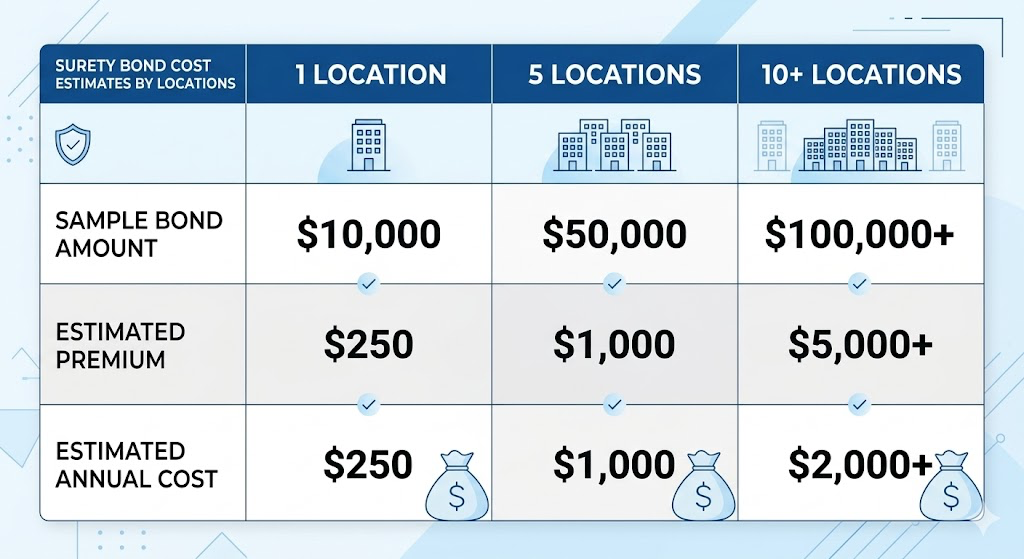
Bond Amounts Scale With Locations — and There May Be a Cap
Most states calculate bond requirements per location, which means a multi-location payday lending operation can face significantly higher bonding costs than a single-store operator. Illinois caps its total bond requirement at $500,000 regardless of how many locations you add beyond ten. Other states like Wisconsin impose no cap at all — your bond amount grows with every location you add. Always verify both the per-location amount and whether a cap exists in each state before projecting your total bond costs.
How to Get Your Payday Lender Bond
The bonding process is straightforward and typically completed within 24 to 48 hours for applicants with good credit. Start by applying with a licensed surety provider — Swiftbonds works with payday lenders across all 50 states and can match you with the right carrier for your specific state and location count. Once you submit your application, you receive a quote based on your credit profile, the required bond amount, and the number of locations you operate. After you pay the premium, the bond is issued — either as a digital document for e-filing or as a physical document — and you file it with the appropriate state licensing authority to satisfy the bonding requirement.
Many states that use the Nationwide Multistate Licensing System (NMLS) allow electronic surety bond filing directly through the NMLS platform, which streamlines the process significantly and ensures the bond is transmitted directly to the licensing authority without mail delays.
Swiftbonds LLC
2024 Surety Bond Provider of the Year
4901 W. 136th Street
Leawood KS 66224
(913) 214-8344
https://swiftbonds.com/
Monthly Pay-As-You-Go Bond Subscriptions
Most surety bonds are sold as annual products requiring a lump-sum premium payment upfront. However, some providers now offer monthly subscription-style bond payments, allowing you to pay for your coverage month-to-month and cancel when the bond is no longer needed. This can be a meaningful cash flow benefit for newer operations or lenders in states with seasonal loan volume patterns. If this matters to your business model, ask specifically about monthly payment options when requesting quotes.
What Triggers a Claim Against Your Bond?
A claim can be filed by a consumer who suffered financial harm due to your violation of state lending laws, or by the state regulator itself. The most common triggers for payday lender bond claims include charging interest rates above the state maximum, using deceptive or misleading loan terms in consumer agreements, failing to honor repayment or rollover terms as disclosed, engaging in unauthorized electronic debits from a borrower’s bank account, and failing to pay state licensing fees or taxes. The surety will investigate any claim filed and determine whether it is valid before paying. If paid, you must reimburse the surety — making claim avoidance your primary financial incentive for operating in full compliance.
FAQs
Do I need a separate bond for each state where I offer online loans? Yes, in most cases. States that require payday lender bonds typically apply the requirement to any lender offering loans to their residents, regardless of physical location. As an online lender, you should confirm bond requirements in every state where you originate loans — not just the state where your business is incorporated.
How does the bond amount for Illinois work with multiple locations? Illinois requires a minimum bond of $50,000 for up to nine locations, with the amount increasing per additional location up to a maximum cap of $500,000. If you are operating or expanding in Illinois, the total bond requirement plateaus at $500,000 no matter how many locations you add beyond the cap threshold.
Will applying for a bond hurt my credit score? No. Most surety bond applications use a soft credit inquiry, which does not appear on your credit report and does not affect your credit score. This means you can shop rates with multiple providers without any credit impact.
Can I get bonded if I have a prior bankruptcy or low credit score? Yes, though your premium rate will be higher. Bad credit surety bond programs are specifically designed for applicants who cannot qualify at standard rates. These programs may require financial statements or collateral in addition to the application, but approval is possible in most cases.
What is the difference between a Payday Loan Reform Act Bond and a Consumer Installment Loan Act Bond in Illinois? These are two separate bonds required for different types of lending activity in Illinois. The Payday Loan Reform Act Bond covers traditional payday loan operations. The Consumer Installment Loan Act Bond covers installment lending. Depending on what types of loans your Illinois license authorizes you to make, you may need one or both.
What happens to my outstanding loans if my bond lapses? A lapsed bond can trigger license suspension or revocation by the state. In some states, a lender whose license is revoked may lose the right to collect on any loans originated during the unlicensed period — a catastrophic outcome. Always renew your bond before it expires and coordinate renewal dates with your license renewal schedule.
How long does it take to get bonded? For applicants with good credit and a standard bond amount, same-day or next-business-day issuance is common. Applicants with credit issues or those requesting bonds in multiple states simultaneously may take 3–5 business days as additional underwriting is completed.
Can one bond cover multiple locations? It depends on the state. Some states allow a single bond that covers all locations up to a maximum amount, while others require a separate bond filed for each licensed location. Confirm your state’s specific requirement before assuming a single bond satisfies multi-location compliance.
Conclusion
The payday lender bond is not a bureaucratic formality — it is a foundational requirement that determines whether your business can legally operate, and getting it wrong has real consequences: license denial, revocation, loss of loan collection rights, and regulatory penalties. The good news is that for a well-qualified applicant, the bond is affordable, quick to obtain, and straightforward to maintain.
The complexity comes from the patchwork of state requirements — different bond names, different amounts, different calculators for multi-location operators, and different filing systems. Understanding these nuances before you apply for your license protects you from costly surprises and keeps your operation running without interruption.
5 Interesting Things About Payday Lender Bonds You Won’t Find in Most Guides
- The term “deferred deposit” — used in the bond name across several states — refers specifically to the mechanics of how payday loans work: the lender accepts a post-dated personal check or electronic debit authorization and “defers” cashing it until the borrower’s next payday. This mechanical definition is actually written into state statutes and shapes the exact legal scope of the bond obligation in those states.
- Some states with no payday lending laws still require a surety bond for the nearest equivalent product. Nevada, for example, requires a single bond that covers check cashing, deferred deposit transactions, title loans, and high-interest loans all under one instrument — one of the broadest bond scopes of any state in the country.
- A handful of states maintain a publicly searchable database of licensed payday lenders, which means your bond status is effectively public record. In Maine, for example, the Bureau of Consumer Credit Protection publishes an active license search that anyone can query — including your competitors and potential borrowers looking to verify your legitimacy.
- Minnesota has among the highest payday lender bond requirements in the nation — up to $1,500,000 — which is more than 30 times the California requirement of $25,000 and reflects Minnesota’s aggressive approach to ensuring lenders have substantial financial backing before serving state residents.
- The payday lending industry itself has been a driver of change in how surety bonds are filed nationally. The adoption of electronic surety bond filing through the NMLS was accelerated in part by the sheer volume of multi-state payday and mortgage lenders who needed to manage bond filings across dozens of states simultaneously — leading to the standardized electronic system that now benefits lenders in virtually every financial services category.
Leave a Reply