
Most people assume getting a surety bond works like applying for a mortgage — mountains of paperwork, weeks of waiting, and no guarantee at the end. The reality? Thousands of businesses get bonded every single day, many within hours of applying. What separates a smooth approval from a frustrating denial is simple: knowing what underwriters are actually looking for before you walk through the door.
This guide breaks down every factor that affects surety bond qualifications — from credit and collateral to industry risk and what to do when your application hits a wall.
The Three Pillars Every Surety Underwriter Evaluates
When a surety company reviews your application, they are not guessing. They are measuring three specific things, often called the “Three Cs” of surety bond qualification.
Credit is the first signal an underwriter reads. Your personal credit score is a direct indicator of how reliably you manage financial obligations. A strong score — generally 650 or above — tells the surety you are low risk, which translates directly into a lower bond premium. A lower score does not automatically disqualify you, but it does raise your rate and may trigger additional documentation requests.
Capacity refers to your financial ability to handle the obligation the bond covers. For a construction contractor, this means your ability to complete a project without running out of money. For a business licensee, it means your company has enough operating capital to fulfill its legal duties. Underwriters look at bank statements, financial statements, and in larger bonds, your working capital and net worth.
Character is the most subjective of the three. It encompasses your work history, professional reputation, industry experience, and whether you have prior claims, lawsuits, or regulatory actions against you. A contractor with fifteen years of clean project history will qualify faster and cheaper than someone brand-new to the trade, even if their credit scores are identical.
These three factors are weighted differently depending on the bond type and the amount. Understanding how they interact puts you in a much stronger position when you apply.
Two Types of Applications: Which One Applies to You?
Not every surety bond requires deep underwriting. In fact, the process splits cleanly into two tracks.
Instant Issue Bonds are available with no credit check at all. Everyone who applies qualifies, and everyone pays the same flat premium. These bonds are typically low-risk license and permit bonds — notary bonds, motor vehicle dealer bonds in some states, and basic business service bonds. Applications only require your business name, address, and basic contact information. You can often purchase and download your bond in under ten minutes.
Underwritten Bonds require a soft credit pull and may request supporting financial documentation. The level of scrutiny scales with the size and risk of the bond. A $10,000 license bond for a small contractor involves far less review than a $2 million performance bond on a public construction project.
Knowing which track your bond falls into saves time and eliminates unnecessary anxiety about the process.
What Documents You Actually Need
The paperwork required varies significantly based on the type of bond. Here is a practical breakdown:
| Bond Type | Typical Documents Required |
|---|---|
| License & Permit Bond | Business name, license number, business structure, owner information |
| Construction / Contract Bond | Financial statements, insurance certificate, project scope, bank reference letter, employee count |
| Vehicle Title Bond | Driver’s license, VIN, vehicle appraisal, DMV-required bond amount |
| Probate / Fiduciary Bond | Court case number, estate asset list, copy of will (if applicable), court documents |
| Business Service Bond | Company name, address, number of employees, type of work performed |
| Federal / High-Value Bond | Full business financials, personal financial statement, industry experience resume, homeownership status |
For any bond involving co-ownership, you will need to provide information on every owner holding a 10% or greater stake in the business. Leaving this out is one of the most common causes of application delays.
How Your Credit Score Affects Your Premium
Your credit score does not just determine whether you qualify — it determines what you pay. Surety bond premiums are calculated as a percentage of the total bond amount, and that percentage drops significantly as your credit improves.
Applicants with excellent credit (720+) typically pay between 1% and 3% of the bond amount annually. Someone with fair credit (620–680) may pay 3% to 7%. Applicants with poor credit or prior financial judgments can expect rates ranging from 10% to 15%, and some high-risk bond types may require collateral on top of the premium.
One important distinction that most guides skip over: surety companies run a soft credit inquiry, not a hard inquiry. A soft pull does not affect your credit score. This is very different from a mortgage or auto loan application. You can apply for a surety bond and shop multiple providers without any impact to your credit whatsoever.
Industry Risk and Why It Matters More Than People Realize
Your line of business carries its own risk profile in the surety market, completely independent of your personal credit or financial strength. Some industries have statistically high claim rates, which means underwriters apply stricter standards regardless of how clean your record looks.
High-risk industries for surety underwriting include mortgage brokering, payday and consumer lending, cannabis-related businesses, auto dealers with prior title issues, collection agencies, and contractors in certain specialty trades. These categories face more rigorous document requests, higher premiums, and in some cases, mandatory collateral.
By contrast, notaries, janitorial services, and many licensed professionals in low-claim industries often qualify instantly with no underwriting at all.
If your business operates in a higher-risk space, it is worth asking your surety provider upfront which underwriting track you fall into and what documents will speed up your approval.
Collateral Requirements: The Part Nobody Explains
One of the least-discussed aspects of surety bond qualifications is collateral, and it surprises a lot of applicants. Collateral is not just for people in financial distress. There are three common situations where collateral gets required.
First, certain bond types carry a high frequency of claims by their very nature — court appeal bonds, tax lien bonds, and release of lien bonds, for example. The surety routinely collects collateral on these regardless of your credit standing, because the claim risk is structurally elevated.
Second, applicants with poor credit may be asked to post collateral as a condition of approval, even if they would otherwise qualify for the bond.
Third — and this surprises people — applicants with strong credit and good experience can still be required to post collateral if their financial strength does not match the size of the bond. A contractor with solid credit but thin working capital applying for a large performance bond may hit this requirement.
Only two forms of collateral are generally accepted: cash and an irrevocable letter of credit (ILOC). An ILOC is a written bank guarantee that funds are available and cannot be touched for the life of the bond. Certificates of deposit, gold, government securities, and physical assets like vehicles are generally not accepted because their value fluctuates or their maturity dates don’t align with the bond term. Some sureties will accept real estate on a case-by-case basis.
Collateral is typically held for up to 90 to 180 days past the bond’s cancellation date, because obligees can still file claims after the bond expires.
What to Do If You Don’t Qualify
A rejection is not the end of the road. It is the beginning of a different strategy.
The first step is to ask specifically why you were denied. Underwriters are required to give you a reason. Common causes include credit issues, incomplete financial documentation, prior bond claims, or a mismatch between your financial strength and the bond size.
If credit is the issue, many surety providers offer bad credit bonding programs specifically designed for higher-risk applicants. These programs approve most applicants, though at higher premium rates. Some providers, including major national platforms, claim approval rates of 99% or above when combining their standard and high-risk programs.
A cosigner or indemnitor can also strengthen your application. Adding a financially strong cosigner — someone who agrees to be equally responsible for any claims on the bond — reduces the surety’s exposure and often unlocks approval.
Shopping multiple surety companies is also worthwhile. Underwriting guidelines vary significantly from one company to another. A bond that gets declined at one carrier may be approved at another.
Finally, improving your financials before reapplying makes a measurable difference. Reducing outstanding debt, cleaning up any tax liens, and building three to six months of documented working capital can move you from a high-risk to a standard-risk applicant within one renewal cycle.
The SBA Surety Bond Guarantee Program
For small businesses that struggle to qualify through conventional surety channels, the U.S. Small Business Administration offers a Surety Bond Guarantee Program worth knowing about.
The SBA guarantees bid, performance, payment, and ancillary contract bonds for small businesses that meet their size standards. Contract values can reach $9 million for non-federal projects and $14 million for federal contracts. The business must meet the surety company’s credit, capacity, and character requirements, but the SBA guarantee reduces the surety’s risk, which opens the door for businesses that might not qualify otherwise.
The guarantee fee for performance and payment bonds is 0.6% of the contract price. Bid bond guarantees carry no SBA fee. This program is particularly valuable for contractors pursuing government work who have not yet built the financial track record that large contract sureties typically require.
How Long Does Qualification and Approval Take?
Timeline expectations are almost never covered in surety bond guides, which leads to unnecessary stress for applicants working against a licensing deadline.
For instant issue bonds — the low-risk, no-credit-check variety — approval and delivery can happen in under fifteen minutes. You apply, pay, download, and file, all in a single session.
For underwritten commercial bonds like contractor license bonds, the process typically takes one to three business days if you submit a complete application with all required documents.
For large contract bonds — performance bonds on construction projects, high-value federal bonds — full underwriting can take one to two weeks. Financial review is more intensive, and the underwriter may request updated financials, bank letters, or project references.
The biggest single factor affecting timeline is documentation completeness. Incomplete applications are the leading cause of delays. Having your financial statements, insurance certificate, and business information ready before you apply can cut your wait time in half.
How to Get Your Surety Bond Qualifications Bond
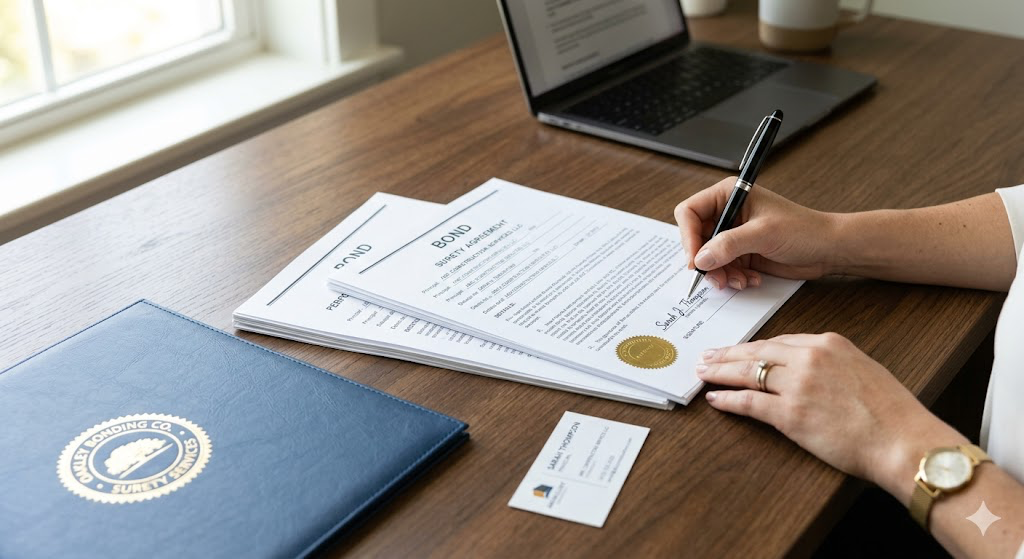
The process is more straightforward than most people expect. Start by identifying the exact bond your licensing authority, obligee, or contract requires — including the bond amount and any state-specific form requirements. Then apply through a licensed surety bond provider, submit the required documents, and receive your quote. Once you accept the terms and pay the premium, your bond is issued and you receive a certificate. File the bond with the appropriate agency — some accept digital copies, while others require an original with a raised seal.
Swiftbonds makes this process easy from start to finish, whether you are getting bonded for the first time or renewing an existing bond. They work with applicants across credit profiles and bond types, and their team can help you identify exactly what qualifications your specific bond requires before you apply.
Swiftbonds LLC
2025 Surety Bond Technology Provider of the Year
4901 W. 136th Street
Leawood KS 66224
(913) 214-8344
https://swiftbonds.com/
Frequently Asked Questions
What credit score do I need to qualify for a surety bond? There is no universal minimum. Most standard underwriting programs prefer a score of 650 or above for the best rates. Scores below 600 may qualify through high-risk bonding programs at higher premiums. Some bonds require no credit check at all.
Does applying for a surety bond hurt my credit score? No. Surety bond applications use a soft credit inquiry, which does not affect your score. You can apply at multiple providers without any negative credit impact.
Can I get a surety bond with no business history? Yes. Many license and permit bonds are instantly issued with no business history required. For larger construction or contract bonds, limited history may mean higher rates or a request for additional documentation, but it does not automatically disqualify you.
What is the difference between surety bond cost and the bond amount? The bond amount (also called the penal sum) is the maximum coverage provided by the bond — the number your obligee or state requires. The premium is what you actually pay, typically 1% to 15% of the bond amount annually, depending on your credit and risk profile.
What happens if a claim is made against my bond? The surety pays the claim on your behalf, up to the bond amount. However, unlike insurance, you are required to reimburse the surety for any amount paid out. A bond is a credit instrument, not a protection policy for the bonded party.
How long does it take to get a surety bond? Instant issue bonds can be issued in minutes. Standard underwritten bonds typically take one to three business days. Large contract bonds involving full financial underwriting may take one to two weeks.
Do I need collateral to get a surety bond? Not always. Collateral is only required in specific circumstances — certain high-claim bond types, poor credit applicants, or cases where your financial strength doesn’t match the bond size. When required, only cash or an irrevocable letter of credit is typically accepted.
Can I get bonded with prior claims or judgments? Yes, in many cases. Prior claims raise red flags and may increase your rate or require additional documentation, but they rarely result in an automatic denial. Working with a surety provider experienced in high-risk bonding gives you the best options.
Conclusion
Surety bond qualifications are not a single bar you either clear or you don’t. They are a spectrum — shaped by your credit, your financial capacity, your industry, the bond type you need, and the underwriting guidelines of the surety company you choose. Most businesses qualify. Many qualify faster and cheaper than they expect. The key is knowing what underwriters are looking for before you apply, having your documentation ready, and working with a provider who can match you to the right program for your situation.
5 Things About Surety Bond Qualifications That Nobody Talks About
1. Your bond qualification can improve mid-term. If your credit score improves significantly during a bond period, you can sometimes request a re-rate at renewal and lower your premium — even if nothing else changes about your business.
2. Being over-bonded can actually hurt your qualifications. Applying for a bond amount significantly larger than your financial strength justifies raises underwriter concerns, even if you have good credit. Surety companies look at the ratio of bond amount to net worth as part of their capacity analysis.
3. A bond claim on a prior owner’s business can follow the company. When you purchase or take over a business, claims history on that entity’s bonds can affect your ability to get bonded under the same business name. Underwriters review entity history, not just personal history.
4. Multi-year bonds can sometimes bypass annual underwriting. Some surety companies offer two- or three-year bonds that lock in your rate and qualification at the time of issuance. This can be strategically valuable if you are in a stronger financial position now than you expect to be at the next renewal.
5. Surety bond qualifications are not the same as insurance underwriting. Insurance companies can drop a policyholder after a bad loss year. Surety companies are legally required to honor bonds in force and give statutory notice before non-renewal. This makes the surety bond market more stable for bondholders, even after a claim.
Leave a Reply