
Wisconsin has one of the more layered surety bond environments in the country — and most people searching for a bond here have no idea just how many different types exist, who requires them, or how the state’s rules differ from every other state in the union. Whether you are trying to register a vehicle without a title, open a fitness center, get a contractor license, or comply with a Wisconsin Department of Revenue tax requirement, there is a specific bond for your situation. Here is the complete guide.
What Is a Surety Bond in Wisconsin?
A surety bond in Wisconsin is a legally binding financial guarantee between three parties. The obligee — the state agency, government body, or client requiring the bond — demands it as a condition of doing business or obtaining a license. The principal — the business or individual — purchases the bond and is legally accountable for any valid claims against it. The surety — the bonding or insurance company — issues the bond and guarantees payment to the obligee if the principal fails to fulfill their obligations.
The key distinction that sets surety bonds apart from insurance: if the surety pays a valid claim, the principal is legally obligated to reimburse the surety. Being bonded is accountability made financial. It is not protection for the business — it is protection for the people and agencies they serve.
Four Main Categories of Wisconsin Surety Bonds
Wisconsin bond requirements span four broad categories, each serving a different legal and regulatory function.
| Bond Category | What It Covers | Who Requires It |
|---|---|---|
| License and Permit Bonds | Guarantee compliance with state laws and regulations | State agencies, licensing boards |
| Contract Bonds | Guarantee completion of construction or service contracts | Project owners, government agencies |
| Court Bonds | Required in legal proceedings to guarantee court-ordered obligations | Wisconsin courts |
| Fidelity Bonds | Protect employers from employee dishonesty or theft | Businesses (elective or required) |
Wisconsin’s Most Common Surety Bonds
Wisconsin requires bonding across a wide range of industries and license types. Here is a practical overview of the most frequently needed bonds in the state.
| Bond Type | Who Needs It | Approximate Bond Amount |
|---|---|---|
| Certificate of Title / Lost Title Bond | Vehicle owners without a valid title | 1.5× vehicle value, minimum $2,500 |
| Motor Vehicle Dealer Bond | Licensed auto, motorcycle, and recreational vehicle dealers | Varies by license type |
| Contractor License Bond | Licensed contractors in Wisconsin | Varies by endorsement |
| Fitness Center Bond | Owners and operators of fitness facilities | Varies |
| Private School Bond | Owners and operators of private educational institutions | Varies |
| Notary Public Bond | Appointed notaries in Wisconsin | $500 (4-year term, $20 premium) |
| Sales and Use Tax Bond | Sellers of alcohol, tobacco, fuel, and other taxable goods | Set by Wisconsin DOR |
| Freight Broker Bond (BMC-84) | FMCSA-registered freight brokers | $75,000 (federal requirement) |
| Employment Agent’s Bond | Licensed employment agencies | Varies |
| Community Currency Exchange Bond | Licensed currency exchange operators | Varies |
| Prescription Drug Wholesale Distributor Bond | Licensed drug distributors | Varies |
| MMA/Boxing Promoter Bond | Licensed combat sports event promoters | Varies |
The Wisconsin Fitness Center Bond: A Consumer Protection Gem
One of the more unusual Wisconsin-specific requirements is the Fitness Center Bond. Wisconsin law mandates that fitness centers, health clubs, and gyms that sell memberships be bonded as a condition of operating. The bond protects consumers who purchase memberships — often paying months or years in advance — if the fitness center closes unexpectedly or fails to deliver the promised services. Most states do not have a dedicated fitness center bond requirement. Wisconsin’s version reflects a history of consumer protection legislation that began well before most states addressed this kind of prepaid service risk.
Wisconsin Tax Bonds: The DOR’s A-133 Requirement
One surety bond requirement that almost no guide addresses clearly is the Wisconsin Department of Revenue tax bond, governed by the state’s Form A-133. Businesses that require a permit to engage in activities subject to taxation under Wisconsin Statutes Chapters 66, 71, 77, 78, and 139 may be required by the DOR to post a surety bond as security for payment of taxes. This bond covers six different tax types — and only one tax type is permitted per bond:
| Tax Type | Mail To |
|---|---|
| Alcohol Beverage Tax | Division of Alcohol Beverages, DOR, PO Box 8934, Madison, WI 53708 |
| Tobacco / Vapor Products Tax | Excise Tax Unit, DOR, PO Box 8900, Madison, WI 53708 |
| Cigarette Tax | Excise Tax Unit, DOR, PO Box 8900, Madison, WI 53708 |
| Fuel Tax | Excise Tax Unit, DOR, PO Box 8900, Madison, WI 53708 |
| Sales and Use Tax | Special Procedures Unit, DOR, PO Box 8901, Madison, WI 53708 |
| Nonresident Entertainer Bond | Nonresident Entertainer Program, DOR, PO Box 8965, Madison, WI 53708 |
The nonresident entertainer bond is calculated at 6% of the total contract price, rounded up to the nearest $1,000. The surety company may withdraw from the bond with 60 days written notice to the DOR, and the bond covers all taxes, interest, and penalties accrued during that period regardless of whether a formal assessment has been issued.
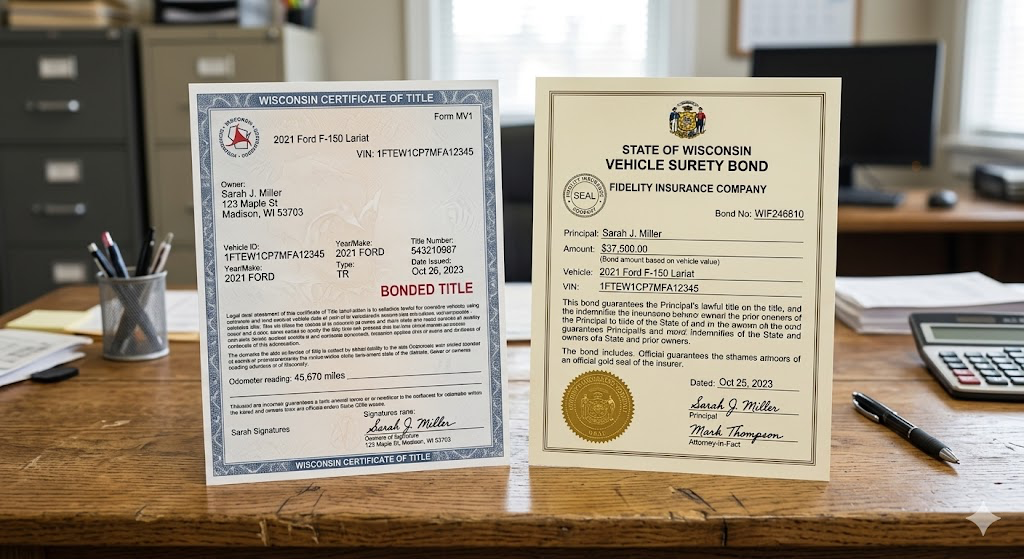
The Wisconsin Certificate of Title Bond: What Makes It Different
Wisconsin’s bonded title bond is one of the most searched-for bond types in the state, and it has a critical feature that most other states do not: a 5-year bond term instead of the standard 3 years. Most states require title bonds for three years before issuing a clean title. Wisconsin requires five, governed by Wisconsin Statute 342.12(3)(b).
The bond is set at 1.5 times the value of the vehicle as determined by WisDOT — not by the applicant or the surety company. The minimum bond amount is $2,500. The bond protects any prior owner, secured party, subsequent purchaser, or anyone acquiring a security interest in the vehicle from expenses, losses, damages, and reasonable attorney fees resulting from the issuance of a bonded title.
During the 5-year period, your Wisconsin title is branded “BOND POSTED.” After the full five years pass with no claims, WisDOT sends a letter notifying you that you can obtain a clean, unbranded title. The surety bond is then returned to the surety company. If you sell the vehicle during the bond term, the bond stays in force for its full duration regardless.
Wisconsin’s Bonded Title: Which Vehicles Are Eligible
Not all vehicles qualify for a bonded title in Wisconsin. The following types are eligible:
| Vehicle Type | Eligibility Notes |
|---|---|
| Automobiles | Standard eligibility |
| Sport utility vehicles (SUVs) | Standard eligibility |
| Light trucks under 8,000 lbs | Standard eligibility |
| Farm trucks under 12,000 lbs | Standard eligibility |
| Motorcycles | Standard eligibility |
| Mopeds | Standard eligibility |
| Campers and mobile homes under 40 feet | Standard eligibility |
Boats, motor homes, and other titled property are also eligible through the same WisDOT process. Vehicles that are stolen, junked, or reported as nonrepairable are not eligible.
Step-by-Step: How to Get a Wisconsin Bonded Title
The Wisconsin bonded title process follows four steps under WisDOT’s guidelines.
- Complete the online Wisconsin Title & License Plate Application (Form MV1) and pay the applicable sales tax, title fees, and loan filing fees.
- Download and complete the Application for a Bonded Certificate of Title (Form MV2082). Submit it with clear vehicle photos (front, rear, sides, and VIN), any ownership documents you have (bill of sale, previous registration), and a written statement explaining how you came into possession of the vehicle. Mail to: Vehicle Research Unit, Wisconsin Department of Transportation, PO Box 8070, Madison, WI 53708-8070.
- Wait for WisDOT to research vehicle records and appraise the vehicle. If approved, WisDOT sends a letter stating the exact bond amount required (1.5× appraised value).
- Purchase the surety bond for the amount specified in the letter. Print, sign, and file the bond with WisDOT.
Using the eMV Public Online Title and Registration Application can reduce review time to 3 business days or less. Mailed applications take up to 14 days. The total cost of a Wisconsin bonded title typically ranges from $120 to $500 depending on vehicle value, state fees, and bond amount.
Wisconsin Title Bond Cost Structure
| Bond Amount | Premium Cost |
|---|---|
| $2,500 – $6,000 | Flat $100 for the 5-year term |
| $6,001 – $50,000 | $15 per $1,000 of coverage (starting at $100) |
| $50,001 – $2,000,000 | Starts at $750; application required |
Most Wisconsin title bonds under $50,000 are available with no credit check. Bonds above $50,000 require a brief underwriting review.
How to Get a Wisconsin Surety Bond
The process for any Wisconsin surety bond — whether a title bond, contractor bond, fitness center bond, or tax bond — follows the same four steps: Apply by submitting your information to a licensed surety provider, including the bond type, required amount, and your basic business or personal details. Receive a Quote almost immediately for most standard Wisconsin bonds. Pay the premium and your bond is issued, typically same-day or the next business day. File the bond with the appropriate Wisconsin agency — WisDOT for title bonds, the DOR for tax bonds, or the relevant licensing board for license and permit bonds.
Swiftbonds issues surety bonds across all categories for Wisconsin businesses, contractors, vehicle owners, and licensed professionals. Most standard bonds are quoted and issued the same day, with no credit check required on many common bond types.
Swiftbonds LLC
Voted 2025 Surety Bond Agency of the Year
4901 W. 136th Street
Leawood KS 66224
(913) 214-8344
https://swiftbonds.com/
Wisconsin Bond Cost Overview
For most Wisconsin surety bonds, the premium is calculated as a percentage of the required bond amount. Here is a general range based on creditworthiness.
| Applicant Credit Profile | Typical Rate Range |
|---|---|
| Excellent credit | 1% – 2% of bond amount |
| Good credit | 1.5% – 3% of bond amount |
| Fair credit | 3% – 7% of bond amount |
| Poor or limited credit | 5% – 15% of bond amount |
The Wisconsin Notary Bond is a notable exception — it is a flat $20 for a $500 bond covering the full 4-year notary commission, with no credit check required. It must be filed with the Wisconsin Department of Financial Institutions, P.O. Box 7847, Madison, WI 53707-7847.
Frequently Asked Questions
Does Wisconsin require contractors to be bonded? Wisconsin does not have a single statewide contractor licensing bond requirement administered by one agency. However, many municipalities, counties, and specific trade licenses require contractors to obtain surety bonds as part of the licensing or permit process. Contractors working on public projects may also be required to obtain bid bonds, performance bonds, and payment bonds depending on the contract terms and applicable state statutes.
How long does a Wisconsin bonded title last? Wisconsin bonded titles are valid for five years, which is longer than most other states. After the full five-year term with no claims filed, WisDOT will notify you that you can obtain a standard, unbranded certificate of title. The surety bond is then returned to the surety company.
Who determines the bond amount for a Wisconsin vehicle title bond? WisDOT determines the bond amount — not the vehicle owner or the surety company. After reviewing your MV2082 application and consulting price guides, WisDOT sends you a letter specifying the exact bond amount required. You cannot purchase the bond until you receive this letter.
Can I sell a vehicle that has a Wisconsin bonded title? Yes. A Wisconsin bonded title allows you to register, insure, and sell a vehicle just as with a standard title. However, the surety bond remains in force for its full five-year term regardless of whether you sell the vehicle before it expires.
Can I get a Wisconsin surety bond with bad credit? Yes. Most Wisconsin title bonds under $50,000 require no credit check and are available for instant online purchase. For larger bonds or license/permit bonds, applicants with poor credit can still qualify — though the premium rate will be higher than the standard market rate.
What is the eMV Public Online system? The eMV Public Online Title and Registration Application is Wisconsin’s online portal for submitting bonded title applications digitally. Submitting through eMV can reduce WisDOT’s processing time to 3 business days or less, compared to up to 14 days for mailed applications.
What happens if a claim is filed against my Wisconsin title bond? If a prior owner, lienholder, or subsequent purchaser files a valid claim during the 5-year bond period, the surety investigates. If the claim is valid, the surety pays the claimant up to the full bond amount. You are then legally required to reimburse the surety for the amount paid, along with any applicable interest and fees.
Does the Wisconsin notary bond protect me as a notary? No. The Wisconsin Notary Public Bond protects the general public against financial loss caused by improper notarial conduct — not the notary. Notaries who want protection for themselves should purchase a separate Errors and Omissions (E&O) insurance policy alongside the required $500 bond.
What is the Wisconsin DOR tax bond (Form A-133)? The A-133 surety bond is required by the Wisconsin Department of Revenue for businesses that obtain permits to engage in taxable activities under Wisconsin Statutes Chapters 66, 71, 77, 78, and 139. Each bond covers only one tax type. Businesses subject to multiple tax types must obtain separate bonds for each. The DOR can recover taxes, interest, and penalties from the surety after providing 10 days’ notice of delinquency.
Conclusion
Wisconsin’s surety bond requirements are broader and more layered than most people expect. From the state’s unique 5-year bonded title term to its rarely-discussed fitness center bond requirement and the multi-category DOR tax bond system, the state has built a comprehensive framework of financial accountability across industries, professions, and license types. Whether you are a vehicle owner trying to establish legal ownership, a business operator navigating license requirements, or a contractor bidding on public work, there is a specific Wisconsin bond that applies to your situation — and getting it right from the start saves time, money, and legal headaches.
5 Interesting Things About Wisconsin Surety Bonds That You Won’t Find in the Top 10 Sites
Wisconsin is one of the few states in the country to require a dedicated surety bond specifically for fitness centers. The Fitness Center Bond grew out of Wisconsin’s consumer protection statutes designed to safeguard people who purchase long-term gym memberships. When a fitness center closes — especially one that sold multi-year contracts — members are left with no recourse without a bond. Wisconsin recognized this gap before most states did.
Wisconsin’s 5-year bonded title term is the longest standard holding period among U.S. states that offer bonded titles. Most states require 3 years before issuing a clean title. Wisconsin’s extended timeline reflects the state’s more conservative approach to establishing vehicle ownership certainty, particularly for older or commercially traded vehicles.
The Wisconsin Department of Revenue’s Form A-133 tax bond contains a self-protection mechanism for surety companies that is unusually explicit. The bond allows the surety to unilaterally withdraw by giving 60 days written notice to the DOR — but any tax liability incurred before the 60 days expire remains fully covered, regardless of whether a formal tax assessment has been issued yet. This is a specific legal protection that many surety company representatives themselves are unaware of.
Wisconsin is one of a small number of states that maintains a separate bonding requirement for nonresident entertainers. Any entertainer or performer from outside Wisconsin who earns income from a Wisconsin performance and does not have sufficient tax nexus in the state may trigger a surety bond requirement equal to 6% of the total contract value, rounded up to the next $1,000. This covers everything from touring musicians to professional speakers performing at Wisconsin venues.
Wisconsin’s bonded title process specifically accommodates campers and mobile homes under 40 feet in length — a practical nod to the state’s enormous recreational vehicle culture, centered around its thousands of lakes and campgrounds. This makes Wisconsin one of the more accessible states for RV owners dealing with lost or missing title documentation, particularly for older units where title chains are incomplete.
Leave a Reply