
You found the RV of your dreams — maybe at an estate sale, a private auction, or from a seller who swore the title was “around somewhere.” Now the paperwork doesn’t add up, the title is missing, and you can’t register, insure, or legally sell the rig. You are not stuck. A bonded title is the legal path forward, and for RV owners specifically, it is more common — and more manageable — than most people realize. Here is everything you need to know, from the first check to the day your title converts to a clean standard document.
What Is a Bonded Title for an RV?
A bonded title is a state-issued certificate of title that is backed by a surety bond — a financial guarantee that protects anyone who might later prove a legitimate ownership claim to your RV. It functions like a regular title for all practical purposes: you can register, insure, and sell with it. The key difference is that a surety bond rides alongside it for a set period, typically three to five years depending on your state, during which the bond remains active in case another claimant surfaces.
The bonded title itself does not guarantee ownership in the way a clean title does. It allows the DMV to issue a title in your name while keeping a financial safeguard in place. Once the bond period expires with no claims filed, most states will convert your bonded title to a standard clean title automatically.
When Do You Need a Bonded Title for an RV?
A bonded title is appropriate — and often the only path forward — when normal title transfer is not possible. Common situations include inheriting an RV from a family member whose estate paperwork was never completed, purchasing from a private seller who lost the title years ago, buying at auction with a bill of sale but no title, or receiving an RV as a gift with no supporting documentation. It is also used when the title exists but contains errors — a wrong VIN, a misspelled name, or incorrect year — that the DMV cannot correct through standard channels.
Before applying for a bonded title, exhaust every other option. If your name is already on the original title and you simply lost it, a standard duplicate title from your DMV is faster and cheaper. If you can reach the previous owner, they can sign the title over to you directly. A bonded title should be a last resort — but when it is the right path, it is a well-established and legally sound one.
Motorized RVs vs. Towable RVs: Title Rules Differ
One detail that almost no bonded title guide addresses is the difference between motorized and towable RVs, and it matters. Class A, B, and C motorhomes are motorized vehicles — they are titled just like cars and trucks, and the bonded title process follows standard motor vehicle procedures in your state. Towable RVs — including fifth wheels, travel trailers, and pop-up campers — are treated more like trailers in many states. Some states do not require titles for trailers below a certain weight threshold, while others title all towable RVs regardless of size. In Texas, for example, trailers are assigned a flat presumptive value based on length rather than an appraisal: $4,000 for trailers under 20 feet and $7,000 for trailers 20 feet or longer. Before starting the process, confirm with your state DMV whether your towable RV requires a title at all — and if so, what valuation method applies.
The RV VIN Challenge
Many RVs have more than one VIN. A motorhome typically carries a chassis VIN — assigned by the vehicle manufacturer (Ford, Freightliner, Spartan, etc.) — and may also have a body or coach VIN assigned by the RV manufacturer (Winnebago, Thor, Tiffin, etc.). Some states will only recognize one of these VINs for titling purposes. When applying for a bonded title, confirm with your DMV which VIN is the controlling one for their records, and make sure your VIN inspection covers that specific number. Getting the wrong VIN on your bond application can delay the entire process significantly.
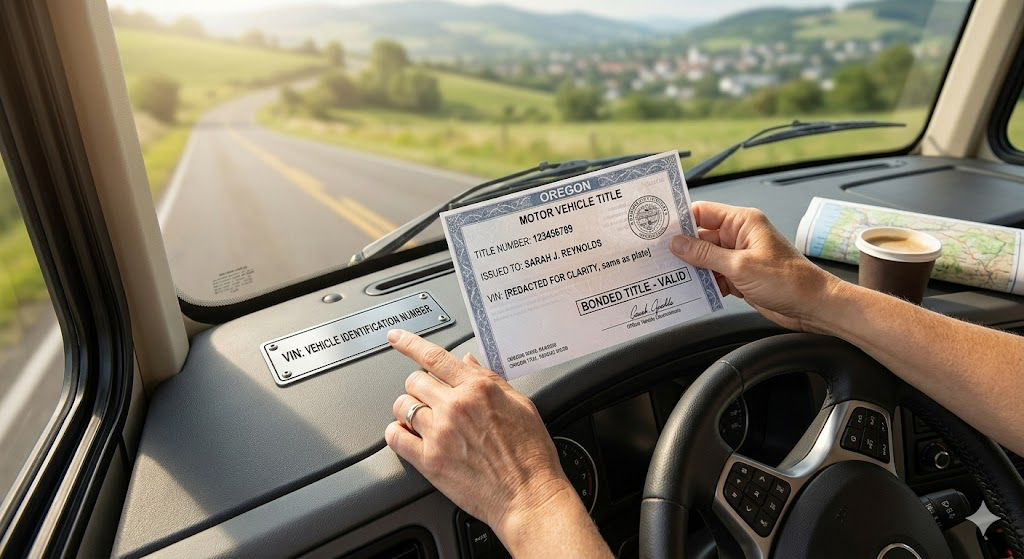
On motorhomes, the chassis VIN is typically found on a metal plate on the driver’s side dashboard, visible through the windshield. On travel trailers and fifth wheels, the VIN is usually on a label near the front of the trailer on the roadside (left) exterior, or on the tongue of the frame.
Do All States Offer Bonded Titles?
No. Not every state permits the bonded title process, and some that do have specific restrictions or alternative procedures. Always contact your state DMV before purchasing any surety bond. Buying the wrong bond — or buying a bond before the DMV tells you the exact required amount — is one of the most common and costly mistakes in this process. Bond amounts, multipliers, and required wording are all state-specific, and a bond purchased without DMV guidance may be rejected entirely.
How to Value Your RV for the Bond
The bond amount required by most states is 1.5 times the RV’s determined value, though some states (Florida and Colorado among them) require 2 times the value. The DMV or the state determines the base value using one or more of these sources: the state’s Standard Presumptive Value database (where available), the NADA RV Guides (specifically the recreational vehicle guide, not the automotive guide), a licensed appraisal from a certified RV dealer or insurance adjuster, or for older RVs in some states, a flat minimum value threshold (often $4,000).
For most used RVs, the NADA RV guide is the starting point. The appraised value will account for the RV’s type (motorhome vs. trailer), class, model year, mileage (for motorhomes), and condition. If you believe the DMV’s determined value is too high — or too low — some states allow you to request an independent appraisal from a licensed dealer or adjuster, which the DMV is required to accept.
Step-by-Step: How to Get a Bonded Title for an RV
| Step | What You Do | Why It Matters |
|---|---|---|
| 1. Check for stolen status | Run the RV’s VIN through NMVTIS or your state DMV database | A stolen RV cannot be bonded — this protects you legally |
| 2. Contact your DMV first | Visit or call your state DMV before doing anything else | They will confirm eligibility, required forms, and exact bond amount |
| 3. Complete the application | Submit your bonded title application form with supporting ownership documents | Bill of sale, previous registration, or any evidence of purchase |
| 4. Get a VIN inspection | Have an authorized inspector verify the VIN(s) | Required by most states; done by law enforcement, DMV inspectors, or licensed mechanics |
| 5. Get the RV appraised | Determine the RV’s current market value | Used to calculate the required bond amount (1.5× to 2× value) |
| 6. Purchase the title bond | Buy a surety bond for the required amount | Bond must match the exact amount, wording, and obligee specified by the DMV |
| 7. Submit everything to the DMV | Return with your bond, application, inspection, and fees | Most states give you 30 days from the date the DMV issues your bond notice |
| 8. Receive your bonded title | Wait for DMV processing (typically 4–6 weeks) | Your RV is now legally registered and road-legal |
What the Bonded Title Lets You Do
Once issued, an RV bonded title functions like a standard title for most practical purposes. You can register the RV with your state DMV, obtain insurance (most insurers accept bonded titles without issue), drive and use the RV freely, and sell it. If you sell, you are required to disclose the bonded status to the buyer in most states. Some lenders and financing companies may decline to offer loans against a bonded title, so if RV financing is part of the picture, check with your lender before going down this path.
Bond Amount and Cost: What to Expect
The cost of the title bond itself is a small fraction of the required bond amount. Most states set the minimum bond at $6,000 regardless of the RV’s value, and the premium for bonds up to $6,000 is a flat $100. For RVs appraised at higher values, the premium typically runs around $15 per $1,000 of coverage above $6,000.
| RV Appraised Value | State Multiplier | Bond Amount Required | Estimated Bond Premium |
|---|---|---|---|
| $20,000 | 1.5× | $30,000 | ~$460 |
| $40,000 | 1.5× | $60,000 | ~$820 |
| $40,000 | 2× (FL/CO) | $80,000 | ~$1,120 |
| $75,000 | 1.5× | $112,500 | ~$1,588 |
| $100,000 | 1.5× | $150,000 | ~$2,110 |
Note: Bonds above $20,000 in coverage may require underwriting review. Your credit score and financial profile may affect pricing at higher bond amounts, though many applicants with imperfect credit still qualify.
How to Get Your Bonded Title for an RV Bond
Once the DMV tells you the exact bond amount required, the bond itself is quick to obtain. Apply with a licensed surety bond provider by submitting basic information — your name, address, RV’s VIN, year, make and model, and the bond amount specified by your DMV. You will receive a Quote almost immediately in most cases. Pay the premium and your bond is issued, typically same-day or next business day. Then File the bond certificate with your DMV within the deadline they specify — usually 30 days from the date of the notice.
Swiftbonds handles title bonds for RVs, motorhomes, travel trailers, and other recreational vehicles across all states that permit the bonded title process. The application takes minutes and most standard title bonds are issued the same day.
Swiftbonds LLC
2024 Surety Bond Provider of the Year
4901 W. 136th Street
Leawood KS 66224
(913) 214-8344
https://swiftbonds.com/
What Happens After the Bond Period Ends
In most states, once the bond period expires — typically three years, five years in states like Wisconsin — without any ownership claims being filed, the bonded status is lifted. Most DMVs will then issue a clean, standard title in your name with no bond attached. At that point, your RV’s title is legally indistinguishable from any other titled vehicle. You do not need to take action in most states — the conversion happens automatically when the DMV’s records confirm no claims were filed.
What Happens If Someone Files a Claim
During the bond period, if a person comes forward with evidence that they are the rightful owner of the RV, they may file a claim against your title bond. The surety company investigates the claim. If it is found valid, the surety pays the claimant up to the full bond amount. You are then legally required to reimburse the surety for whatever was paid out. This outcome is uncommon — valid competing ownership claims on RVs are relatively rare — but it is the entire reason the bond exists. The financial guarantee protects the potential true owner during the window when ownership is being established.
Frequently Asked Questions
Can I get a bonded title for a travel trailer or fifth wheel? Yes. Towable RVs including travel trailers, fifth wheels, and pop-up campers can receive bonded titles in states that title trailers. However, some states do not title trailers below a certain weight. Always check with your state DMV first, as the rules for towable RVs often differ from those for motorized vehicles.
Can I drive an RV with a bonded title across state lines? Generally yes. A bonded title issued by one state is recognized by other states for registration and insurance purposes. However, some restrictions may apply, and individual state DMVs have different policies. Confirm with your state DMV and your insurer before making multi-state travel plans.
Will my RV insurance company accept a bonded title? Most standard RV insurance providers accept bonded titles without issue. The bonded title allows you to register and insure the vehicle just as you would with a clean title. A small number of specialty lenders or insurers may have additional requirements — confirm with your provider when shopping for coverage.
How long does the bonded title process take for an RV? From the time you submit your application to your DMV, the full process typically takes four to eight weeks for the bonded title to be issued. Purchasing the surety bond itself is usually same-day. The longer wait is the DMV’s own processing and review time.
Can I sell an RV that has a bonded title? Yes, but you must disclose the bonded status to any buyer. Some buyers are comfortable proceeding with full disclosure; others may prefer to wait until the bond period expires and a clean title is issued. Be transparent — failing to disclose a bonded title can create legal liability later.
What if my RV has no title history at all — it was never titled? Some older or custom RVs were never formally titled. This is actually one of the primary situations that the bonded title process was designed to address. Contact your state DMV to confirm eligibility and any additional requirements, as some states have specific rules for vehicles with no prior title history.
Can the DMV reject my bonded title application? Yes. Applications can be denied if the RV is reported as stolen, if there is an active lien that cannot be resolved, if required documentation is missing or incorrect, or if the vehicle does not meet your state’s eligibility requirements. Always confirm requirements with your DMV before purchasing a bond.
Do I need to be a state resident to get a bonded title for my RV? Most states require you to either be a legal resident of that state or be active military personnel stationed there. Some states will consider your application if the RV itself was last titled in that state, even if you now live elsewhere. Requirements vary — check with your specific state’s DMV.
Conclusion
Getting a bonded title for an RV is a legitimate, well-established legal process that turns an ownership problem into a solvable paperwork challenge. The key is to start with your DMV — not with the bond — and let them tell you exactly what is needed before spending a dollar. Once you know the required bond amount, the bond itself is fast and affordable. From there, a few weeks of DMV processing and your RV goes from stuck in legal limbo to registered, insured, and ready to roll.
5 Interesting Things About Bonded RV Titles That You Won’t Find in the Top 10 Sites
Many RV manufacturers assign their own serial numbers — sometimes called a coach number or unit number — that are different from the chassis VIN. These manufacturer-assigned numbers sometimes appear on older RV paperwork and get confused with the official VIN during title applications, causing delays. When applying for a bonded title, only the state-recognized VIN (usually the chassis VIN for motorhomes) should be used on all official documents.
Some states have “RV-specific” title categories that distinguish between motorhomes and travel trailers in their vehicle registration databases. In these states, the bonded title application may require you to select the correct sub-category, and choosing the wrong one — for example, categorizing a Class B van conversion as a standard motor vehicle rather than a motorhome — can require the entire application to be restarted.
The NMVTIS (National Motor Vehicle Title Information System) database, which is used to verify that an RV is not stolen before applying for a bonded title, is operated by the U.S. Department of Justice and was mandated by the Anti Car Theft Act of 1992. It was significantly expanded in 2009 to require all states, junk yards, salvage yards, and insurance companies to report title and total loss information, making it far more reliable for RV ownership research than it was in earlier years.
In states that treat towable RVs as trailers rather than motor vehicles, the bonded title process can sometimes be completed faster because trailer bonds often have lower minimum amounts and simpler valuation methods. A pop-up camper worth $8,000, for example, might qualify for a flat-rate bond in a trailer-title state, while a similarly-valued vehicle would require a full appraisal and credit-based underwriting.
A bonded title can sometimes be used to resolve a situation where an RV was inherited but the estate was never formally probated — meaning no legal transfer of the vehicle occurred through the courts. Rather than reopening an old estate (which can be expensive and time-consuming), the bonded title process gives the inheritor a practical path to legal ownership without requiring court intervention, as long as supporting documentation of the inheritance exists.
Leave a Reply