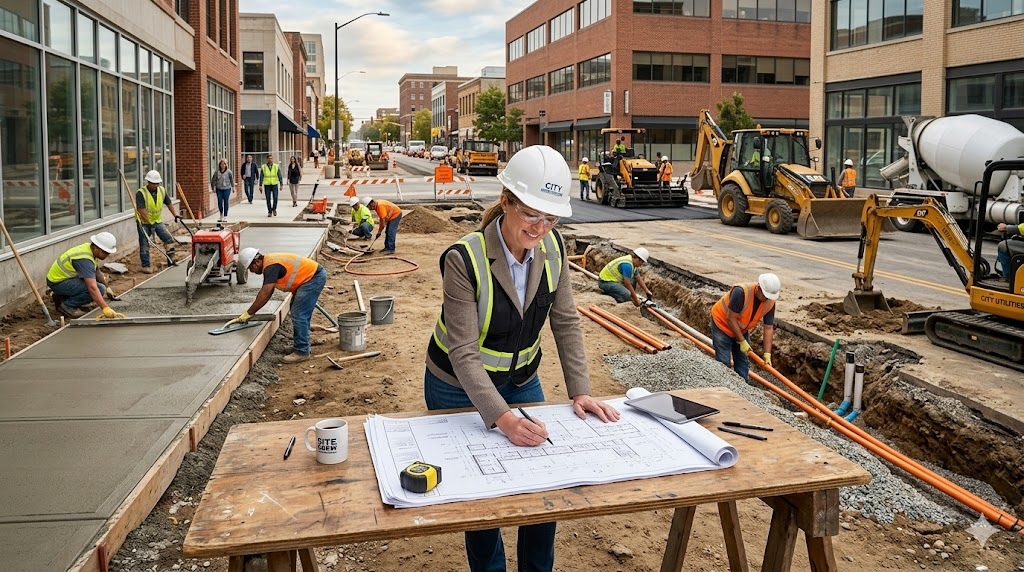
You pull a permit to upgrade an existing site — new sidewalks, extended utilities, improved drainage — and the municipality hands you a bond requirement you have never seen before. It is not a contractor license bond. It is not a performance bond for the building itself. It is a site improvement bond, and it operates under a set of rules that catches developers and general contractors off guard every year. Some of those surprises are expensive.
This guide explains exactly what a site improvement bond is, how it differs from every other bond on a development project, and what the fine print can cost you if you do not understand it before you sign.
What Is a Site Improvement Bond?
A site improvement bond is a contract surety bond that guarantees a developer or contractor will complete all required improvements to an existing property or site in accordance with local building codes, approved plans, and contractual specifications. It is required before a construction permit is issued or a final parcel map is recorded with the local jurisdiction.
The bond protects public funds and publicly owned infrastructure. When improvements to sidewalks, roads, drainage systems, utilities, or landscaping are made as part of a private development project, those improvements typically become public property once complete — owned and maintained by the municipality. The bond ensures the developer funds and finishes that work before transferring it. If the developer defaults, the municipality files a claim and the surety steps in.
Like all surety bonds, it is a three-party agreement. The principal is the developer or contractor who purchases the bond. The obligee is the local government or municipality requiring it. The surety is the bond company that backs the guarantee and pays valid claims — then seeks full reimbursement from the principal.
Site Improvement Bond vs. Subdivision Bond: A Critical Distinction
These two bonds are closely related and frequently confused — even by experienced developers — because they cover nearly identical categories of work. The distinction is straightforward but legally important.
| Bond Type | What It Covers | Project Type |
|---|---|---|
| Site Improvement Bond | Improvements to an existing site, structure, or subdivision | Existing properties being upgraded or expanded |
| Subdivision Bond | Improvements required for a brand-new subdivision development | New construction on previously undeveloped or newly platted land |
In plain terms: if the land has already been developed and you are adding to or improving it, you likely need a site improvement bond. If you are building out a new subdivision from scratch, you likely need a subdivision bond. Some jurisdictions use the terms interchangeably. Always confirm the specific bond form required in writing from the obligee before ordering the bond — a mismatch in bond type or form can delay permit issuance and requires a full re-application with the surety.
What Improvements Does the Bond Cover?
Site improvement bonds are most commonly required to guarantee the completion of public infrastructure tied to private development. Covered improvements typically include roads and paved streets, sidewalks and curbs, gutters and drainage channels, storm drains and sewer connections, streetlights, power lines and electrical connections to the grid, water mains and utility hookups, landscaping and grading, and monuments.
One angle that most guides overlook: the bond also guarantees that utility connections — the actual hookups of water, power, and electrical systems to the municipality’s grid — are completed correctly. It is not limited to visible surface improvements. A developer who builds the road and installs the drainage but fails to properly connect utilities has still triggered a valid bond claim.
The Legal Risk Most Developers Never Read
Here is what separates a site improvement bond from a standard performance bond, and it is the single most important thing to understand before signing as principal on one of these bonds.
On a standard performance bond, if the project owner fails to pay the contractor, the contractor generally has a legal defense — non-payment excuses performance. The contractor can stop work. The surety’s obligation under the bond may be similarly excused.
A site improvement bond eliminates that defense. The improvements must be completed regardless of whether the principal ever receives payment. The developer or contractor is obligated to finish the work — and the surety is obligated to backstop that guarantee — whether or not the project owner, the lender, or anyone else has paid a cent. This is the completion-regardless-of-payment rule, and it significantly increases risk for both the principal and the surety.
For general contractors, this creates a specific danger that almost no competing guide addresses. If a GC agrees to post a site improvement bond on behalf of the project owner, the GC loses the right to stop work due to non-payment. Normally, a contractor who is not being paid can legally suspend work — that protection exists under virtually every construction contract. Once the GC is the named principal on a site improvement bond in favor of a public agency, that protection is gone. The GC is obligated to complete the improvements and pay all bills regardless of whether the owner pays them. That is a business decision that deserves serious consideration before any GC accepts that position.
The Dual-Obligee Risk When a Lender Is Involved
On projects financed by a lender, the surety may be exposed to two obligees simultaneously — the municipality and the financial institution — whose interests often directly conflict. The municipality wants the improvements completed. The lender wants its loan repaid or the asset secured. If the developer defaults, those two demands can pull in opposite directions.
Worse, some bond forms include language guaranteeing “repayment” rather than strictly “construction completion.” If the bond wording extends beyond completion of physical work and touches on financial repayment obligations, the surety may be contractually obligated to pay the lending institution on default — an exposure that dramatically exceeds the cost of simply finishing roads and utilities. Developers should work with their surety to ensure the bond form is limited to completion of improvements only, not financial repayment, and that a “savings clause” is inserted where possible to explicitly cap the surety’s obligation.
What a Site Improvement Bond Costs
Premiums for site improvement bonds are calculated individually — no flat rate applies across all projects. The underwriter prices each bond based on project size, the developer’s financial strength, credit history, and experience.
| Bond Amount | Typical Rate | Estimated Premium |
|---|---|---|
| $100,000 | 2%–3% | $2,000–$3,000 |
| $250,000 | 1.5%–3% | $3,750–$7,500 |
| $500,000 | 1.5%–2.5% | $7,500–$12,500 |
| $1,000,000 | 1%–2% | $10,000–$20,000 |
Applicants with strong credit (700+), documented project experience, solid financials, and fully committed financing will land at the lower end of those ranges. Applicants with credit challenges, limited track records, or contingent financing will pay higher premiums and may face collateral requirements.
One cost factor no competitor covers: if the project runs beyond the bond’s initial term, the premium renews annually until the municipality formally releases the bond. Budget for multiple annual premiums on multi-year projects — this is not a one-time cost.
The Bond Form Must Contain Specific Language
This is a detail almost no competitor mentions, and it matters for both compliance and claim protection. A properly prepared site improvement bond form should contain the estimated cost of the required improvements and the anticipated completion date. These are not optional additions — they define the scope and duration of the surety’s obligation. If a bond form is missing either element, it can create ambiguity in a claim situation about what was guaranteed and for how long.
Always request the municipality’s required bond form in writing before going to your surety. Many local governments have their own standard form that must be used verbatim. Using a surety’s generic form when the municipality requires a specific one can result in rejection at the permit stage and delays the entire project.
Why Surety Bonds Beat Letters of Credit and Cash for This Bond Type
Municipalities will typically accept three forms of financial assurance for site improvements. Here is how they compare in practice.
| Option | Developer Protection | Liquidity Impact | Cost |
|---|---|---|---|
| Surety Bond | Surety reviews claims before paying; disputes can be contested | No assets tied up; unsecured credit | Annual premium (1%–3% of bond amount) |
| Irrevocable Letter of Credit (ILOC) | Bank can draw on demand; developer must sue to recover wrongful draws | Reduces borrowing capacity dollar-for-dollar | Bank fee (1%–2%) + reduced credit line |
| Cash / Certificate of Deposit | Municipality or bank can access immediately; no review mechanism | Full cash committed and locked | Opportunity cost on full amount |
The surety bond is the most capital-efficient option in nearly every scenario. Because it is unsecured credit, it does not reduce the developer’s borrowing capacity with their lender the way an ILOC does. The surety’s claims review process — which verifies a claim before any payout — also protects developers from municipalities filing inflated or premature claims. With cash or an ILOC, there is no such review; the funds can be accessed before any dispute is resolved, leaving the developer to litigate for return of money already drawn.

Underwriting: What the Surety Examines
Site improvement bonds are carefully underwritten because of the completion-regardless-of-payment rule and the potential for long project timelines. For smaller bonds, a personal credit check from all business owners with 10% or more ownership is typically sufficient. As bond amounts grow, more documentation is required.
| Bond Amount | Typical Requirements |
|---|---|
| Under $250,000 | Application and personal credit check |
| $250,000–$750,000 | Credit check, project scope, experience summary, funding source |
| Over $750,000 | Full personal and business financial statements, improvement agreement, engineer’s estimate |
| Over $1,000,000+ | CPA-prepared financials, full underwriting including LLC operating agreement |
The surety will want to understand how the project is financed. Fully committed, unconditional financing is strongly preferred over contingent or draw-based loan structures. If the project is lender-financed, a set-aside letter confirming that funds specifically allocated to the improvements are committed and held is a standard underwriting requirement. Projects with contingent financing — where improvement funds are tied to sales milestones or additional approvals — represent elevated risk and will be scrutinized accordingly.
How to Get Your Site Improvement Bond
The process is straightforward once your project details, improvement agreement, and financing are in order. You submit an application with the required project scope, estimated improvement cost, and financial documents. Swiftbonds works with developers and contractors across all 50 states and has access to the specialty surety markets that actively write this bond class — not all surety providers do. You receive a quote, pay the premium, sign the bond agreement, and receive the executed bond documents. The bond is then submitted to the local permitting authority — along with the municipality’s required bond form if they have one — before the permit is issued and work begins.
Swiftbonds LLC
2025 Surety Bond Agency of the Year
4901 W. 136th Street
Leawood KS 66224
(913) 214-8344
https://swiftbonds.com/
The Bond Release Process
A site improvement bond does not close automatically when the work is done. The developer must formally request release from the obligee. In most jurisdictions, the municipality sends an inspector to verify that all required improvements have been completed to the standards specified in the approved plans. Once the improvements are accepted, the municipality issues a written release. The surety then closes the bond obligation.
Many jurisdictions also allow partial bond reductions as specific segments of the improvement work are completed and accepted — for example, releasing the portion of the bond tied to completed roadwork while keeping the drainage-related portion open. Requesting partial reductions as work progresses lowers the outstanding bond amount, which in turn reduces annual renewal premiums on the remaining obligation.
State-by-State Variation
Site improvement bond requirements are not uniform across the country. They vary significantly by state, county, and municipality — in terms of whether they are required at all, how the bond amount is calculated, which bond form must be used, and how the release process works.
| State | Notes on Variation |
|---|---|
| California | Site improvement bonds typically required for all public improvements tied to new or existing developments |
| Texas | Requirements vary by municipality; some cities have detailed standard forms, others leave specifics to the development agreement |
| Florida | County-level variation is significant; bond amount may be set by a government engineer from approved construction plans |
This table is illustrative. Always verify requirements directly with the local permitting or public works department before applying for the bond. Submitting a bond that does not match the required form or amount is one of the most common causes of permit delays on improvement projects.
FAQs
Is a site improvement bond the same as a performance bond? No, though they are related. A performance bond guarantees a contractor completes a project per the contract — and allows non-payment by the project owner as a valid defense for non-performance. A site improvement bond guarantees completion of improvements to public property regardless of whether payment is received. That “regardless of payment” element is the key legal distinction and significantly increases the risk to the principal.
Can a small project require a site improvement bond? Yes. There is a common misconception that site improvement bonds are only for large commercial or residential developments. Many jurisdictions require them for relatively small projects — any private development that requires improvements to a public right-of-way, public utility connection, or publicly maintained infrastructure may trigger a bond requirement regardless of the overall project value.
What happens if I do not secure a site improvement bond? The municipality will not issue the permit. Construction cannot begin until the bond is posted and accepted. In some jurisdictions, operating without a required bond after work has started can result in stop-work orders, fines, and legal penalties. The bond must be in place before the first shovel goes in the ground.
If I am a general contractor, do I have to post the bond? It depends on the project. Typically, the developer or project owner posts the bond. In over 90% of cases, the owner or developer is the named principal. However, some owners ask their GC to post the bond. If a GC agrees to do so, they must understand that they are now obligated to complete the improvements and pay all bills regardless of whether the owner pays them — they lose their non-payment defense under the bond.
Does the bond cover defective work after completion? The bond primarily covers completion of the specified improvements, not long-term defect liability after the municipality has accepted the work. If post-completion warranty coverage is needed, that is handled by a separate maintenance bond, which guarantees that infrastructure will remain in acceptable condition through a defined warranty period — typically 12 to 24 months after acceptance.
How long does it take to get a site improvement bond? For smaller bonds with good credit and straightforward financials, quotes can come back within 24 to 48 hours. For larger bonds requiring full financial statement review, one to two weeks is more typical. Having all required documents ready — including the improvement agreement, engineer’s cost estimate, and lender commitment — speeds the process significantly.
What is an offsite improvement bond? An offsite improvement bond is a specific variant of the site improvement bond that covers public infrastructure improvements located offsite from the main development — for example, a road widening, utility extension, or drainage improvement required on a public street adjacent to or near the development site. The same principals apply: completion is required regardless of payment, and the obligee is the local government requiring the work.
Conclusion
A site improvement bond is one of the most commonly misunderstood instruments on any development project — mistaken for a performance bond, confused with a subdivision bond, or treated as a routine administrative step until the underwriting requirements or the completion-regardless-of-payment clause creates a real problem. The developers and contractors who handle these bonds correctly understand that the legal obligations are broader than a standard construction bond, that posting the bond as a general contractor has specific consequences for payment rights, and that the choice of financial assurance instrument — surety bond, ILOC, or cash — has real capital implications for the business.
Get the bond requirements in writing from the municipality. Confirm the required form. Understand who is the named principal. And budget for annual renewals if the project timeline extends beyond the first year.
5 Interesting Things About Site Improvement Bonds You Won’t Find in Most Guides
- In some California jurisdictions, the bond amount for a site improvement bond is not set by the developer’s own cost estimate or the surety’s underwriting — it is set by the local agency’s independent engineer, whose estimate of the cost to complete all required improvements becomes the controlling number. If the government engineer’s estimate is higher than the developer’s, the developer pays premiums on the higher amount. This is the same mechanism used in Miami-Dade County for subdivision improvement bonds and it is more common than most developers realize.
- The term “offsite improvement bond” refers specifically to a site improvement bond covering public infrastructure located outside the boundary of the development parcel itself — such as a required road widening on an adjacent public street or an off-property utility main extension. This variant is common in fast-growing suburban areas where new developments are required to contribute to regional infrastructure upgrades, not just improvements immediately adjacent to the project.
- Some municipalities allow developers to post a “blanket” site improvement bond covering multiple smaller improvement projects across different sites under a single aggregate program — rather than a separate bond for each individual permit. This aggregate bonding approach is particularly common for developers who frequently pull improvement permits within the same jurisdiction. It reduces administrative overhead and can lower overall premiums when the developer’s bonding capacity is established at the aggregate level.
- Unlike most commercial construction contracts — where a contractor’s right to stop work for non-payment is well-established — site improvement bonds effectively nullify that right for any party that posts the bond as the named principal. This is not a matter of contract language; it is a structural feature of the bond obligation itself. The moment a party accepts the role of principal on a site improvement bond in favor of a public agency, their leverage over the obligee through payment disputes is eliminated for the duration of the bonded work.
- When a site improvement bond is required for a project that is also subject to a development agreement or conditions of approval from the planning department, the improvement agreement referenced in the bond is a legally separate document from the construction contract. Errors or omissions in the improvement agreement — such as an incomplete list of required improvements or a missing completion deadline — can create significant ambiguity about what the bond actually guarantees. Courts have ruled in claims situations that the bond covers what the improvement agreement says, not what the developer or surety assumed — making the accuracy of that underlying agreement one of the highest-stakes documents in the entire bonding process.
Leave a Reply