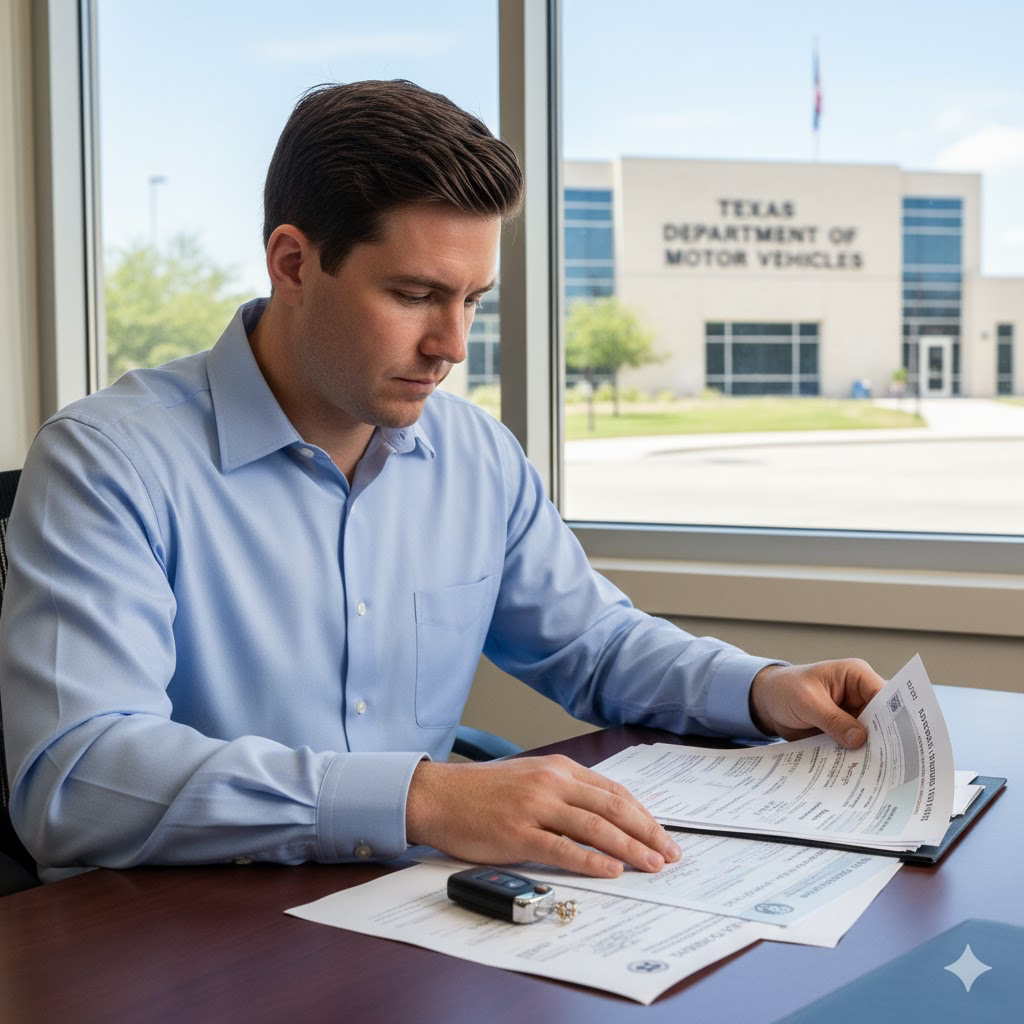
You bought a vehicle. You have a bill of sale, maybe a canceled check, maybe even a text message from the seller. But when you go to register it, the Texas DMV tells you there is no valid title they can work with. You cannot drive it legally. You cannot insure it fully. You cannot sell it. What you need is a bonded title — and Texas has a specific, well-established legal process for getting one. Here is exactly how it works, what it costs, and what your rights are once you have it.
What Is a Bonded Title in Texas?
A bonded title — officially called a Certificate of Title Surety — is a vehicle title issued by the Texas Department of Motor Vehicles (TxDMV) when ownership cannot be proven through standard documentation. It proves you are the legal owner of a vehicle just like a regular title, with one key difference: it is backed by a surety bond you purchase as a financial guarantee that your ownership claim is legitimate.
The governing law is Texas Transportation Code Section 501.53, which requires a title surety bond when registering vehicles with lost, missing, or otherwise unavailable titles. The full regulatory framework is codified in 43 Texas Administrative Code § 217.9, last amended in November 2024.
The bond protects anyone who might have a prior valid claim to the vehicle — a previous owner, a lienholder, or a future buyer — by ensuring financial compensation is available if a legitimate ownership dispute arises during the bond period. If no one challenges your ownership during the three-year bond period, the bonded status is removed and you can apply for a regular clean Texas title.
Who Needs a Bonded Title in Texas?
A bonded title is the right path when any of the following situations apply:
- You purchased a vehicle and never received a title from the seller
- The title was lost or stolen before you could transfer ownership into your name
- The title was incorrectly assigned, signed over improperly, or contains errors that cannot be corrected
- You inherited or were gifted a vehicle without sufficient documentation for a standard title transfer
- You have a vehicle that was never titled or registered in Texas
Who Qualifies — and Who Does Not
To be eligible for a bonded title in Texas, you must meet at least one of the following residency criteria: you are a Texas resident, the vehicle was most recently titled in Texas, or you are military personnel stationed in Texas.
The vehicle itself must also qualify. It must be in your physical possession, must not be classified as junked, nonrepairable, stolen, abandoned, or involved in active litigation, and must have all major components intact — a body, motor, and frame — though it does not need to be operational.
The critical disqualifier many applicants discover too late: if there is a recorded lien on the vehicle that is less than ten years old, you are not eligible for a bonded title unless you can provide an original release of lien or a letter of no interest from the lienholder. No exceptions. If you cannot obtain that release, the TxDMV cannot issue a bonded title and recommends consulting an attorney to pursue a court order establishing ownership.
How the Bond Amount Is Calculated
The bond amount is set by the TxDMV — not the bonding company — and equals exactly 1.5 times the vehicle’s determined value. The TxDMV uses the following hierarchy to set that value:
The Standard Presumptive Value (SPV), available on the TxDMV website, is the primary source. If the SPV is unavailable, the NADA national reference guide is used. If neither source yields a value, you may obtain a certified appraisal from a Texas-licensed motor vehicle dealer (for their licensed vehicle category) or a Texas-licensed insurance adjuster (who may appraise any type of vehicle). Appraisals must be dated and submitted to the department within 30 days.
Two important special rules apply. For vehicles 25 years old or older with an appraised value under $4,000, the bond amount is automatically set at $4,000 regardless of actual appraisal. For trailers and semitrailers, alternative bond amounts apply: $4,000 for trailers under 20 feet, and $7,000 for trailers 20 feet or longer.
What a Bonded Title Costs in Texas
A bonded title involves several separate fees. Understanding all of them prevents surprises at the county tax office.
| Cost Item | Typical Amount |
|---|---|
| Surety bond premium (bond ≤ $6,000) | $100 flat |
| Surety bond premium ($6,001–$50,000) | Starts at $100; approx. $15 per $1,000 |
| TxDMV administrative fee | $15 |
| Vehicle appraisal (if required) | $50–$100 |
| VIN inspection fee (if required) | $20–$40 |
| County tax office fees (title, registration, sales tax) | Varies by county and vehicle value |
Most applicants with standard passenger vehicles pay between $100 and $300 for the bond itself. No credit check is required for most Texas title bonds — the bond can typically be purchased instantly online.
The Complete Step-by-Step Process
Getting a Texas bonded title follows a defined sequence across two government offices. Skipping steps or going out of order is the most common cause of delays.
Step 1 is verifying eligibility. Before collecting any paperwork, confirm with your nearest TxDMV Regional Service Center that your vehicle and situation qualify for a bonded title. The TxDMV offers same-day and next-day appointments online.
Step 2 is submitting your application to the TxDMV. Complete and submit the following documents to your local TxDMV Regional Service Center along with the $15 administrative fee: Form VTR-130-SOF (Bonded Title Application and Statement of Fact — both pages required), Form 130-U (Application for Texas Title and/or Registration), any available proof of ownership such as a bill of sale or canceled check, a government-issued photo ID, and an affidavit of fact explaining how you acquired the vehicle and why the regular title is unavailable. If the vehicle was never titled or registered in Texas, you must also include Form VTR-68-A (Law Enforcement Identification Number Inspection) completed by an auto theft investigator. For out-of-state vehicles, a Vehicle Inspection Report (VIR) from a certified safety inspection station is required to verify the VIN. For imported vehicles, include the customs declaration form. For commercial vehicles, include a weight certificate.
Step 3 is receiving your Notice of Determination. If your documents are approved, the TxDMV will issue Form VTR-130-ND (Notice of Determination for a Bonded Title), which states the exact bond amount you must purchase. You then have one year from the date of this notice to purchase the surety bond. If that deadline passes, the notice expires and you must restart the application process.
Step 4 is purchasing your surety bond. Take the Notice of Determination to a licensed surety bond provider and purchase the bond (Form VTR-130-SB) in the exact amount stated. Every detail on your bond form must match the Notice of Determination exactly — vehicle information, owner name, and address — or the county tax office will not accept it.
Step 5 is filing at the county tax office. Within 30 days of purchasing the surety bond, bring the following to your county tax assessor-collector’s office: Form 130-U (completed), Form VTR-130-SOF (both pages), Form VTR-130-ND (original Notice of Determination), Form VTR-130-SB (original surety bond), Form VTR-270 (VIN Certification, if applicable), any available proof of ownership, release of lien or letter of no interest (if lien existed), proof of insurance in your name, and valid photo ID. Title fees, sales tax, and registration fees are also due at this step.
Your Bonded Title: What You Can and Cannot Do
Once issued, your bonded title will be clearly marked “Bonded” and will include the bond expiration date — three years from the date of issuance. During that three-year period, you can legally drive, register, insure, and even sell the vehicle. A bonded title is legally valid for all standard purposes.
If someone challenges your ownership during the three-year period by filing a claim against the bond, the surety company investigates. If the claim is valid, the claimant receives financial compensation from the surety up to the bond amount — they do not automatically get the vehicle back. You, as the bonded title holder, remain in possession of the vehicle unless a court order specifies otherwise. You are then required to reimburse the surety for any valid claim paid.
If no claims are made during the three-year period, the bonded status expires. You can then apply for a standard clean Texas title by submitting a new title application. No additional bond, inspection, or extraordinary process is required. The “bonded” label is removed and your ownership is fully confirmed by the state.
One important note about selling a bonded title vehicle: you must disclose the bonded status to any buyer. Most buyers comfortable with the process simply want to verify there are no pending claims. The bond does not transfer to the new owner — if the new owner also needs to establish ownership through a bonded title, they must complete the process independently.
How to Get a Texas Bonded Title Bond
The surety bond portion of the process is typically the easiest and fastest step. Once you have your Notice of Determination from the TxDMV in hand, apply with a licensed surety provider by submitting your vehicle information (VIN, year, make, model), owner name and address, and the bond amount from your notice. Swiftbonds works with Texas vehicle owners across the state and can issue most title bonds instantly online — most bonds under $50,000 are delivered digitally within minutes with no credit check required. Once your payment is processed, print the original bond form, sign it, and file it with your county tax office along with the rest of your documentation.
Swiftbonds LLC
2024 Surety Bond Provider of the Year
4901 W. 136th Street
Leawood KS 66224
(913) 214-8344
https://swiftbonds.com/
FAQs
What is a bonded title in Texas? A bonded title, also called a Certificate of Title Surety, is a vehicle title issued by the TxDMV when standard ownership documentation is unavailable. It is backed by a surety bond you purchase equal to 1.5 times the vehicle’s value. It is legally valid for three years and converts to a standard clean title if no ownership claims are made against the bond during that period.
How much does a Texas bonded title cost? Total costs typically range from $130 to $500 or more depending on the vehicle’s value. The surety bond premium starts at $100 for most standard passenger vehicles. Additional costs include a $15 TxDMV administrative fee, an appraisal fee of $50–$100 if required, a VIN inspection fee of $20–$40 if required, and county tax office fees for the title, registration, and sales tax.
How long does a bonded title last in Texas? Three years from the date of issuance. If no valid claims are made against the bond during that period, you may apply for a standard title and the bonded designation is permanently removed. There is no renewal or extension — the bonded status either converts to clean after three years or remains subject to claims during its validity.
Can I sell a car with a bonded title in Texas? Yes. You can drive, register, insure, sell, and transfer a vehicle with a bonded title. You must disclose the bonded status to any buyer. The surety bond does not transfer to the new owner — if a new owner needs a bonded title, they must complete their own separate application process.
What happens if someone claims ownership of my bonded title vehicle? The claimant files against the surety bond. The surety company investigates the claim. If valid, the claimant receives financial compensation up to the bond amount — they do not automatically repossess the vehicle. Physical possession of the vehicle remains with the bonded title holder unless a court order specifies otherwise. You must reimburse the surety for any paid claim.
What if my vehicle has a lien? If the vehicle has a recorded lien less than ten years old, you must obtain an original release of lien or a letter of no interest from the lienholder before the TxDMV can process your bonded title application. If you cannot get that release, you are not eligible for a bonded title. The TxDMV recommends consulting an attorney to pursue a court order in that situation.
How long does the bonded title process take in Texas? Typically four to six weeks from initial TxDMV application to receiving the bonded title from the county tax office. Delays are most often caused by incomplete documentation, vehicles needing inspection, or high processing volume at the county office. Having all documents complete and accurate before your first TxDMV visit significantly speeds up the process.
Is a bonded title the same as a clean title? No. A bonded title indicates that ownership was established through the surety bond process rather than through standard title documentation. It is fully legal and valid for all purposes during its three-year period, but it is marked “bonded” and remains subject to potential claims. A clean title has no such designation and no outstanding claims risk.
Can I get a bonded title for a boat in Texas? The bonded title process for boats in Texas is a separate process from the motor vehicle bonded title. You must contact the appropriate state agency for watercraft titling. The vehicle bonded title process described here applies only to motor vehicles.
Conclusion
A Texas bonded title is the state’s official, legally sound solution for vehicle owners who find themselves holding a car, truck, or motorcycle but unable to prove ownership through standard documentation. The process is more structured than most people expect — two government offices, specific form numbers, a defined one-year deadline, and precise bond amounts — but it is entirely manageable with the right preparation. Understanding that you have one year to purchase the bond after receiving your Notice of Determination, that the bond does not transfer to a new buyer, that previous owners receive financial compensation and not the vehicle itself, and that a clean title awaits after three claim-free years gives you the full picture most guides leave incomplete.
5 Interesting Things About Bonded Titles in Texas Not Found in Any of the Top 10 Sites
- Texas is one of only a small number of states that processes the bonded title application at the state DMV level first and then requires a second trip to the county tax office for final issuance. Most states that offer bonded titles process the entire transaction through either a state DMV or a county office — not both. This two-stop structure is unique to Texas and is one of the primary reasons the process takes longer than applicants expect when they assume it can be completed in a single visit.
- The surety bond purchased for a Texas bonded title is a three-party contract in which the obligee is technically the Texas Department of Motor Vehicles — not the previous owner or any specific claimant. This means the state itself is the protected party in the bond’s legal structure, which is why all claims must flow through the formal TxDMV reporting process rather than being handled privately between the bonded title holder and a claimant.
- Texas specifically prohibits the TxDMV from being named as a defendant in any lawsuit filed to establish vehicle ownership free and clear of liens. If a lienholder refuses to provide a release and the applicant cannot obtain a bonded title as a result, any court action attempting to resolve the lien must be filed against the lienholder directly — the TxDMV is explicitly excluded as a party. This protection is embedded in TxDMV policy and is designed to prevent the agency from being drawn into private ownership disputes it did not create.
- The Standard Presumptive Value (SPV) used by Texas to determine bonded title bond amounts was originally developed as a tool to combat title washing and odometer fraud — not specifically for bonded title purposes. The SPV system calculates a floor value for vehicles below which the state will not allow a taxable transaction to be recorded, preventing sellers and buyers from artificially deflating transaction prices to avoid sales tax. The fact that it was later adopted as the primary valuation method for bonded title bond amounts reflects how the same anti-fraud infrastructure built for one purpose was repurposed to serve another government function.
- Texas allows a Tax Assessor-Collector Hearing as an alternative pathway to vehicle titling for applicants who cannot qualify for a standard bonded title — a process that exists entirely in parallel with the bonded title route but is almost never explained to applicants. At a Tax Collector Hearing, the county tax assessor-collector hears the applicant’s ownership claim and has authority to issue a title based on the preponderance of evidence presented, without requiring the standard bonded title surety bond in all cases. This alternative is referenced in the same TxDMV form (VTR-130-SOF is titled “Bonded Title Application OR Tax Collector Hearing Statement of Fact”) but is almost entirely absent from every guide, article, and informational page in the top 10 SERP results.
Leave a Reply